it's been a while but i think 72" blades are about $8 to $10. i use 1/4" 6 tpi blades the most often on my ss bandsaw. also a couple sites that may interest you:
http://penturners.org/
http://bwwt.org/
What Live Center Size Should I Buy
Moderator: admin
-
RobertTaylor

- Platinum Member
- Posts: 569
- Joined: Mon Sep 03, 2007 9:28 am
- Location: North Canton, Ohio
ss bandsaw blades
Bob
1954 greenie, 1963 anniversary edition now a mini,
1984 500, 1985 510, 1987 510, pro-planer, bandsaw, dust collector
1954 greenie, 1963 anniversary edition now a mini,
1984 500, 1985 510, 1987 510, pro-planer, bandsaw, dust collector
-
myoung44708

- Gold Member
- Posts: 48
- Joined: Fri Oct 07, 2011 10:24 pm
- Location: North Canton, Ohio
Fortunate or not, I now have 3 band saws so I would be able to have a different blade on each and avoid having to change in the middle of a project. So far, I have found that my Craftsman 80" saw does a good job and is easier to control than either of the tiny table Shopsmith saws. Guess I should save the ss saws for smaller detailed bandsaw work and use the bigger Craftsman for the heavy lifting tasks.
The blades are cheap and I love cheap...
The blades are cheap and I love cheap...
Martin
1983 MARK V - 500
1960...ish MARK VII with a 510...ish table
1983 MARK V - 500
1960...ish MARK VII with a 510...ish table
Alright, this is probably a stupid question, but I have never done any turning before so I am still trying to figure this all out. I have been wanted to get into pen turning but still need to get some additional parts/tools. My question is about a live center and exactly how it is used. I get how the pen mandrel works and how the mandrel saver keeps the shaft from getting bent.terrydowning wrote:Actually penn state has a mandrel specifically for the shopsmith. I use that and the mandrel saver, I really like the mandrel saver for mandrel turning. As for the live center, if you can afford it, you may want to get the MT2 60 degree live center. Once you get started on pens, you will find the live center a useful tool in your inventory.
How does a live center fit into the setup? Is it used in conjunction with the mandrel or does it allow you to turn the pen without the mandrel thereby eliminating any potential out of round issues? Can someone explain its use and maybe show a pic of it being used?
Thanks!
pessen
1981 Mark V, bought used in Feb. 2011
-
myoung44708
- Gold Member
- Posts: 48
- Joined: Fri Oct 07, 2011 10:24 pm
- Location: North Canton, Ohio
The live center point fits into a recess on the end of the mandrel. When the work is snug against the live center, the berrings within the live center take the load so you are not spinning steel on steel. You must use a live center when turning with a pen mandrel to create two support points along the center line.pessen wrote:Alright, this is probably a stupid question, but I have never done any turning before so I am still trying to figure this all out. I have been wanted to get into pen turning but still need to get some additional parts/tools. My question is about a live center and exactly how it is used. I get how the pen mandrel works and how the mandrel saver keeps the shaft from getting bent.
How does a live center fit into the setup? Is it used in conjunction with the mandrel or does it allow you to turn the pen without the mandrel thereby eliminating any potential out of round issues? Can someone explain its use and maybe show a pic of it being used?
Thanks!
pessen
I've now made 20 pens and must say that it is a blast!
Martin
1983 MARK V - 500
1960...ish MARK VII with a 510...ish table
1983 MARK V - 500
1960...ish MARK VII with a 510...ish table
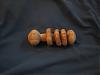
Thanks, that helps. One additional question. Some people use the mandrel saver while others use the live center. Seems they both provide support for the end of the mandrel which should reduce the chance the mandrel will get bent. Are there cases where you would want the mandrel saver, or have those of you who have gone to the live center quite using the mandrel saver altogether?rkh2 wrote:Here is a picture of the Pennstate mandrel with the shopsmith live center. Hope this helps you.
[ATTACH]14639[/ATTACH]
Is there any reason I should get both the mandrel saver and the live center?
Thanks,
1981 Mark V, bought used in Feb. 2011

For me personally, I've always had a live-center, and I've always used the Penn State mandrel like above. I did bend my first mandrel and finally got a 2nd one. With the 2nd one I've got enough accumulated experience that I can finesse my setup to avoid stresses, and my mandrel is still dead straight after many months of use.pessen wrote:Is there any reason I should get both the mandrel saver and the live center?
Thanks,
Chris

To quote the Penn State Industries web site:pessen wrote:Thanks, that helps. One additional question. Some people use the mandrel saver while others use the live center. Seems they both provide support for the end of the mandrel which should reduce the chance the mandrel will get bent. Are there cases where you would want the mandrel saver, or have those of you who have gone to the live center quite using the mandrel saver altogether?
Is there any reason I should get both the mandrel saver and the live center?
Thanks,
"Are you tired of bending your Mandrel and ruining the point on your live center? If so, then this fail-safe live center accessory is for you. Mandrels usually bend when you tighten the tailstock center point [font="]into theend[/size][/font] indentation of your mandrel. This system solves that problem [font="]because your[/font] mandrel shaft goes through the hollow live center. Your bushings press against the center with zero pressure on the mandrel shaft. The tube and bushing assembly tightens up by turning your tailstock quill adjustment wheel."
________________________________________________________________________________________________
1981 Mark V 500, bandsaw, belt sander, jig saw, jointer; contractor's table saw; multiple circular saws and miter saws; and a trailer full of tools.
"It is better to remain silent and thought a fool than to speak out and remove all doubt"
Abraham Lincoln
1981 Mark V 500, bandsaw, belt sander, jig saw, jointer; contractor's table saw; multiple circular saws and miter saws; and a trailer full of tools.
"It is better to remain silent and thought a fool than to speak out and remove all doubt"
Abraham Lincoln
-
terrydowning
- Platinum Member
- Posts: 1678
- Joined: Mon Jul 19, 2010 3:26 pm
- Location: Windsor, CO
Additional Mandrel Saver info.
Since the mandrel goes through the live center rather than stopping at the end, you reduce the length of the mandrel which reduces run out and whip.
Reducing length of the mandrel can be good and bad. Good stated already. Bad, it can be difficult to fit your tool rest correctly. I had a second tool rest that I had a friend with a metal cutting band saw cut down to be shorter than the stock tool rest, this has helped a lot in positioning the tool rest properly.
Since the mandrel goes through the live center rather than stopping at the end, you reduce the length of the mandrel which reduces run out and whip.
Reducing length of the mandrel can be good and bad. Good stated already. Bad, it can be difficult to fit your tool rest correctly. I had a second tool rest that I had a friend with a metal cutting band saw cut down to be shorter than the stock tool rest, this has helped a lot in positioning the tool rest properly.
--
Terry
Copy and paste the URLs into your browser if you want to see the photos.
1955 Shopsmith Mark 5 S/N 296860 Workshop and Tools
https://1drv.ms/i/s!AmpX5k8IhN7ahFCo9VvTDsCpoV_g
Public Photos of Projects
http://sdrv.ms/MaXNLX
Terry
Copy and paste the URLs into your browser if you want to see the photos.
1955 Shopsmith Mark 5 S/N 296860 Workshop and Tools
https://1drv.ms/i/s!AmpX5k8IhN7ahFCo9VvTDsCpoV_g
Public Photos of Projects
http://sdrv.ms/MaXNLX