algale wrote:The original article was referring to jointing a bowed board (in contrast to a cupped board). I agree a cupped board should be jointed with the crown of the cup up.
As for bowed boards, the article suggests convex side down (he calls it a reverse rainbow) but I'm not convinced. The more I think of it the more I like Reible's jig for short pieces and for longer pieces I'm going to try the chalk line and the band saw next time and take the bow out before jointing.
Thank You!;)
As usual WE tend to go off in tangents.
Ed's jig works for bowed edges, not face warps.
Finally cupping is definitely a different animal.
As is wind!
I am guilty of missing the word 'cupped' in your post EiT.
╔═══╗
╟JPG ╢
╚═══╝
Goldie(Bought New SN 377425)/4" jointer/6" beltsander/12" planer/stripsander/bandsaw/powerstation /Scroll saw/Jig saw /Craftsman 10" ras/Craftsman 6" thicknessplaner/ Dayton10"tablesaw(restoredfromneighborstrashpile)/ Mark VII restoration in 'progress'/ 10E[/size](SN E3779) restoration in progress, a 510 on the back burner and a growing pile of items to be eventually returned to useful life. - aka Red Grange
I apologize too I thought we are talking of cupped board rather than a bowed board.
If the board is short enough a jig will work very well.
For longer bowed boards there is two excellent ways.
One mentioned is snapping a chaulk line and cutting it on a bandsaw and then jointing the edge.
The other way is using a guide tool system. Where a straight edge is clamped on the board and circular saw is ran against the straight edge cuttting the wood perfectly straight.
I have seen the above done in a Festool demo and the results were glue line ready on a perfectly straight board. This method afforded the most straight wood for the original length of the board.
A third method is to crosscut the board at various places to minimize the bow and then either joint or use one of the above methods to finally straighten it. This method will usually yield maximium width of the original board.
"... and it was after long searching that I found the carpenter's chest, which was indeed a very useful prize to me, and much more valuable than a ship loading of gold." Daniel Defoe, Robinson Crusoe, 1719
terrydowning wrote:+1 on the hand planes. Better workout too. Not to mention quieter.
Y'all read post # 5 (parting shot)?:D
╔═══╗
╟JPG ╢
╚═══╝
Goldie(Bought New SN 377425)/4" jointer/6" beltsander/12" planer/stripsander/bandsaw/powerstation /Scroll saw/Jig saw /Craftsman 10" ras/Craftsman 6" thicknessplaner/ Dayton10"tablesaw(restoredfromneighborstrashpile)/ Mark VII restoration in 'progress'/ 10E[/size](SN E3779) restoration in progress, a 510 on the back burner and a growing pile of items to be eventually returned to useful life. - aka Red Grange
Thanks 'JPG' I missed your #5 post final line. You are absolutely correct on jointers being designed for edge work. I get the hebby-jeeves just thinking about planning a board on a jointer. I understand the younger woodworker not knowing about hand planes, as I didn't learn about them in woodshop class, and didn't learn until I starting working with my father's (Craftsman - made by Stanley) #5 back in the '80's. I still use Dad's plane, but love a Casimiro Sousa & Sons #5 plane that is made of Mahogany with a Teak bottom. It glides over the the surface effortlessly, a real joy to use. I did a Google search for Casimiro Sousa and did not come up with this plane being manufactured any longer. I bought it from Garrett Wade about ten years ago.
"... and it was after long searching that I found the carpenter's chest, which was indeed a very useful prize to me, and much more valuable than a ship loading of gold." Daniel Defoe, Robinson Crusoe, 1719
"... and it was after long searching that I found the carpenter's chest, which was indeed a very useful prize to me, and much more valuable than a ship loading of gold." Daniel Defoe, Robinson Crusoe, 1719
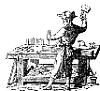
I found this pix in my just arrived 4 volume 'Practical Woodworker' reprint(original 1916 vintage) from Popular Woodworking(Thank You Megan!!!!). Dated, but practical and gorgeous!
[ATTACH]22290[/ATTACH]
Says nothing about edges!:eek:
Attachments
Surface planer from 1916.jpg (166.24 KiB) Viewed 2827 times
╔═══╗
╟JPG ╢
╚═══╝
Goldie(Bought New SN 377425)/4" jointer/6" beltsander/12" planer/stripsander/bandsaw/powerstation /Scroll saw/Jig saw /Craftsman 10" ras/Craftsman 6" thicknessplaner/ Dayton10"tablesaw(restoredfromneighborstrashpile)/ Mark VII restoration in 'progress'/ 10E[/size](SN E3779) restoration in progress, a 510 on the back burner and a growing pile of items to be eventually returned to useful life. - aka Red Grange
I know how you feel as I checked the chapter in the old PTWFE by DeCristoforo and there is more than enough on surfacing boards on the SS Jointer. Still, there is a reason they make planers with rollers on top and bottom - safety perhaps! Even DeCristoforo says one's hands should never cross over the blades on top of the board. Looking at the picture you posted, that jointer is a beast. Looks like specialized hold down equipment on the fence. Still, if I am flattening cupped boards I prefer hand planes, then my SS planer.
"... and it was after long searching that I found the carpenter's chest, which was indeed a very useful prize to me, and much more valuable than a ship loading of gold." Daniel Defoe, Robinson Crusoe, 1719