Page 2 of 2
Posted: Thu Sep 04, 2008 8:46 pm
by charlese
Drew & Ray - Those projects are simply amazing!! The work in the above photos is wonderful and inspiring. I also find it amazing that all you really would need need is a 2X4. I think there is a thing called motivation in there somewhere.
Thanks for the posts!:)
Posted: Fri Sep 05, 2008 12:27 am
by hobbyist
Thanks guys, I appreciate the compliments --
The guitar is sounding great. I've had it strung up for about three months. Now I'm itching to get started building another...
Drew, nice work on the electric! That's looking really good. How long does it take you to build a guitar like that?
Ray
Posted: Sat Sep 06, 2008 3:18 pm
by drewa
Depending on the funds you have available and outside of getting the perfect finish, I got to this point in about a week (20 hours). Right now I am "negotiating" with my wife for a couple hundred dollars for pick-ups. Until then I am on hold to finish this beauty.
Be good,
Drew
Posted: Sun Sep 07, 2008 7:36 pm
by mtobey
I am stalled in the middle of a walnut/sitka OM(34 years ago I built some)- actually it was the guitar that got me making tools and then to SS and this fine group of friends.jet
Posted: Tue Sep 30, 2008 10:03 am
by wearymicrobe
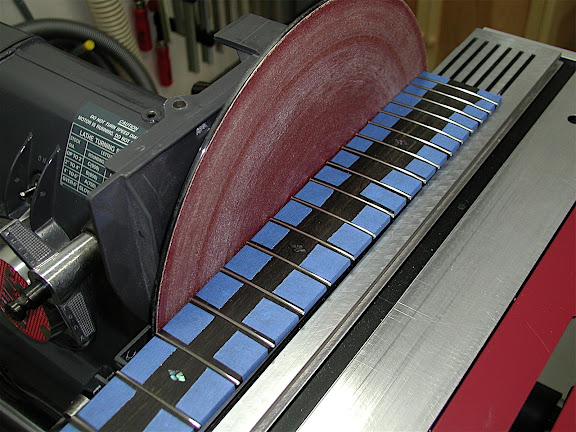
First post here, how did you get the fingerboard that shiny. Does it effect the way that you play. I have just bought a SS 510 to help with my electric ukulele builds and I have never seen a fingerboard like that.
Posted: Tue Sep 30, 2008 4:52 pm
by dusty
hobbyist wrote:
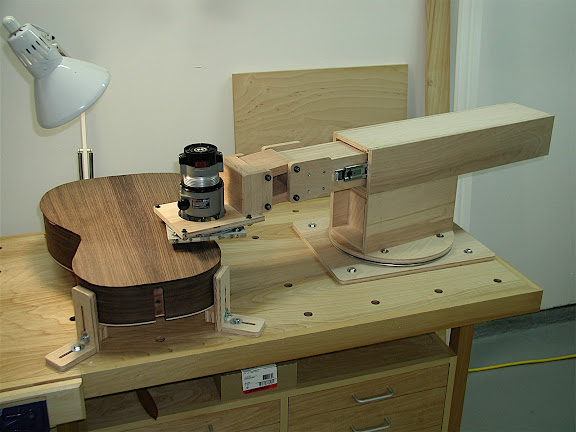
Williams-style Guitar binding jig that I built myself.
Ray
Please excuse my intrusion into your work space but you have a very nice looking work area. I wish we could have met when I lived in Plano. I worked and lived there before I retired from Rockwell. Maybe your keen sense of organization would have rubbed off.
But I'm off topic. Ray, would you please consider opening another thread and do a post about your jig. This looks real intriguing and a very handy bit of craftsmanship.
Posted: Wed Oct 01, 2008 10:19 pm
by hobbyist
wearymicrobe wrote:First post here, how did you get the fingerboard that shiny. Does it effect the way that you play. I have just bought a SS 510 to help with my electric ukulele builds and I have never seen a fingerboard like that.
Welcome to the forum!
I polished the ebony fingerboard with small cushioned Micro-mesh pads. They work great. The finest of these pads is 12000 grit. Here's a link to the Micro-mesh pads at Rockler...
http://www.rockler.com/product.cfm?Offerings_ID=17318&TabSelect=Details
I later applied a small amount of Stewmac fretboard finishing oil. This oil leaves the fretboard slightly shiny, but it doesn't affect the feel at all. The shininess diminishes after a few weeks.
Ray
Posted: Wed Oct 01, 2008 11:00 pm
by hobbyist
dusty wrote:Please excuse my intrusion into your work space but you have a very nice looking work area. I wish we could have met when I lived in Plano. I worked and lived there before I retired from Rockwell. Maybe your keen sense of organization would have rubbed off.
But I'm off topic. Ray, would you please consider opening another thread and do a post about your jig. This looks real intriguing and a very handy bit of craftsmanship.
Thanks Dusty -- the mess in my shop is behind the camera

.
The binding jig is based on a design by luthier Don Williams. You can read more about it at his site. My jig also has a second lazy susan around the router, which is a design by luthier David White. Here's some links to their sites...
http://www.dewguitars.com/BindingJig/Binding%20Jig.htm
http://www.defaoiteguitars.com/page38.htm
The purpose of the second lazy susan is to allow the router to revolve around its center point, which enables you to use a bearing edge guide, rather than a bearing-guided router bit. Here's a photo showing the edge guide that I made...
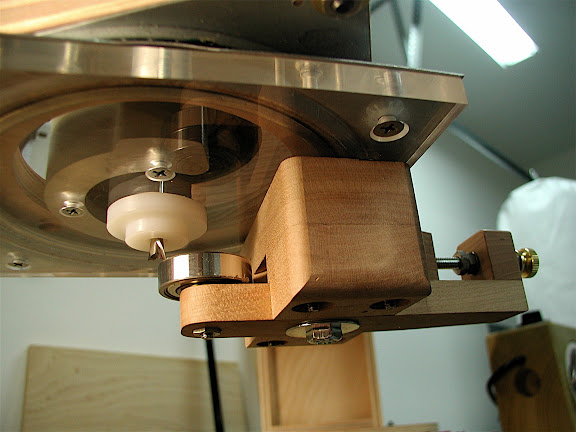
The white disk around the bit is low friction UHMW plastic. It rides along the top/bottom edges of the guitar.
The idea of the jig is to hold the router vertically aligned as it rides around the guitar. The binding channel is then always cut parallel to the sides of the instrument. This solves the problems that would be encountered guiding a router with its baseplate on the top or bottom of the guitar. Since the top and bottom surfaces of the guitar are convex and sloped, it is very difficult to manually route binding channels and keep them parallel to the sides.
Ray
Posted: Wed Oct 01, 2008 11:05 pm
by a1gutterman
Ingenious!
Posted: Wed Oct 01, 2008 11:18 pm
by charlese
Hi Ray! I must add to ingenious - fascinating, beautiful and all the time being very functional. Thanks for the Photos! You get a big ATTA BOY!