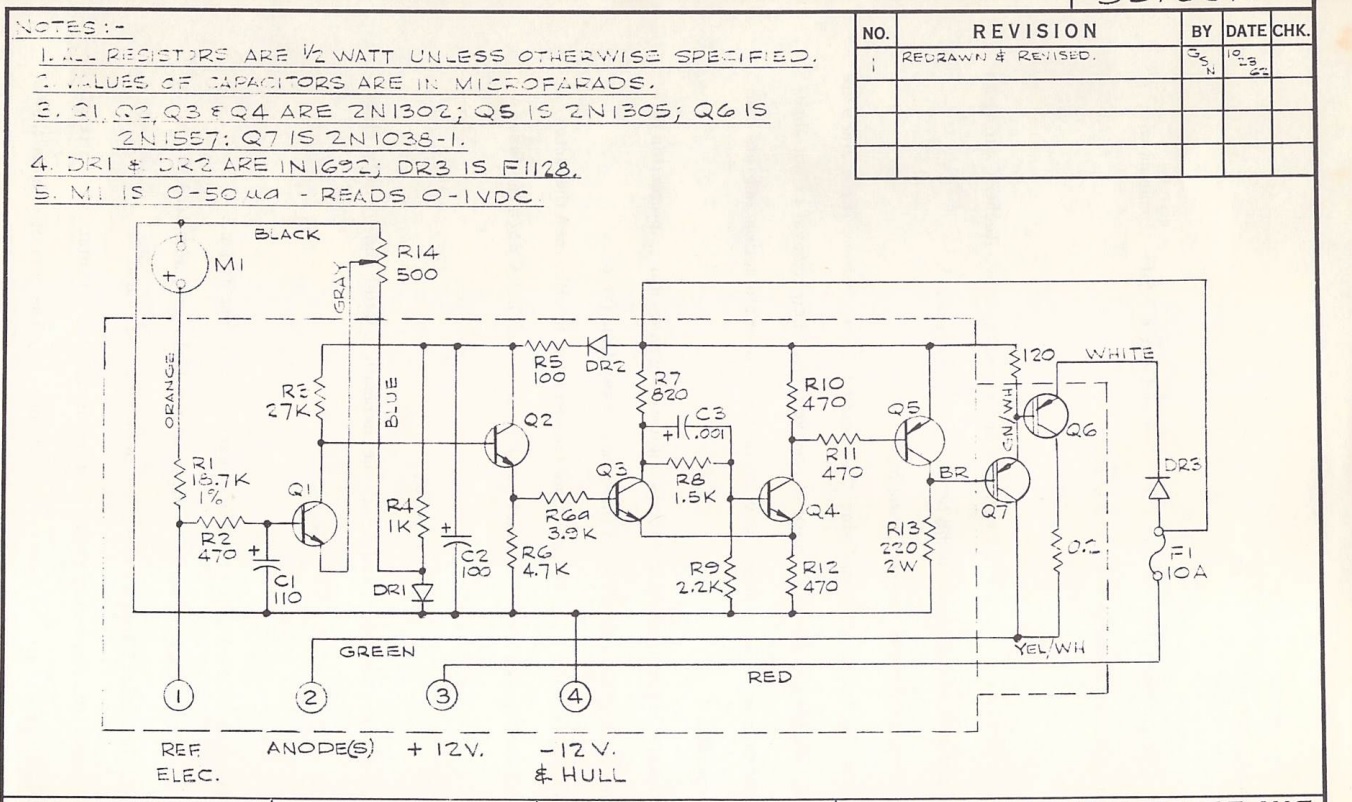
The 1N prefix is/was commonly used for diodes where 2N is for transistors. I didn't catch that before. I don't recall the reasoning, and it might be old school now. This was extremely common in my time in the service, late 70's. Maybe it is a Mil-Spec number.(?) Because of that, I read all of these as 1N, and am reasonably certain that is correct. I agree regarding 1's and I's in the drawing, they should be clearly differentiated.
roamer46 wrote
I'm curious--if DR1 is shorted, shouldn't the +11.24v still pass through R4 (assuming it's good) and show up on the blue wire, minus whatever portion the resistor blocked?
Yes but in this case it would be 100%. Electrical current will still pass through R4 if the diode is shorted, but the ground via the presumed short will result in a 0V reading. So in this case the full 11.24V is being 'dropped' (converted to heat) by the resistor. If this was working correctly it would look similar to the R5 and DR2 combination you also noted, with voltage drops across both DR2 (also 0.7 V) and R5.
- David