roneg
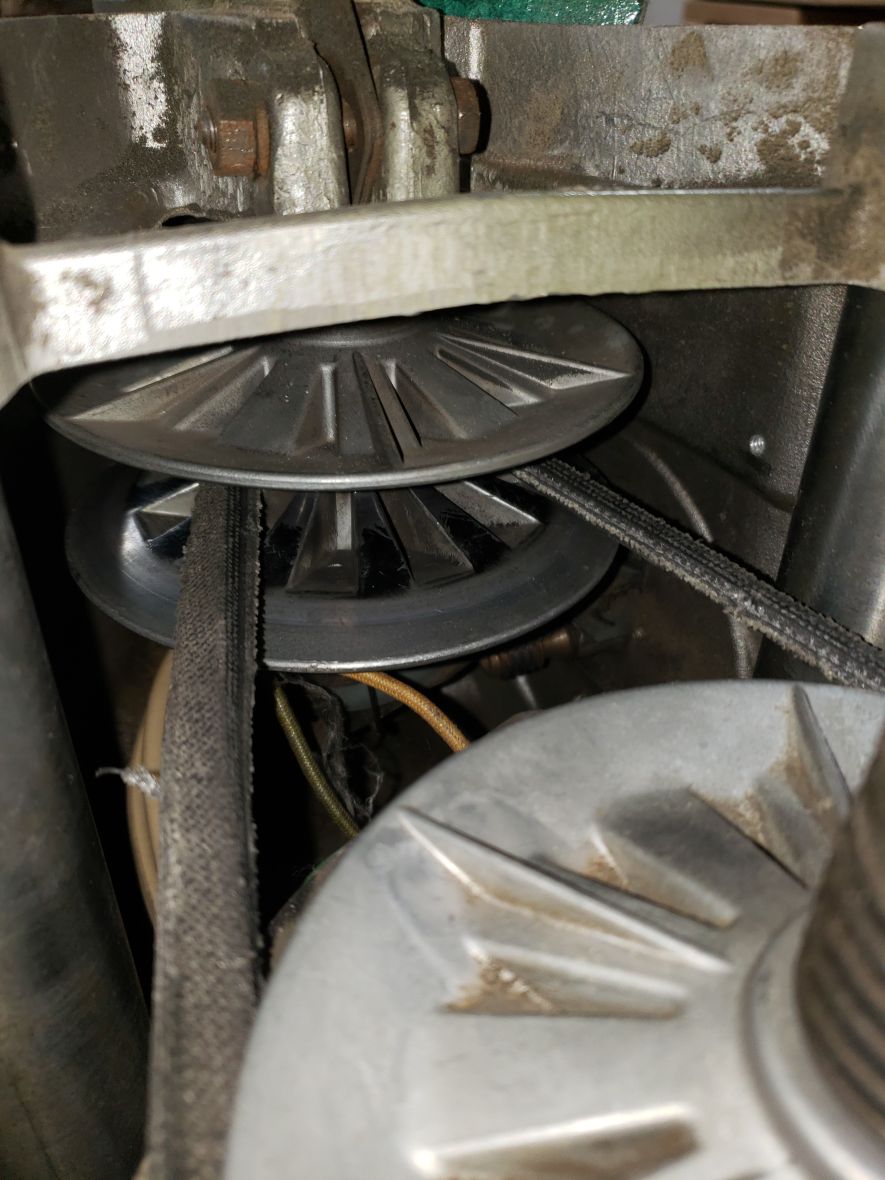
Sorry wrong again.. :) I only posted that last pic. to hopefully get some responses on, if the tracking on that belt looked OK. the deformed belt issue is concerning the v-belt pic posted. Sorry for the confusion..my bad! :o
reible
So we can all see the image at a decent size:
Ed
garys
That belt is definitely beyond its useful life. I'd order a new one from Shopsmith if you plan to use your Shopsmith.
roneg
Thanks garys :D I had come to that conclusion :eek: I was wondering if anyone here has exsperienced a simular situation on their SS. I ordered a replacement yesterday. I also learned to acces the sheeve from the medallion or..nameplate to release the keeper so as to remove/install the belt.
JPG
I gotta agree with Dusty. The control sheave looks excessively open.
As for Gilmer vs Poly-v, the v-belt sheaves are the same(only the drive belt pulleys are different.
The Gilmer looks to be tracking too far back. The idler sheave may be too far back causing both that and the excessive sheave opening. Idler bearing/shaft too far back?
dusty
Just a question:
Why when doing a belt replacement do we routinely position the belt so that at high speed the belt is approximately 1/8" below the circumference of the sheave?
Is there a consensus on 1/8" being the correct position?
Why not, for example, 1/4"?
Is there a consensus that the correct v-belt length is 26 3/4"?
JPG
Lotta 'maybe/whyfor' involved.
The dimension depends upon the wear status of the belt.
When new the belt should ride nearer the rim than when worn.
My own 'opinion' is that the belt to rim dimension(motor pulley at fast) should be the same as the belt to rim dimension(idler pulley at slow).
Thus it is not a single dimension nor at a single place/condition. It is equivalence at the ends of the speed adjustment range.
I think the nominal belt length is 25.5", but that is difficult to 'measure'.WHOOPS too many "5" 26.5
The length at the outer edge should be slightly greater than 25.5".26.5
Of equal importance is the width. A new belt needs to be slightly greater than 1/2". Unfortunately now days 1/2"(12mm) belts are slightly less than 1/2". For a while belt lengths at 1/2" increments disappeared. Recently some have appeared.
I recommend cogged belts either the internal ones or the newer top cog belts(more flexible).
dusty
JPG wroteLotta 'maybe/whyfor' involved.
The dimension depends upon the wear status of the belt.
When new the belt should ride nearer the rim than when worn.
My own 'opinion' is that the belt to rim dimension(motor pulley at fast) should be the same as the belt to rim dimension(idler pulley at slow).
Absolutely...and I suggest that that dimension is approximately 1/8".
Thus it is not a single dimension nor at a single place/condition. It is equivalence at the ends of the speed adjustment range.
Absolutely...but I further suggest that where the belt is positioned "on the other sheave" is a function of the reeves drive. That position is determined automatically.
I think the nominal belt length is 25.5", but that is difficult to 'measure'.
I disagree on 25.5" being the outside dimension of a new belt based on my own measurements of three belts (two being brand new from Shopsmith. I measure those belts, both the 1 used and 2 new, to be 26.75".
The length at the outer edge should be slightly greater than 25.5".
Of equal importance is the width. A new belt needs to be slightly greater than 1/2". Unfortunately now days 1/2"(12mm) belts are slightly less than 1/2". For a while belt lengths at 1/2" increments disappeared. Recently some have appeared.
Of some importance is the width. The sheaves will adjust to that width. Yes, the diameter of the sheaves will be different and thus the diameter of the two pulleys will change but they will change equally and thus will not effect the ratio between the two significantly. If the ratio is not altered, speed changes will occur as they normally do.
I recommend cogged belts either the internal ones or the newer top cog belts(more flexible).
I have seen comments about clogged belts but have no experience or opinion o0n the matter.
My comments are highlighted.
roneg
JPG wroteI gotta agree with Dusty. The control sheave looks excessively open.
As for Gilmer vs Poly-v, the v-belt sheaves are the same(only the drive belt pulleys are different.
The Gilmer looks to be tracking too far back. The idler sheave may be too far back causing both that and the excessive sheave opening. Idler bearing/shaft too far back?
And what would be the test, and or remedy? I mean, how do I tell if there is some ongoing problem?
dusty
I am not sure of what you are asking. Hope this helps.
1) Lubricate the sheaves.
2) Replace the belt.
3) Perform a "High Speed Stop" adjustment"
4) Check position of the belt on both the motor sheave and the idler sheave.
Go make sawdust and enjoy. Nothing should change for quite a long time. I have not replaced a belt or performed a high speed stop adjustment for at least 3 years.
Keep the sheaves lubricated at the risk of over lubricating. The downside of over lubrication would be the excess oil that gets slung aroung the inside of the headstock. You already have experienced the down side of not doing the above.
With some operating time under your belt, you will hear the differences that might indicate a developing problem. When you think you hear something different - check it out.
Don't operate the machine without the locks all secured. If you do that, you will hear that too. Squeaks, rattles, etc. To say nothing of the table or carriage or tilt or quill moving on you during a cut. :eek: :eek:
garys
Assuming you have the correct length and width belt, then setting the high speed according to the book with the belt 1/8" should set the sheaves to the correct position.
dusty
Something to ponder:
This chart results from some real world measurements combined with some spreadsheet expansion of that data collected.
Belt Check for Forum.xlsx
JPG
Nominal belt length is NOT the od, but something between the od and the belt id. It is the 'effective' length when running over a pulley. I goofed when I said 25.5. I do not know where that first 5 came from(s/b 6). :o
Yes the reeves drive will accommodate a narrower belt(like when it wears), but the resultant speed range will be altered. i.e. for a given setting of the control sheave, a narrow(worn) belt will ride lower in the idler pulley. The motor pulley will also be responding to the narrower belt by allowing the floating sheave to be closed more. This will result in the belt riding higher in the motor pulley. The resultant speed will be an increase over that attained with the wider(new) belt.
dusty
Yup. I agree with all of that. That simply means that when you turn on the Shopsmith and set it to saw speed (as an example) you don't really know what the speed is. It is somewhere in the general vicinity of the recommended speed.
This is true whether you have a brand new belt or one that is somewhat worn and frayed.
Further more, for discussion here or for work in the shop, the "measured" od of the drive belt is as good as any other number you might use for calculations. "Effective" length is to be measured at that location where the support fibers are located. Since that can not be determined without manufacturing specs for 'that specific belt' I use the od.
My belts all measure 26 3/4".
roneg
Um..Iz just wondering what might cause a thing like this to happen. :eek:
dusty
garys wroteAssuming you have the correct length and width belt, then setting the high speed according to the book with the belt 1/8" should set the sheaves to the correct position.
I agree BUT why do we all seem to believe that the belt should ride 1/8" below the rim of the sheave? Are there consequences if it rides closer to the rim? Like say the belt and the rim are at the same level?
To avoid confusion...let us assume that we have the proper belt installed and it is in excellent condition (brand new from Shopsmith).
roneg
Got some time to go down to the shop and remove the belt. Couple of things I noticed;
First... there is no access from the logo (no hole) on my SS. It is as old as me! So removing the "pork chop"(86) from the control sheave (110) ..tricky. Good thing I was in a wood shop..plenty of various sizes long sticks. ;)
Second... both the idler sheave(109) and floating sheave(117) seem stuck to their respective shafts.
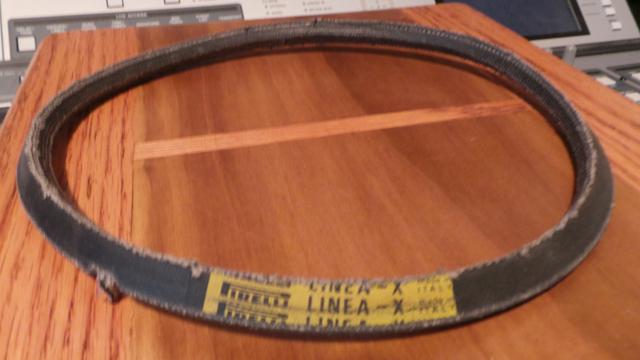
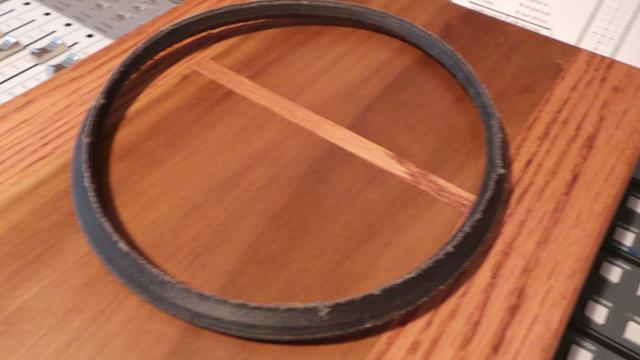
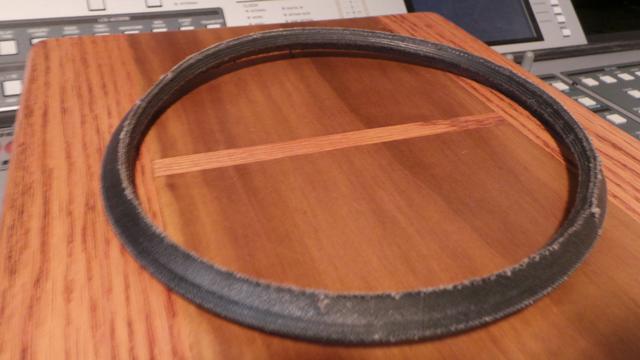
JPG
The idler sheave(109) is NOT supposed to slide on the idler shaft(105).
The floating sheave(117) is under a strong spring(116) tension. However it can be moved by hand. That said if it IS stuck it likely is causing your problem.
The control sheave(110) needs to be positioned at the 'fast' position(closest to the quadrant(86 aka porkchop) in order to remove the clip(attached to the control sheave).
No access hole, therefore you have an "A" headstock. You may also have movable sheaves WITHOUT an oil hole and it likely has not been adequately lubricated(oiled) these past 60+ years.
So your immediate task is to get it lubricated so the movable sheaves do so easily. Then that belt MAY track correctly. I dare say the floating sheave is starved for oil.
Be careful using the online exploded view on line. Your greenie has several differences. I strongly suggest you download a greenie manual from Everitt's google drive.
roneg
Thanks JPG,
Not real familiar with the innards of these "marvels of modern man" yet! :eek:
What you recomend for lubrication of the sheaves?
JPG
roneg wroteThanks JPG,
Not real familiar with the innards of these "marvels of modern man" yet! :eek:
What you recomend for lubrication of the sheaves?
#10 MACHINE oil. 3 in 1, sewing machine oil, turbine oil, Recommend any with a 'zoom' spout extension. If yours does not have the oil holes, apply it to the shaft directly where he sheave slides. Likely you will need to get in between the sheaves.
