In answer to your specific questions:
1.) The floating tables for a 505/510/520/Mark 7 table system can be purchased separately, but they "float" on rails which a 500 main table does not have. And due to table size differences, the 500 table cannot be modified to accommodate the rails. The newer table systems also use different fences.
2.)You say you have an extension table. This is the easiest way to get extra width.
There are two sizes for the extension tables ... the original is about 4" wide, the larger version is about twice that wide. Both versions use the same mounting posts. Shopsmith or eBay are a good source for the wider extension table (with or without the supporting posts). Others users have mounted two main carriages and tables side by side for extra table surface area. While this will limit other functions, if your main use is as a table saw, that might work for you. The second carriage could be left installed but the table removed to give more flexibility for other functions. I am unaware of any other workarounds, but I'm sure there have been others, including adding custom wood tables on top of the existing aluminum table.
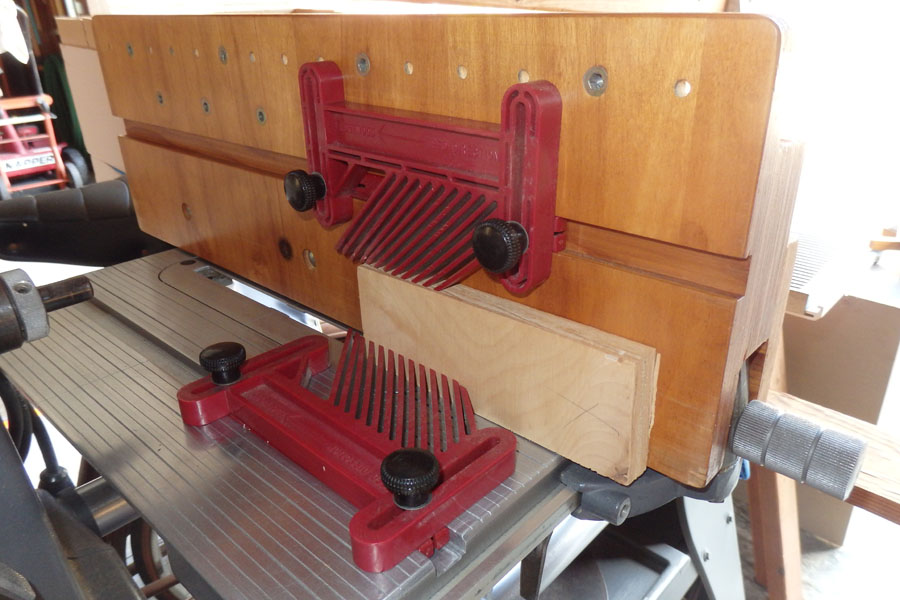
3.)There are different style front rails for 500 tables and extension tables ... some are integral to the table and some are bolted on. You may have a mixture of the two styles. Where the main table and extension meet is tricky to get the fence to transition smoothly. The extension table can be adjusted to better align by loosing the 4 bolts that hold it to its posts. A wider extension table can help in that it gives more surface area. An auxillary face can be added to the fence to allow positioning the fence further away from the joint between the two tables, while achieving certain rip widths in that range between mounting the fence on the main table and mounting fence on the extension table. Attached is a picture of an auxillary fence face I use. This is my second version, with slot added for feather boards. This only gives 3/4" of additional offset, but a thicker face could give more ability to "span the gap" between the 2 tables.
Also, earlier Mark V tables had a second saw slot to the left of the main slot, which gave greater rip capacity while the fence was mounted to the table. I think this second slot was meant for smaller diameter blades, but still might be an option for you. This second slot was eliminated due to concerns that it weakened the main table, and a second slot should not be simply cut into a main table. This second slot also left the blade unprotected above and below the table with no saw guards, and also had no capability for dust collection.
Finally, any pictures that you could post would go a long way in helping to provide suggestions and advice ... and besides, we love pictures!


