woodhead52 wrote
I very much appreciate everyone's input and advice. I've carefully read your posts and and I've re-read the section on Horizontal Boring in Power Tool Woodworking for Everyone. All of it is helpful and helps me to set my expectations in the right place. I plan to follow up with my results and experiences with some pictures, thoughts and conclusions so that you can offer critiques and advice. All of this will be happening amidst other things so it may be several days or even a few weeks before I post my results.
If you or anyone else should wish to share any other thoughts, pictures, etc. on this, let them fly.
Thanks again.
Regards,
Pete
Pete,
Please understand that any Shopsmith owner that sets their mind to it can accomplish anything. The horizontal boring feature is a great feature and many here on the forum use it often and love it. I merely wanted to caution you on attempting so many dowel placements in a large panel like that. It can be done, but accurate placement of every dowel hole is critical to both achieve a flush top and an easy glue up. Some mentioned that joinery (e.g. dowels) aren't needed for edge to edge glue-up. They mentioned this because the chemical bond of the glue is stronger than the lignin holding wood fibers together - in other words a good glue joint is stronger than the rest of the board itself (assuming a good quality wood glue like Titebond brand). This works best for straight and true lumber, which isn't always so easy to procure or mill. For a handful of dowel joints, in my experience, I find that the horizontal boring is acceptable and works well. However, I continue to have issues with my 520 fence slipping (during horizontal boring) and I am not willing to tighten it more than the level that I have it at now. Some here suggest using auxiliary clamps to hold the 520 fence in place on the table for this operation. Dowel centers are a must as are brad point drill bits. Doing around 80 of these for example on a large panel is not something I would choose to do and I will explain why:
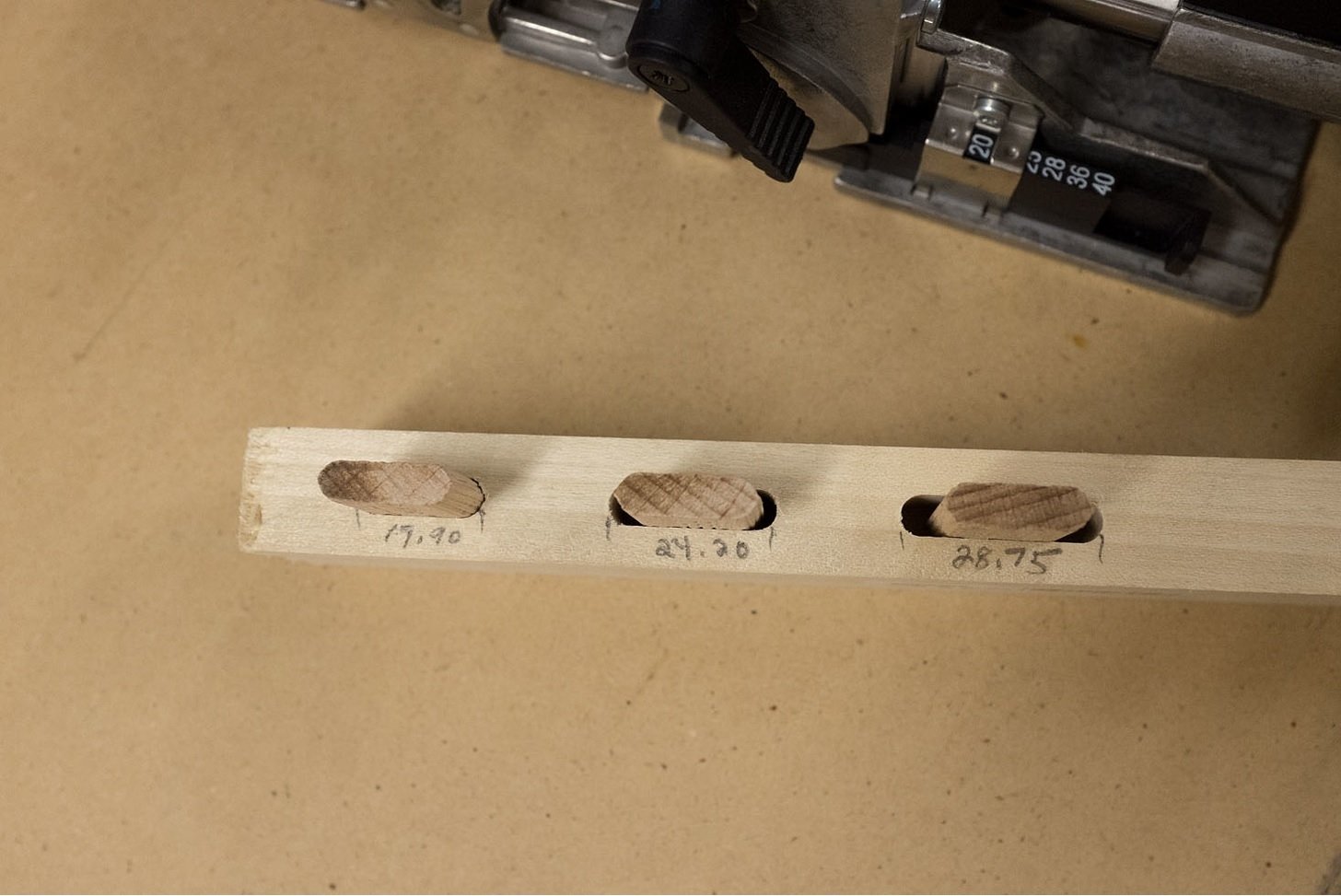
I recommend joinery, even for panels because I often find a 6' length board will not be perfectly flat or non-twisted. So, I am usually correcting a bit of cup or twist when I assemble a panel. It is helpful to alternate end grain so that the panel will tend to self correct with time, i.e. so you don't end up with a potato chip one day instead of a flat panel. When I mention vertical alignment I am referring to two boards side-by-side, edge glued where you want the top to be perfectly flush. You assume the boards are exactly equal thickness but in reality there can be some difference, albeit small. You want to run your hand across the seam on the top of the panel and feel nothing but one continuous surface. So, the desire is to have vertical alignment between the two boards such that the top surface is the reference to achieve a flush surface. Note that biscuit joinery gives you this with vertical alignment, but they don't give you any horizontal alignment, so the board ends could be askew relative to each other. For panels you don't have to have horizontal alignment from the joinery, but must make sure you achieve this on glue-up or you will need to trim both ends of the panel instead of simply sanding them. Dowel joinery isn't very forgiving because they provide both vertical and horizontal alignment - in other words their placement needs to be precise. Consequently any error in placement will either result in a panel that won't assemble or result in a top surface that isn't flush. Loose tenon joinery, such as the Domino, can give both vertical and horizontal alignment. Not trying to talk you into the Festool Domino, but just pointing out where it excels. On a large panel like a table top, you can mortise the first mortise on one end of the board with the tight setting. Then the rest of the mortises down that board can be done on one of the 2 optional loose settings that they offer. This results in a mortise that has more side to side play but keeps the same mortise height in the vertical dimension. As a result, the one Domino on the panel ends (one in each board to board connection) sets the horizontal reference so that all of the boards will be flush on the end, while the interior dominoes will maintain the vertical alignment only. This makes panel assembly easy and quick which is helpful considering the glue sets quickly during assembly of a panel. Without this feature, making all of the domino mortises tight fitting would have the same problem as dowel joinery and require absolute precision of every mortise or the panel would not assemble, i.e. holes in the wrong places. :o
Not trying to talk you into new tools and especially not trying to talk you into the Festool Domino because it costs a small fortune. I love my Festool Domino though. 😃 For me, I figured out where my Shopsmith excelled and where I would rather spend my time/enjoyment on other tools. IF you are set on doing dowel joinery on a large panel, I would recommend a dowel joinery jig such as Jessem's or any other good name brand. Doing approximately 80 dowel holes and mating them all on a large panel can be done with a Mark V, but it isn't going to be easy or fast. I think you will get better alignment and better results doing that with a dowel joinery jig IMHO. For smaller projects, fewer horizontal borings like what Ed showed, the Mark V is fantastic for this. Just my opinion and there may be others on the forum who disagree with this. Taking the Shopsmith out of the discussion, I think the real question becomes do you need/want joinery in your large panel that you started discussing on this thread? IF so, you may be better off with other joinery methods. The Festool Domino is fantastic, but expensive. Biscuit joiners are more accessible and give only vertical alignment, but that is all you really need for a panel provided you take care on assembly to keep the ends flush and square. For small panels, such as a cutting board, you may want to forgo joinery altogether and/or give it a go with horizontal boring and dowel joinery on the Mark V. JMO.
P.S. I know a picture would really help with this, so below is a pic illustrating the 3 different width settings of the Festool Domino. The one on the left is the standard (tight setting) and what I would use on one end of a panel. Then subsequent mortises down the length of the board would be done on the 2nd setting (loose setting). In such a way, the 1st (tight) Domino sets the vertical and horizontal alignment between the two boards and each subsequent loose Domino down the length of the board holds that vertical alignment to give a flush top surface to the panel. This gives some small horizontal play of each loose Domino so that a panel can be easily assembled at glue up. Unfortunately you can't do something similar with dowel joinery. Biscuits give a little bit of horizontal slop and make assembly of panels easier, though not all biscuit machines are equal in quality...