Many thanks to everyone for sharing your experience and answering my questions. It's good to know I'm not just bugging everyone.
JPG, thanks for the concise answers!
I will probably have this machine broken down for a month or two so I have some time to decide on the bearings. My gut tells me that if I'm going to replace one, I might as well replace them all.
I'm planning on applying current to the motor soon for testing. I can spin the shaft fairly well but am a bit concerned about grit getting in the bearings and coils. Sometimes blowing out an electric motor can make problems worse since you end up with dust in places it shouldn't be.
I haven't had much luck finding diagrams for the 1 1/8 motor. I removed the four long carriage bolts in the motor housing and it still didn't come apart. I removed the black plastic cover on the back of the motor next to the capacitor and found two more screw-slotted carriage bolts inside with king nuts, under a couple of springs. I cautiously loosened them and the shaft seemed to spin more freely. I'm afraid of taking them all the way out for fear of disassembling it improperly. I've never worked on a motor this size, just power tool motors like drills. That's a different animal.
So how do I get this motor apart correctly? The fan sheave is still mounted on the shaft. Do I need to remove it first? Does that require a puller? There is a key/shear pin along the shaft so it looks like the sheave should slide right off but some gentle prying hasn't budged it.
Also, I want to test the motor and capacitor with a multimeter before I power it up and continuity test. It's 15amp, 115v, but what are the acceptable draw ranges upon start up and running? What are the specs for this capacitor? Sorry, I don't have access to pics right now (at work).
As for my photos, the key is lighting. Most of my photos are taken with a camera phone (3.2mpxl) but all you need is something between 3 and 5 megapixels. These 10 and 12 mpxl cameras out now are really only an improvement for drastic zooms and super close ups. My cameras have the feature where you depress the shutter button half way and it will auto focus and that's key for me. I did my first youtube videos with what I thought was ample lighting and they came out very dark. Now I also use a shop light and a flood light that are mounted on movable brackets so I can hang them where I want in the shop. Now the shop feels dark without them! A couple of clamp lights would do the trick. I also use a small LED flashlight for illuminating interior shots and close ups.
JPG, I have found that it depends upon which HF store you visit as to whether they will accept the 20% coupon on top of sale prices.
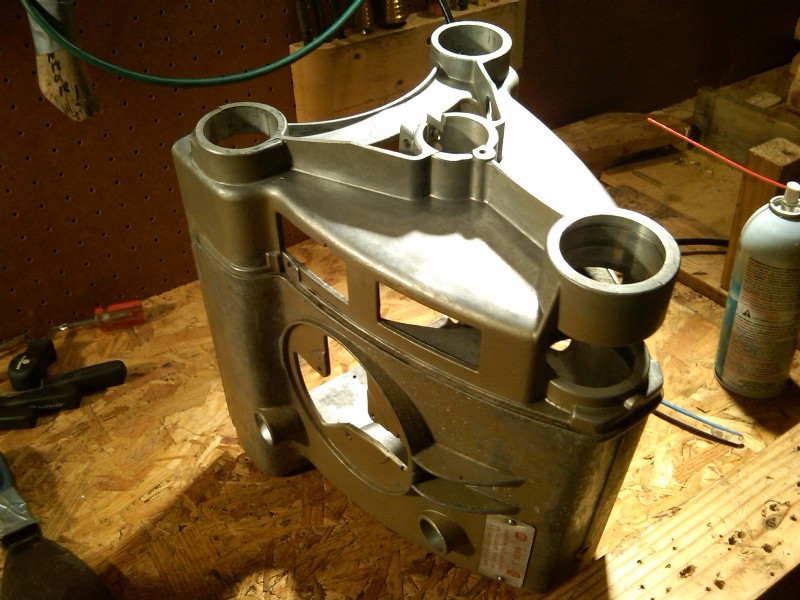
Here's a shot of the headstock casting after some mineral spirits, tooth brush and a soft paint remover wheel.