gac5ss
One of the used Shopsmiths I bought in past years came with a conical sanding disk. It had a worn out sand paper on it so I have not used it as the sand paper for it is fairly expensive. I have since removed the worn out paper and cleaned it up.
Today I have been scanning through eBay and see one being bid to $42+ and shipping adds another $20.
My question to the forum is what advantage is the conical disk over the flat disk? Why not just run the edge of my board over the jointer? Or use my random orbit sander to clean up saw marks? Not sure if i want to invest $22 plus shipping in the sandpaper.
I may put this one on eBay and put the procedes to other uses.
Thanks,
RFGuy
I don't own a conical sanding disc and never really saw the point myself. Yes, I know it can be useful for alternatively jointing figured woods like birdseye maple, etc. Of course with a helical cutter head and proper direction and feed rate you can do the same thing on a jointer. They're just an alternative (and cheaper) method to joint (IMHO). I would also be interested to know if anyone uses the conical sanding disc on a regular basis and what tasks you use it for...maybe I am missing something.
stew
It is very useful if you want to sharpen your jointer or planer knives. I suspect not the helical cutters.
JPG
One advantage is no swirls.
I would get a new one from SS rather than a used one on E-bay for > $40.
I would also NOT get disks for it until I had a need!
algale
There are times that I go a long time between uses of my conical disk.
But in a nutshell it does do an amazing job of "jointing" stuff with crazy grain. Maybe a jointer with a helical head would do as good a job without tear-out but I would not know since I don't own a helical jointer. Even if I did own a jointer with a helical head, there are some wood products (plywood/melamine) that I use that I would not want to run through a jointer for fear of dulling/ruining jointer blades. I think sandpaper, even for the conical disk, is a lot less expensive than jointer blades.
Beyond jointing, the conical disk does a superior job of sanding to width than the flat disk because, unlike the flat disk, you don't have to screw up your fence alignment to do so (I gather the 500 fence has an offset feature that doesn't screw up your alignment but the 510 & 520 fences do not as far as I know) and it leaves the edge sanded parallel to the grain, without the characteristic cross-grain swirls left behind by the flat disk.
On the down side in addition to cost of the conical disk and the consumable sandpaper, set up can be a little finicky because you need to get the table tilt to an exact 90 degrees relative to the slope of the conical disc. Even with a good square, that can be frustrating as tightening the table tilt lock can cause a small amount of creep. A Wixey or other digital angle gauge can help with the process. Attach it to the slope of the conical disk, zero it, and then put it on the table and adjust the tilt until you get that perfect 90 degree alignment.
Is it an absolutely necessary accessory? Nope. And it's hard to appreciate its capabilities if you haven't tried one. But it's a good tool to have in the bag along with all the other tools.
JPG
Yes the 500 fence has the SINGLE off set screw for that purpose.
gac5ss
Appreciate the information. I had not considered the sharpening aspect, yet I have set up an 8" SLOW speed grinder for that. I would trade someone a flat disk for the conical disk if we lived close enough to do so.
Probably better to put on eBay.
stew
I will trade a flat for your conical. Just send me a Private message and we can work out the details
chapmanruss
I have and have used the Conical Sanding Disk, as mentioned above, for sharpening my Planer and Jointer blades. It does an excellent job of sharpening the blades and the Jointer 4" and the old Jointer Head 2-1/2" blades can be done as a set. This is especially important for keeping the sets equal on the 2-1/2" blades. I have sharpened quite a few Jointer blade sets doing restorations as well as my own Jointer and Planer blades. I wouldn't sharpen them any other way.
As for edge sanding on wood, since only a narrow section comes in contact with the wood it makes easy work on finishing edges. Since you use the fence as a guide the stock comes out to the width set for the entire length of the board. As mentioned before great for plywood and pressboard/composite stock. If used on a Model 510, 520 or Mark 7 you can add floating tables and the legs to handle even wider stock safer by having it flat on the tables than by holding the edge over the Jointer against it's fence.
The current Conical Sanding Disk is not the first one made for a Shopsmith. The Mark VII came with a 10" dual sided Sanding Disk with one side flat and the other side (where the hub is) conical back in the 1960's.
sehast
Best use for me is sanding highly figured woods flat and to width. Something you wouldn't want to use a jointer or planer on. Here is a good overview.
https://www.shopsmith.com/ssacademy/SS_Archives/SS101/SS101_ConicaL_Sander.htm
gac5ss
I need an opinion on acceptable run out on my conical disk that Stew and I agreed to swap. As an after thought, I decided to check the run out using my dial gauge. Since I have not used the disk in any way since purchasing it used.
The run out on it is 19 thousandths at 180 degees. My flat disk run out is 10 thousandths. I checked my quill shaft run out and it is 1 thousandth.
Just to insure that I am not sending a defective disk to Stew, Is this run out within acceptable norms? We are planning to drop them in the mail tomorrow.
Thanks,
JPG
Those numbers are meaningless without also including the distance out from the center.
I do not think those numbers are excessive for the intended purpose of the disks if at the periphery.
gac5ss
JPG wroteThose numbers are meaningless without also including the distance out from the center.
I do not think those numbers are excessive for the intended purpose of the disks if at the periphery.
The measurement was taken on the perimeter face of the disk. Thanks for your help.
reible
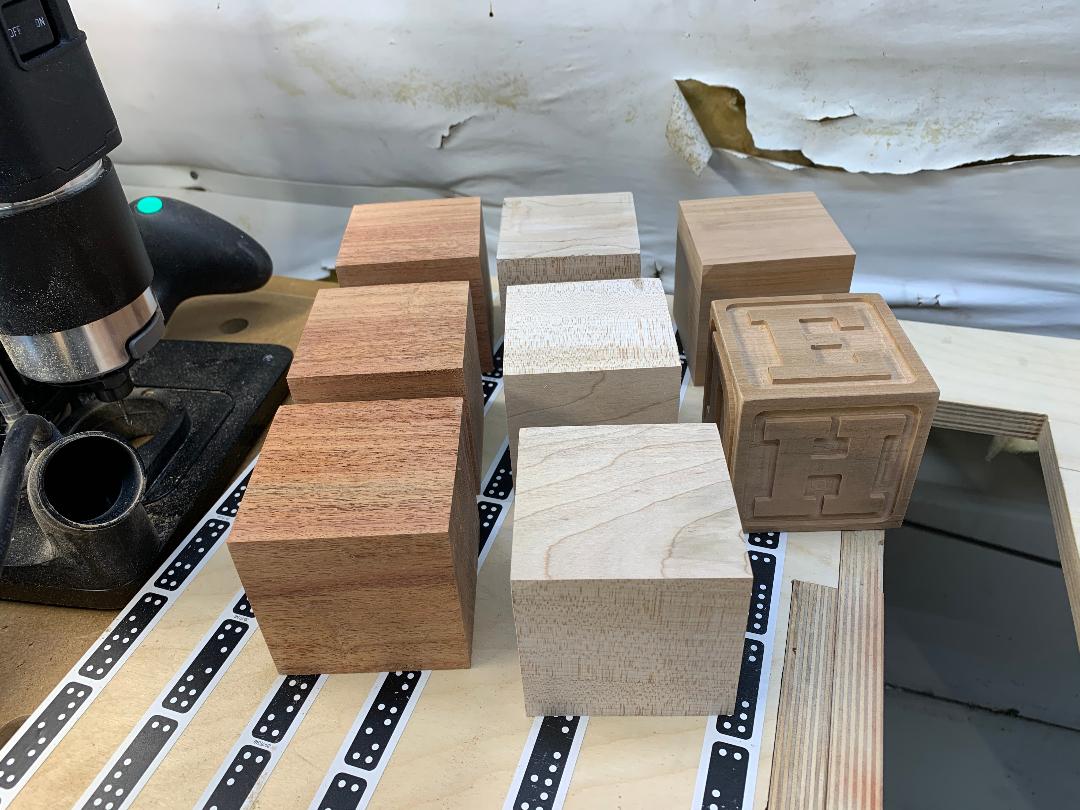
I just used my conical disk to finish these blocks:
The one with the letters was done by hand and was a prototype but with that many to do it was easier to do some power sanding.
I cut them just a little over sized then sanded all 6 sides so they are all uniform and sanded. I think the fine paper for these is 150 grit, anyway I forgot to write the grit on the disk but it is the fine paper.
Ed
tucsonguy
The conical disk offers a level of precision that allows grinding metal surfaces. Not just jointer knives - but here's an example;
I bought some standard aluminum bar stock which I wanted to precision grind to fit in the miter slot.
I just set up the conical disk with sandpaper, then started slowly grinding the edge (and flipping it to do the other edge with each pass). With each pass, I lowered the table (using the precision adjusting ring SS sells) and in a short time I had a 3 ft length of precision ground metal that will slide along the miter slot perfectly.
The conical disk is really the only thing that gives you that level of precision, whether you need it for really find sanding of difficult wood, or grinding or edging metal.
Gene Howe
Thanks, guys. A file it is. Simple ways for a simple guy.
Bruce
Has anyone tried cutting your owned conical disk sandpaper from a sheet for the flat disk? I don't imagine it would be difficult if you have an old piece to use as a template.
JPG
You need some fairly rugged backing.
