Right now my garage is overrun and disorganized. So my first few projects are going to be storage carts and cabinets.
I looked at the creative multi-SPT carts crafted by forum members, and was planning on going that route, when it occurred to me that if I made a stand-alone cart for the planer, I could build it with the possibility of converting to a stand-alone planer in the future.
So that brings dimensions into question. Since the way tubes are about 32" off the floor, that is how tall a rolling cart should be, but I'm not so sure that would be the optimal height for a stationary planer. I've limited experience with planers, and the one I worked with years ago, mounted with the tables at nearly chest level, was much too high.
Of course another option would be to just shop for a Pro Planer -- but I'm not sure it would give me any advantages. Which brings me to another question -- is there a measurable advantage to having the variable speeds of the SS vs the Pro Planer's fixed cutter speed? I realize the feed rate is always variable.
Converting planer to stand-alone?
Moderator: admin
-
paulrussell

- Platinum Member
- Posts: 675
- Joined: Sun Apr 11, 2010 10:35 am
- Location: Dewitt MI
Converting planer to stand-alone?
Paul
520 PowerPro, Planer, Bandsaw, Jointer, Belt Sander, 20" Scroll Saw, Dust Collector, conical disc
Also: 3D printers, and a homebrew CNC
520 PowerPro, Planer, Bandsaw, Jointer, Belt Sander, 20" Scroll Saw, Dust Collector, conical disc
Also: 3D printers, and a homebrew CNC
From what I have read, there is no advantage to having a variable cutter speed. There are obvious advantages to having a variable speed feed rate as you already know. The pro-planer used to have a slower speed and they upgraded the speed to a higher one by changing the pulleys. The kit (555114) changes the original speed from 3450 to 5750. The more cuts per inch the smoother the board is going to be. I can not find a planer anywhere that has a variable cutter speed (other than the SS) so it can't be all that important.
If you are designing your own system, I would keep the speed no higher than the design (5750 rpm) for safety reasons. You don't want the planer destroying itself.
If you are designing your own system, I would keep the speed no higher than the design (5750 rpm) for safety reasons. You don't want the planer destroying itself.
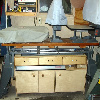
The current pulley configuration on the standalone planer stand allows for 5750 RPM for the cutter. This is driven by a 1-3/4 hp motor. So the standalone offers a higher cutter speed (5750 vs. 4100, using Shopsmith's recommended top speed, 5200 otherwise) and more power than the Mark V headstock. The increased cutter head speed for a given feed rate usually translates to a smoother cut. You can always dial the feedrate down to keep the number of cuts per inch higher.
Anyway whether it is worth the extra cost would be a personal decision.
Anyway whether it is worth the extra cost would be a personal decision.
Rob in San Diego
Email: SDSSmith51 AT gmail.com
Email: SDSSmith51 AT gmail.com
-
paulrussell
- Platinum Member
- Posts: 675
- Joined: Sun Apr 11, 2010 10:35 am
- Location: Dewitt MI
Hmm. Wonder what the PowerPro will do to those speed limits?SDSSmith wrote:The current pulley configuration on the standalone planer stand allows for 5750 RPM for the cutter. This is driven by a 1-3/4 hp motor. So the standalone offers a higher cutter speed (5750 vs. 4100, using Shopsmith's recommended top speed, 5200 otherwise) and more power than the Mark V headstock. The increased cutter head speed for a given feed rate usually translates to a smoother cut. You can always dial the feedrate down to keep the number of cuts per inch higher.
Anyway whether it is worth the extra cost would be a personal decision.
Paul
520 PowerPro, Planer, Bandsaw, Jointer, Belt Sander, 20" Scroll Saw, Dust Collector, conical disc
Also: 3D printers, and a homebrew CNC
520 PowerPro, Planer, Bandsaw, Jointer, Belt Sander, 20" Scroll Saw, Dust Collector, conical disc
Also: 3D printers, and a homebrew CNC
You would think based on the info provided to date is that you would have more speed and more power. Another reason to hold off.paulrussell wrote:Hmm. Wonder what the PowerPro will do to those speed limits?
If I had not happened upon a deal for a standalone Pro Planer, I would still be using my Mark V mounted planer. I was very pleased with it (even the manual feed crank). With that planer, I told my wife that I had an important job for her:D and an opportunity for the two of us to spend some quality time together]
Rob in San Diego
Email: SDSSmith51 AT gmail.com
Email: SDSSmith51 AT gmail.com
-
paulrussell
- Platinum Member
- Posts: 675
- Joined: Sun Apr 11, 2010 10:35 am
- Location: Dewitt MI
I have to write it out: Laughing out loud!SDSSmith wrote:You would think based on the info provided to date is that you would have more speed and more power. Another reason to hold off.
If I had not happened upon a deal for a standalone Pro Planer, I would still be using my Mark V mounted planer. I was very pleased with it (even the manual feed crank). With that planer, I told my wife that I had an important job for her:D and an opportunity for the two of us to spend some quality time together]
Beautiful plan for togetherness. Funny how they don't pick up on the hints!

In any case, yes, I think I'll hold off for now on anything planer related. The PowerPro really does answer a whole lot of questions -- slower speeds for the lathe, higher speeds for the planer and shaper/router functions, more power for the table saw.
Paul
520 PowerPro, Planer, Bandsaw, Jointer, Belt Sander, 20" Scroll Saw, Dust Collector, conical disc
Also: 3D printers, and a homebrew CNC
520 PowerPro, Planer, Bandsaw, Jointer, Belt Sander, 20" Scroll Saw, Dust Collector, conical disc
Also: 3D printers, and a homebrew CNC