To be as kind as possible to the mindless hack who pasted together Ringmaster’s dismal excuse for an Owner’s Manual, it really does suck dead toads. The business that you have pointed out concerning angles is just one of the many, many boats this clueless cretin missed.
Not so with the tool. Drew and I have been exploring the Ringmaster for these last few weeks, getting ready for the January 12 Sawdust Session, and we’ve found that it is delightfully versatile and capable. I fully expected to find that it was a moderately useful gizmo the capacity of which could be demonstrated in 15 to 20 minutes. Not so. Drew and I are now considering that it will take 3 or 4 sessions just to explain the major uses of the Ringmaster, and we can already see possibilities for more.
Those two things being established – the tool is great; the manual is horse puckey – let me say one more thing. There is no reason in the world why the user should be restricted to using a single angle for a given thickness of stock. In fact, if you reject this premise, begin exploring what you can do with a range of angles, and navigate this new territory using a little trigonometry, the possibilities begin to multiply quickly.
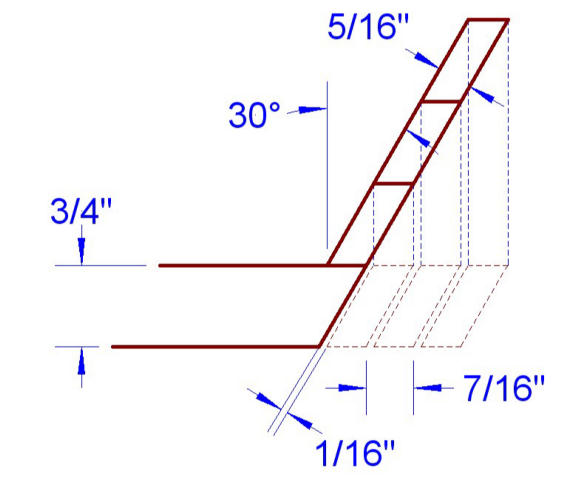
This coming weekend, I’m going to address how to create bowls with straight sides from a single piece of wood. Select the thickness of your stock (up to 1”) and the slope of the bowl wall (up to 45 degrees), then calculate the “ring spacing” needed to achieve it. You can also figure the wall thickness, if you want. The illustration below hints at the process. If you plane your stock to 3/4” thick and want to create a bowl with walls sloped at 30 degrees (not the suggested 22-1/2 degrees), cut rings every 7/16”. (3/4 x tan30 = 7/16) They will match up perfectly.
By the way, Drew and I have also developed an Excel calculator for the mathematically challenged who would rather not deal with sines, cosines, and tangents. Think of it as a GPS for exploring Ringmasterland.
With all good wishes,
