Page 2 of 3
Posted: Tue Apr 22, 2014 11:34 am
by bffulgham
heathicus wrote:......... straight/square edge on a board of that size?
I'd clamp a piece of channel iron or a C-purlin down the length of the board as an edge guide and run a circular saw down it. I've used angle iron for shorter runs, but angle iron will flex sideways on a long run if you put pressure against it as you hold the saw plate against it. (unless it's really thick angle iron)
Posted: Tue Apr 22, 2014 1:33 pm
by charlese
You have already gotten excellent responses to your questions. There are quite a few ways to saw a straight edge on dried pine lumber. I wouldn't worry about it until the lumber is dried.
Assuming it is going to be used for vertical wall paneling, like knotty pine paneling, there is going to be additional milling work in addition to making a straight edge. All pine paneling I have seen has varying widths. Likewise you will find that not all boards will remain 8" wide. (See Ed in Tampa's post) You will be caused to select what part of the boards can be used for paneling. Cupping will have to be removed by ripping as well as planing. Edges will be machined to make them ship lapped, etc.
Before selection and milling, boards sill have to be dry. From what I've read, vertical drying will produce just about as many defects, due to wood movement as horizontal. Only time will tell for dad's/your boards.
Posted: Tue Apr 22, 2014 3:55 pm
by heathicus
Yep, great ideas for straightening the edges. These will be used in a new shop/storage area he's building so he may end up not caring about the faces.
Hhmm….
Posted: Tue Apr 22, 2014 8:54 pm
by forrestb
rbursek wrote:Ed,
right on, talked to a custom table maker, sez everyone wants as wide as possible boards in there table tops when they talk to him, he uses nothing over 4" wide for finished stability of the table top.
Well, I guess we know he, too, has a Shopsmith!

Forrest
Posted: Fri May 02, 2014 12:52 pm
by heathicus
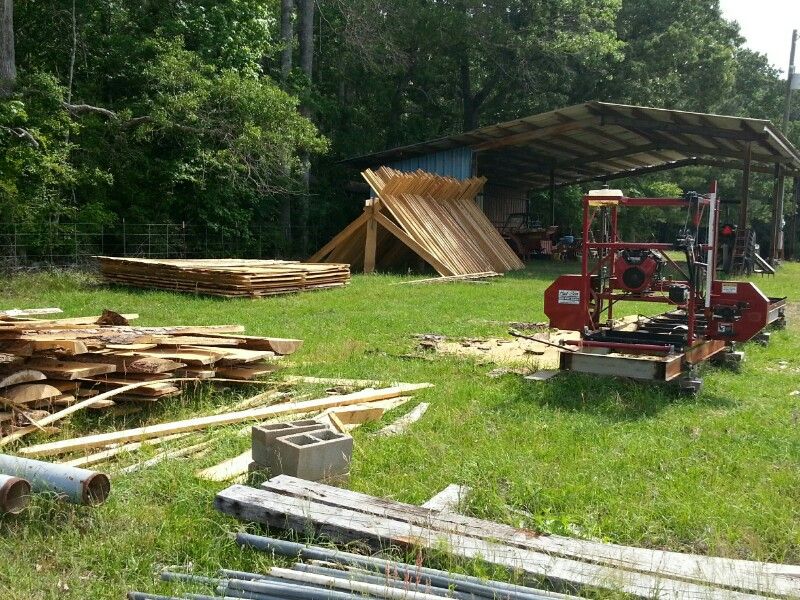
Spent the morning at my dad's helping worm, tag, and castrate cattle. I managed to get a pit of his Sawmill operation. The sawmill is on loan in exchange for him fixing it up. He got the motor running, built a longer and stronger bed for it, etc. But I wanted to show the leaning stack in the background. I'm just a little leary of that stacking method.
Posted: Fri May 02, 2014 1:10 pm
by beeg
Might have been better to stack it under that roof?
Posted: Fri May 02, 2014 3:16 pm
by heathicus
I mentioned that to him as well, and he said he had thought about it, but had too much equipment to keep under there and just didn't have the room.
Re: Straightening the edge of very long boards?
Posted: Sun Jan 02, 2022 9:48 am
by theaccentpiece
Assuming the wood is now dry, there are a couple methods in this post that would be helpful for jointing boards when you don't have a jointer:
Re: Straightening the edge of very long boards?
Posted: Tue Jan 04, 2022 12:49 pm
by philipharris
In the case of my fence table saw, simply placing a rail over untreated wood would not result in adequate contact with the fence.
Once the guide is attached to the rough work piece, you can use the table saw to make a real cut in the wood.
The ends of the stock can be trimmed with a miter saw to create a square piece of lumber. I think
this time to work on it.
Re: Straightening the edge of very long boards?
Posted: Tue Jan 04, 2022 1:32 pm
by JPG
Huh????