Page 2 of 2
Re: Power pro 220
Posted: Mon Jul 11, 2016 11:30 am
by jonesuh
thanks gentlemen ---think I'll put off adding a 220 plug for a while (if ever)
Re: Power pro 220 vs 110 current
Posted: Mon Jul 11, 2016 12:28 pm
by JPG
Anybody who has one read the current rating for the two different voltages(assuming there is more than one current rating)?
Re: Power pro 220
Posted: Mon Jul 11, 2016 1:23 pm
by dusty
http://www.shopsmith.com/markvsite/specs.htm
I believe that it goes without question that a device which works on both 110 and 220 will draw different amounts of current.
Re: Power pro 220
Posted: Mon Jul 11, 2016 1:49 pm
by JPG
Yep, but I am surprised the ratio is what is listed with this animal.
Re: Power pro 220
Posted: Mon Jul 11, 2016 2:46 pm
by dusty
I would not be surprised to learn that the PowerPro motor is more efficient than they advertise it to be.
Having said that, I am surprised at the "heat" issues that have been reported.
Re: Power pro 220
Posted: Mon Jul 11, 2016 3:23 pm
by JPG
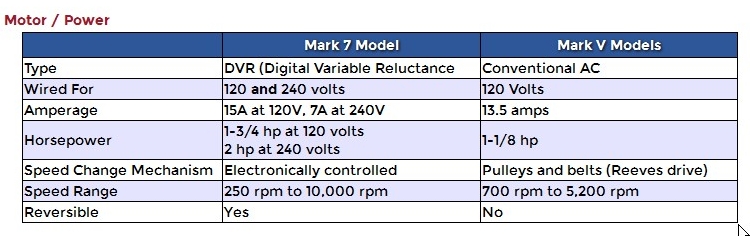
- MOTOR DATA.jpg (102.27 KiB) Viewed 7956 times
Consider the numbers.
I assume all the current numbers are 'maximum'.
The power is greater.
The upper speed range is higher.
The 120v current is higher.
More HP(55 % greater) Faster speed(92% faster) at only a 11% current increase.
Yes I would say it is much more efficient 'overall'.
Allow for the power supply heat loss and the motor is even more efficient.
I simply do not understand WHY the 120v/240v current ratio is near 2:1 considering the power supply design(of which I assume a lot).
I dare say the 'average' motor power consumption is much less than the maximum listed with slow speeds and lower mechanical power output.
Re: Power pro 220
Posted: Mon Jul 11, 2016 6:01 pm
by BuckeyeDennis
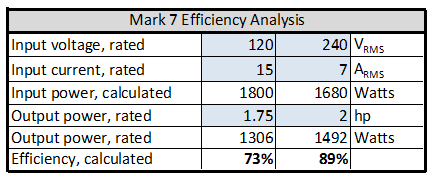
A modern motor drive is basically a switching power supply, and it behaves a lot like a continuously-variable transmission. It's much easier to think about it in terms of power flow, rather than current & voltage. The output power is simply the input power multiplied by the efficiency of the drive. Within limits, if the input voltage drops, the drive will adjust its duty factor to draw more input current, thereby maintaining the desired output power. The drive efficiency will generally be reduced somewhat at lower input voltages, but not hugely.
Here's a calculation of the combined motor/drive efficiency at rated output power for each of the two input voltages. (I've assumed that the power supply has power-factor correction circuitry on it's input, and thus draws a sinusoidal input current). Those calculated efficiencies both look reasonable in comparison with similar technologies, and 89% is very good indeed.
- Capture.PNG (10.61 KiB) Viewed 7936 times
Shopsmith didn't included the rated speed specification (which is generally the speed at which a motor can generate the maximum continuous power), but you can be sure that there is one. If you get too far above or below the rated speed, the continuous power capability of any electric motor falls off, eventually going down to zero at both ends.
Re: Power pro 220
Posted: Mon Jul 11, 2016 7:36 pm
by rjent
BuckeyeDennis wrote:A modern motor drive is basically a switching power supply, and it behaves a lot like a continuously-variable transmission. It's much easier to think about it in terms of power flow, rather than current & voltage. The output power is simply the input power multiplied by the efficiency of the drive. Within limits, if the input voltage drops, the drive will adjust its duty factor to draw more input current, thereby maintaining the desired output power. The drive efficiency will generally be reduced somewhat at lower input voltages, but not hugely.
Here's a calculation of the combined motor/drive efficiency at rated output power for each of the two input voltages. (I've assumed that the power supply has power-factor correction circuitry on it's input, and thus draws a sinusoidal input current). Those calculated efficiencies both look reasonable in comparison with similar technologies, and 89% is very good indeed.
Capture.PNG
Shopsmith didn't included the rated speed specification (which is generally the speed at which a motor can generate the maximum continuous power), but you can be sure that there is one. If you get too far above or below the rated speed, the continuous power capability of any electric motor falls off, eventually going down to zero at both ends.
If I understand it correctly as explained to me by SS during my purchase phase, the motor makes as much
torque (the important number) at 0 RPMs as it does at 10000 RPM's. Probably why it was left out.
Just my hunch JMH <-

Re: Power pro 220
Posted: Mon Jul 11, 2016 9:10 pm
by BuckeyeDennis
rjent wrote:BuckeyeDennis wrote:A modern motor drive is basically a switching power supply, and it behaves a lot like a continuously-variable transmission. It's much easier to think about it in terms of power flow, rather than current & voltage. The output power is simply the input power multiplied by the efficiency of the drive. Within limits, if the input voltage drops, the drive will adjust its duty factor to draw more input current, thereby maintaining the desired output power. The drive efficiency will generally be reduced somewhat at lower input voltages, but not hugely.
Here's a calculation of the combined motor/drive efficiency at rated output power for each of the two input voltages. (I've assumed that the power supply has power-factor correction circuitry on it's input, and thus draws a sinusoidal input current). Those calculated efficiencies both look reasonable in comparison with similar technologies, and 89% is very good indeed.
Capture.PNG
Shopsmith didn't included the rated speed specification (which is generally the speed at which a motor can generate the maximum continuous power), but you can be sure that there is one. If you get too far above or below the rated speed, the continuous power capability of any electric motor falls off, eventually going down to zero at both ends.
If I understand it correctly as explained to me by SS during my purchase phase, the motor makes as much
torque (the important number) at 0 RPMs as it does at 10000 RPM's. Probably why it was left out.
Just my hunch JMH <-
Your got good information. And based on all the PP owner's reports I've seen, the low-end torque is ample.
On a conventional headstock, the speed reduction actually
increases the torque available at the spindle. Presumably to more than you would ever need. The downside is that dragging that variable-speed transmission around consumes considerable power. I did some measurements on mine a while back that indicated total transmission losses of almost 1/2 hp, IIRC. Subtract those losses off of the rated induction-motor power, and the PowerPro looks even better in comparison.
Re: Power pro 220
Posted: Sun Jul 17, 2016 9:11 am
by rlkeeney
I need to have more circuits added so I don't have to play musical extension cords. Most of my standalone tools will run on 220V. I would also like to have four 120V 20A circuits so I can have multiple tools running at once.
When I finally get around to getting this done I will add the 220V circuits. The breakers are already in the box three of them left from switching to natural gas.
In my case I will add 220V circuits. because the cost is minimal. If I didn't already have the capacity I would not add it.