JPG wrote:Who what came up with THAT gobbly gook marketing 'information'.
Since one should rarely(hopefully) experience that 'developed' horsepower how is it relevant in typical everyday use?
Again a hypothetical instant in time. HP is time and distance related.
I was also very skeptical of “developed horsepower” marketing claims, until one day I was contemplating an operation that required a lot of torque for a short period of time. Here’s where that train of thought led me.
As you know, the continuous rated horsepower of a motor tells us how much power the motor can make, forever, at a specified ambient temperature, without overheating. But home-shop woodworking operations hardly have a continuous load. Ripping an 8’ long hardwood board would be about as long as we would ever need maximum power, and even that is a very rare load condition.
Thermal time constants of decent-sized motors are usually measured in minutes, so actually overheating from a short-term load isn’t the issue. I just checked the specs for a 1 hp motor that I own. Safe time at stall is 10 seconds. Locked-rotor (stall) current is 21.4A. Continuous rated current is 3.8A. So resistive losses at stall current are (21.4/3.8)^2 = 31.7 times higher than under full continuous-load conditions — and the motor can handle that safely for ten seconds.
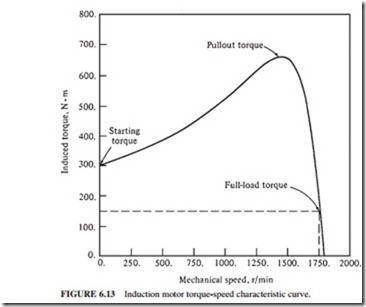
When operating in the usual speed/torque region, the operating point is “stable”. That is, if you increase the torque load, the speed will drop just a bit, and then the motor can happily supply the required torque. Until, that is, you hit the motor’s “pullout torque”, which is the highest point on the speed/torque curve. That’s the point of no return, because if the speed drops any farther, the available torque actually decreases, and the motor immediately stalls.
Now mind you, I’ve designed systems mostly with DC motors, and they develop peak torque at zero RPM. But an induction motor is a different animal. The speed/torque curve below tells the story.
- C94E0328-484F-45D0-AF60-FA22B09F1FB1.jpeg (27.68 KiB) Viewed 14220 times
I don’t know this for a fact, but it seems logical that the “developed horsepower” numbers that the marketeers became so fond of are actually a specification of the horsepower available when operating very near the “pullout torque”. You can’t run there continuusly, for sure. But you probably could for upwards of a minute, which is ample for most woodworking cuts.
So in that sense, I do care about developed horsepower. The more I have, the heavier a cut I can take. And I’ll bet that I’d never trip the thermal overload unless I stall the motor, because I’m not doing continuous-production cutting.


