Page 2 of 2
Re: What is it?
Posted: Wed May 08, 2019 9:06 am
by RFGuy
JPG wrote:RFGuy wrote:Very impressive! Was there a reason why you chose KD fittings for mounting the horizontal part to the verticals? From the picture, I think it looks like KD fittings. I am not trying to nitpick here and I don't know the holding strength of KD versus other means of attachment. Just curious...one thought I had was potentially to run a couple of threaded rods horizontally to mate the two up, but this could be overkill.
I think you are referring to the barrel nuts(cross dowels) as KD fittings.
They provide far greater strength resisting the vertical pieces pulling loose from the horizontal base.
Good choice IMO. Actually quite necessary!!!!
Yeah, it may be the best solution. Again, I wasn't saying I am an expert on the strength of one attachment versus another. Just curious on the use of them here. It would certainly make assembly a lot easier, I would think.
Re: What is it?
Posted: Wed May 08, 2019 9:22 am
by rpd
And for those of us who are easily confused.

KD fitting=
Knock
Down - think Ikea. Not
Kraft
Dinner

- which was my first thought.


Re: What is it?
Posted: Wed May 08, 2019 9:25 am
by BuckeyeDennis
RFGuy wrote:Very impressive! Was there a reason why you chose KD fittings for mounting the horizontal part to the verticals? From the picture, I think it looks like KD fittings. I am not trying to nitpick here and I don't know the holding strength of KD versus other means of attachment. Just curious...one thought I had was potentially to run a couple of threaded rods horizontally to mate the two up, but this could be overkill.
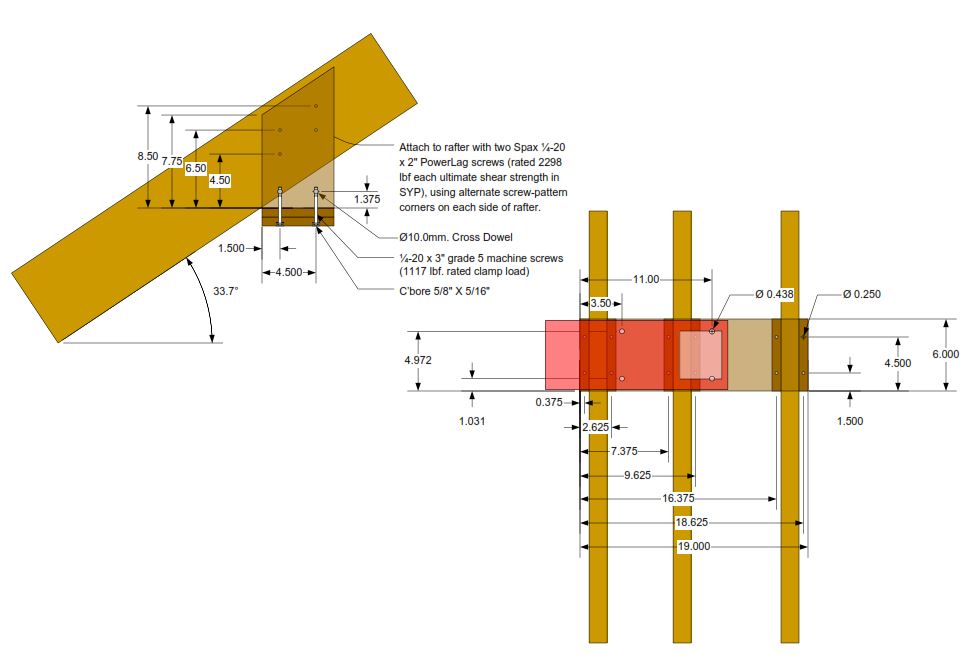
I used the cross dowels because I didn't know how to determine the holding power of lag screws in end grain. The cross dowels (McMaster's term at the time, IIRC, now they call them dowel nuts) have more threads than ordinary hex nuts, so I'd expect the 1/4-20 machine screws to fail before before the steel cross dowels stripped. Mechanically, it's essentially the same as running a threaded rod all the way through -- you just don't have to make such a long bore.
The mechanical fasteners that I used are actually already overkill. Each 1/4-20 machine screw is rated for 1100 lb of clamp load (4000 lb. ultimate tensile strength), and there are 12 of them. The wood screws that fasten the bracket to the rafters are rated for 2300 lb. ultimate shear strength in southern yellow pine, and there are 12 of those as well. So I figure that the likely failure modes are: a) the bracket vertical members split at the cross dowels, b) the rafters split at the mounting screws, or c) the entire roof collapses.
But the hoist itself is only rated at 880 lb, and that's using the one supplied pulley to double the 440 lb rated cable load. I left room to add another pulley to the hoist bracket, which would give me a 1760 load rating with 440 lb. of cable tension. Even then, we're only looking at an average load of about 150 lb. per fastener.
- Capture.JPG (59.03 KiB) Viewed 8598 times
Re: What is it?
Posted: Wed May 08, 2019 10:28 am
by RFGuy
BuckeyeDennis wrote:RFGuy wrote:Very impressive! Was there a reason why you chose KD fittings for mounting the horizontal part to the verticals? From the picture, I think it looks like KD fittings. I am not trying to nitpick here and I don't know the holding strength of KD versus other means of attachment. Just curious...one thought I had was potentially to run a couple of threaded rods horizontally to mate the two up, but this could be overkill.
I used the cross dowels because I didn't know how to determine the holding power of lag screws in end grain. The cross dowels (McMaster's term at the time, IIRC, now they call them dowel nuts) have more threads than ordinary hex nuts, so I'd expect the 1/4-20 machine screws to fail before before the steel cross dowels stripped. Mechanically, it's essentially the same as running a threaded rod all the way through -- you just don't have to make such a long bore.
The mechanical fasteners that I used are actually already overkill. Each 1/4-20 machine screw is rated for 1100 lb of clamp load (4000 lb. ultimate tensile strength), and there are 12 of them. The wood screws that fasten the bracket to the rafters are rated for 2300 lb. ultimate shear strength in southern yellow pine, and there are 12 of those as well. So I figure that the likely failure modes are: a) the bracket vertical members split at the cross dowels, b) the rafters split at the mounting screws, or c) the entire roof collapses.
But the hoist itself is only rated at 880 lb, and that's using the one supplied pulley to double the 440 lb rated cable load. I left room to add another pulley to the hoist bracket, which would give me a 1760 load rating with 440 lb. of cable tension. Even then, we're only looking at an average load of about 150 lb. per fastener.
Capture.JPG
Thanks. Yeah, I didn't know KD fasteners, cross dowels, etc. were
that strong. I know they are used sometimes on bed rails and of course on desks and bookcases so they have to be strong...I was just wondering
how strong they were. Good to know. Looks like a
very well built mount for the hoist. Thanks for sharing all of this. Wish I had a taller garage attic so that maybe I could utilize the area over my shop and put in a hoist for it too.