Page 2 of 3
Re: Improving lighting
Posted: Mon Dec 13, 2021 9:48 am
by Ed in Tampa
garys wrote: Sun Dec 12, 2021 9:49 am
I looked into replacing just the tubes, but the ones I found didn't offer the light level I'm looking for. The LED tubes available to fit flourescent fixtures seem to be limited to around 5000 lumens for a pair of them which is about the same as the flourescent tubes. Replacing the entire light allows me to jump to 10,000 lumens.
A few years ago when I looked at 4' LED lights for my workbench, the only commonly available ones were 5000 lumen, about the same amount of light as my flourescent 4' ones. Anything bigger than 5000 lumen was too pricey to even consider. I did get one of the 5000 ones for over my workbench, and at close quarters like that, it is enough.
I wanted more for the ceiling where they are farther away. With a few years to work on them, the manufacturers are commonly offering 10,000 and even 12,000 lumen lights in the same package, and selling them for less than I paid for the 5,000 a few years ago.
Not sure of the lumens but I thought they were twice the fluorescent tubes they replaced. In any case the light in my garage is bright enough to film in. Almost need sunglasses. Works for my 75 year old eyes.
Re: Improving lighting
Posted: Mon Dec 13, 2021 11:47 am
by bainin
Dave- today with LED lighting, you have the ability to select CRI at any given CCT point-so no limit on selection

That is-you can choose 70/80/90/90+ CRI for whichever CCT you prefer.
There is a visual acuity (ability to discern small objects) component to color of light as well, but this is 2nd order
compared to total Illuminance on the object. So for the shop-brighter is better within your comfort range, regardless
of the CCT/CRI you choose.
As a reference point, a 60 year old man with typical macular degeneration will require about 15 times as much light for similar discrimination
ability as does a 10 year old boy. Pretty dramatic difference.
b
Re: Improving lighting
Posted: Mon Dec 13, 2021 3:40 pm
by algale
This is a super timely post as I'm looking to replace my old, buzzing, flickering, dim, fluorescent fixtures for replacement. I don't feel like modifying the old fixtures. Is there a LED direct replacement bulb if the ballast is questionable bad? Or am I better off just buying the new LED fixtures?
Re: Improving lighting
Posted: Mon Dec 13, 2021 4:35 pm
by HopefulSSer
bainin wrote: Sun Dec 12, 2021 1:28 pm
I've spent 20 years making the LED world what it is. We were able to create reasonable light qualities with much higher efficiencies than previous technologies (flourescent, incandescent etc) . Its not perfect-but if the goal is efficiency, it is pretty good.
I've worked for Lumileds, Philips, Cree, Soraa and others...and my job was to find/develop the materials to create the White light spectra that meet
the general requirements of "white light". Materials science of luminescent materials.
Very cool!
Re: Improving lighting
Posted: Mon Dec 13, 2021 4:35 pm
by garys
There are a number of options. If you suspect that you have questionable ballasts, you want LED tubes that have you remove the old ballasts. This option should be a bit more energy efficient as you no longer power the old ballasts. If you want the easiest way, then using LED tubes that directly plug in and use the old ballasts is the way to go, but you then still rely on the old ballasts to work, and the ballasts comsume a bit of power themselves.
The third option is to replace the entire fixture. That has both good and bad things about it. These fixtures have no option to replace a bulb. If one fails, you again replace the entire fixture. However on the good side, it seems there are this type of fixture with higher lumen levels than the separate bulbs.
You might want to price the different options and see what gives you the best product for your dollar and the highest lumens for your dollar.
Re: Improving lighting
Posted: Mon Dec 13, 2021 4:48 pm
by DLB
algale wrote: Mon Dec 13, 2021 3:40 pm
This is a super timely post as I'm looking to replace my old, buzzing, flickering, dim, fluorescent fixtures for replacement. I don't feel like modifying the old fixtures. Is there a LED direct replacement bulb if the ballast is questionable bad? Or am I better off just buying the new LED fixtures?
When I looked there were two types. One uses the ballast, which has to be good, and is true plug and play. The other, which I chose, requires a minor wiring change to take the ballast out of the circuit. I didn't want to rely on the ballast due to failures, noise, inefficiency, etc. But as mentioned earlier in the thread, you can get new LED fixtures with more light output. This was the more expensive route when I looked, but the numbers were great.
- David
Re: Improving lighting
Posted: Mon Dec 13, 2021 5:40 pm
by bainin
JPG wrote: Sun Dec 12, 2021 11:52 am
Low K temperature is for gastronomical ambiance.
So thee cannot see what thou are consuming.

Generally low illuminance level is for mood and romance - i guess that still applies to not see what you are consuming (consummating?) ...but I will offer one anecdote for you on where Low CCT is used.
In general Low CCT means "more red" - in the early days, we found that supermarkets wanted low CCT (lots of Red) in the butcher areas.
The reason being, the reflected light off the meat looked redder...ie bloodier/fresher for us carnivores. When you buy meat, do you take the grey looking one, or the red one ?
With enough red in the light source, even a shabby grey piece of meat looks redder than it is
b
Re: Improving lighting
Posted: Mon Dec 13, 2021 5:51 pm
by jsburger
bainin wrote: Mon Dec 13, 2021 5:40 pm
JPG wrote: Sun Dec 12, 2021 11:52 am
Low K temperature is for gastronomical ambiance.
So thee cannot see what thou are consuming.
Generally low illuminance level is for mood and romance - i guess that still applies to not see what you are consuming (consummating?) ...but I will offer one anecdote for you on where Low CCT is used.
In general Low CCT means "more red" - in the early days, we found that supermarkets wanted low CCT (lots of Red) in the butcher areas.
The reason being, the reflected light off the meat looked redder...ie bloodier/fresher for us carnivores. When you buy meat, do you take the grey looking one, or the red one ?
With enough red in the light source, even a shabby grey piece of meat looks redder than it is
b
Caveat Emptor!
Re: Improving lighting
Posted: Mon Dec 13, 2021 8:22 pm
by Erik
I went down the lighting rabbit hole a couple years ago when I built my shop. I learned a couple of things which might be helpful to others. The first is that you need between 500-1,000 lumens per square meter for good lighting (see the attached table -- note that 1,000 lumens per square meter is approximately 93 lumens per sqft). Another piece of advice was to adjust the spacing of the lights such that they overlap at the height you typically work at. To understand this you need to know the height of your ceiling, 9.5' in my case, and the hight of your typical work surface, about 3' in my case. When I did that calculation the math suggested the lights should not be more than 10' apart.
In the end I settled on 1,600 lumen, 94 CRI LEDs that I spaced about 4.5' apart (rows are 4' apart, lights within rows are 5' apart). That spacing delivers an average illumination of 87 lumens per sqft with no shadows or holes. I also get a little extra light during the day from the garage-door windows (on the right) and the light well on the bottom. It's really nice to have great lighting. I'm glad I went down the lighting rabbit hole!
-Erik
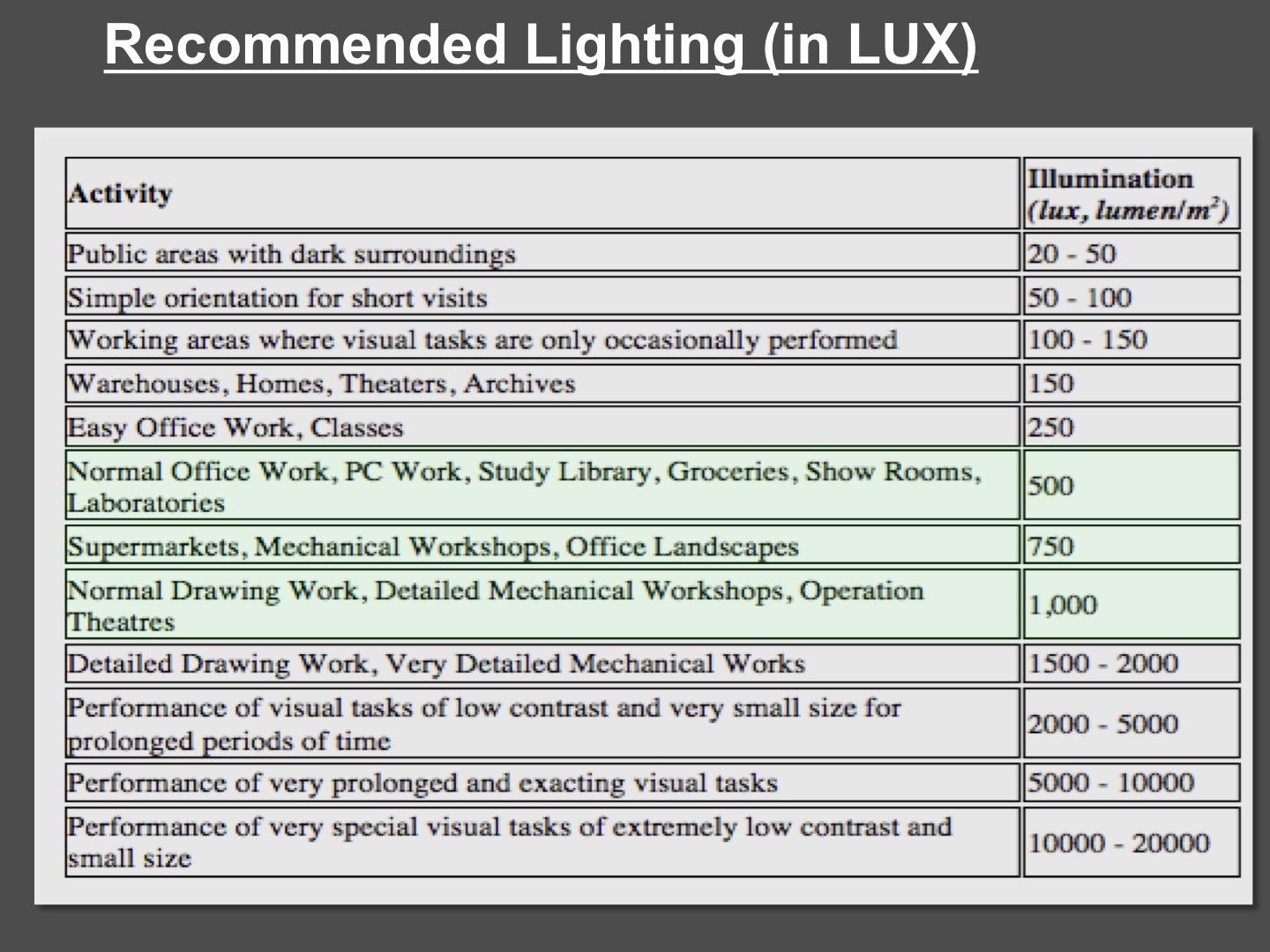
- Illumination Table.jpg (362.52 KiB) Viewed 2459 times
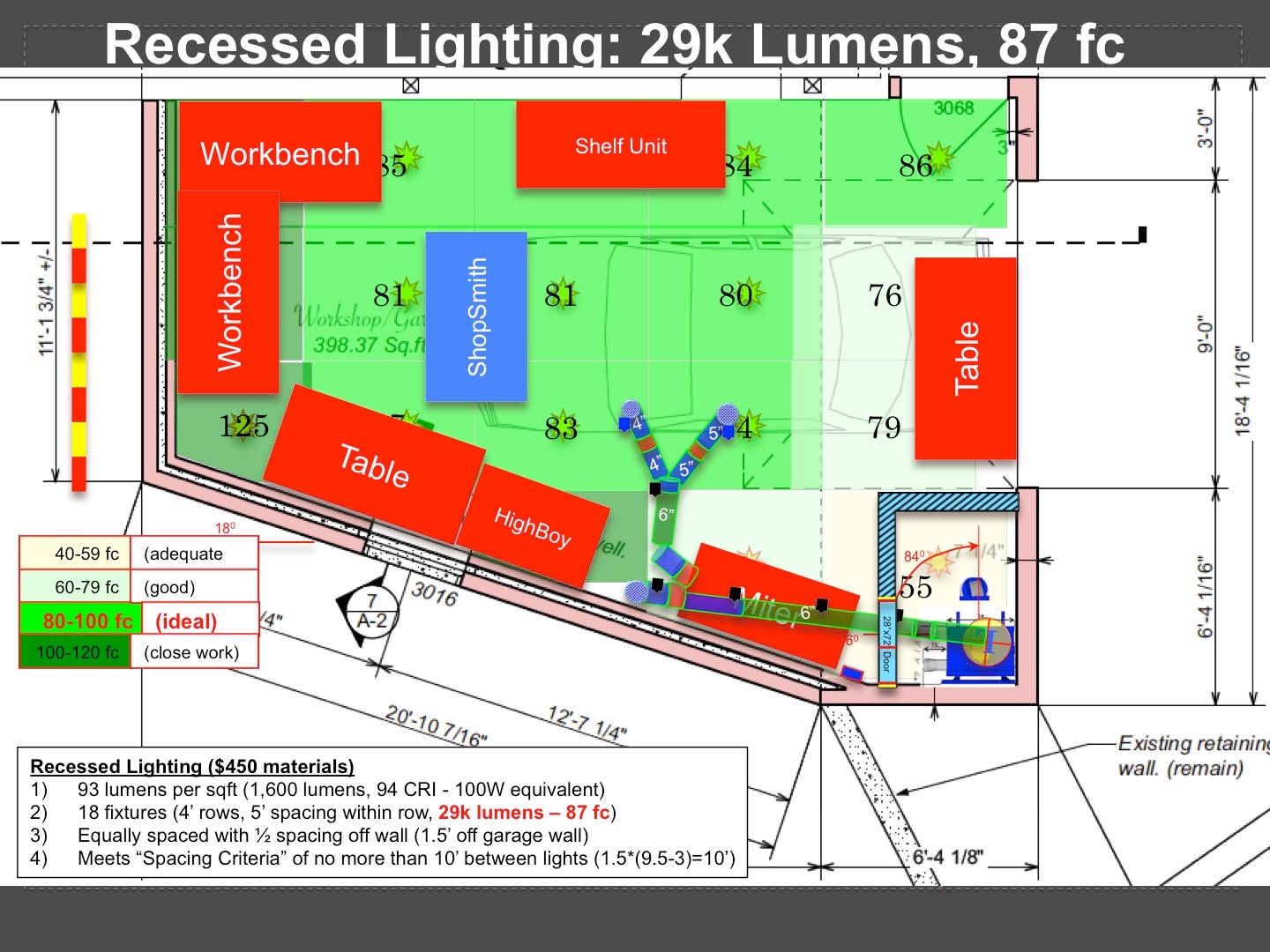
- Shop Lighting and Layout.jpg (394.14 KiB) Viewed 2459 times
Re: Improving lighting
Posted: Tue Dec 14, 2021 10:41 am
by Ed in Tampa
algale wrote: Mon Dec 13, 2021 3:40 pm
This is a super timely post as I'm looking to replace my old, buzzing, flickering, dim, fluorescent fixtures for replacement. I don't feel like modifying the old fixtures. Is there a LED direct replacement bulb if the ballast is questionable bad? Or am I better off just buying the new LED fixtures?
If you want to get rid of the buzzing you only have two options, since it the ballast that is buzzing. Your options are remove the ballast from the circuit or get new fixtures.
As I mentioned the removal of the ballast is very very easy. Turn of the light. Disconnect the ballast, you can remove it (usually only one screw) or just let it there, slide off the tombstones and all associated wiring, install new tombstones, make the connection specified in the instructions, button up the fixtures, install tubes, turn the power back on. Replacing the fixtures is going to require all most the same electrical work, if that is effecting your decision.
To replace the fixture you turn off power disconnect the lamp which is the same as disconnecting the ballast, remove the fasteners that hold fixture to ceiling, get new fixture install fasteners and reconnect the electric to lamp, and restore power.