Page 13 of 13
Posted: Tue Jun 22, 2010 2:49 pm
by hohenfelsjoe
Here we go. I wiped it down as best I could. I did not want to scrape but I think I might be through the copper in a couple spots.


and

Posted: Tue Jun 22, 2010 3:04 pm
by mickyd
hohenfelsjoe wrote:Here we go. I wiped it down as best I could. I did not want to scrape but I think I might be through the copper in a couple spots. ....
Or you've come across a type of
copper that rusts....

Posted: Fri Feb 25, 2011 3:19 am
by russsaw
I have a question. Will the bubbling stop when the Electrolysis is complete and there is no rust left on the tool?
Posted: Fri Feb 25, 2011 12:21 pm
by hohenfelsjoe
I usually wait 24 hours and shut it down and inspect. I never had all the bubbling stop.
Posted: Fri Feb 25, 2011 4:28 pm
by JPG
hohenfelsjoe wrote:I usually wait 24 hours and shut it down and inspect. I never had all the bubbling stop.
If you put two electrodes into a container of 'ionized'(by way of the washing soda) water and connect a dc electrical current, the water will break down into hydrogen and oxygen. IIRC, hydrogen at the cathode(-) and oxygen at the anode(+).
That occurs independent of whether either electrode is rusty.
However in our realm of interest, the use of rusty cathodes and iron anodes introduces the additional reaction that results in removal of the rust from the cathode and depletion of iron from the anode. When all the rust has been 'removed' that reaction essentially stops. The breaking down of the water into hydrogen and oxygen will continue(making bubbles!).
If you remove the accumulation of sludge during all this, the diminished/ending of the creation of the sludge is an indicator the rust be gone. The foam becomes white, rather than rust colored.
The main point is, that the base metal of the cathode is not eaten away by excessive time in the 'pot'! This is a good attribute shared also by Evaporust!
P.S. The simultaneous creation of hydrogen and oxygen is the reason this is best done 'outdoors'!
Re: Electrolysis Power Source
Posted: Wed Oct 24, 2018 3:33 pm
by larkesm
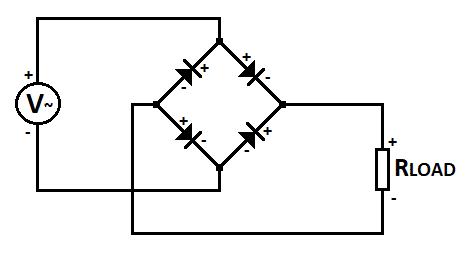
The full wave rectifier looks like this
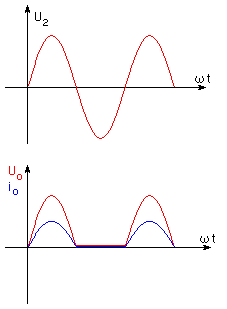
The half wave bridge rectifier give the results like this
The rest of rectifier diode and rectifier circuits comes from here
https://911electronic.com/rectifier-diode/
Re: Electrolysis Power Source
Posted: Wed Oct 24, 2018 7:52 pm
by JPG
The circuit is of a full wave rectifier.
The second waveform is half wave.
Illustrative if it were accurate, but it is not germane to the thread.