Page 3 of 4
Re: Problem Ripping a Groove
Posted: Fri May 15, 2015 3:56 pm
by benush26
Okay, my thought process started with Dennis's harmonics and WHY "just at the top". Then I looked more closely and I believe it has more to do with the grain where THAT specific cut is being made. It would answer why not all the cuts "wobbled", if you look at that grain, it would naturally try to force the blade to follow it (hence the harmonic distortion appearance) but only for a short distance which would start with the in cut and end with the out cut.
So I say it was the wood grain.
OR
He could try some new soul music while ripping his groove (yup I'm back in the 60s)

to see if that would straighten it out.
Be well,
Ben
Re: Problem Ripping a Groove
Posted: Fri May 15, 2015 4:09 pm
by rcplaneguy
If a blade was wobbling that much due to harmonics it would be dangerous!
Re: Problem Ripping a Groove
Posted: Fri May 15, 2015 4:26 pm
by JPG
I think it would be a good idea to look for a(or more) loose tooth.
Re: Problem Ripping a Groove
Posted: Fri May 15, 2015 7:40 pm
by charlese
I have a new and better theory about the grooves on the board to the right.
Theory: The sides of the board (workpiece) were not square with the bottom. Pressure against the fence tilted the board giving the sloped grooves.
Re: Problem Ripping a Groove
Posted: Fri May 15, 2015 8:45 pm
by reible
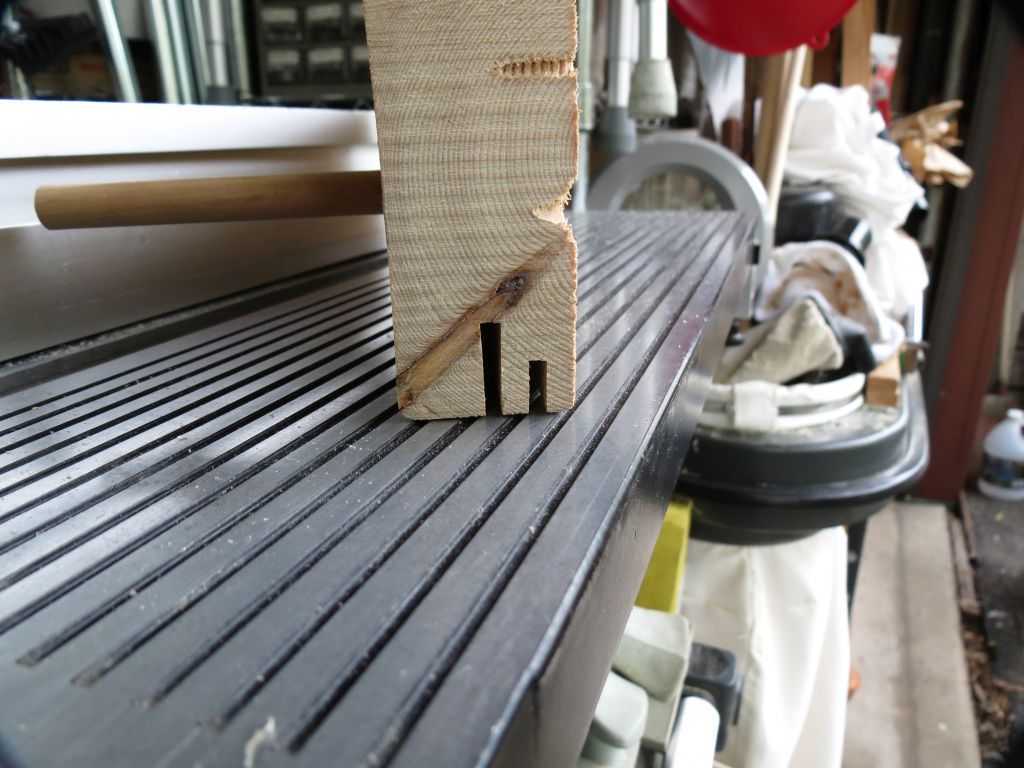
Look, my cuts look the same way. As in I can reproduce the same issue. As I expected in is just plain as the nose on your face.
BTW both cuts have the same issue but it is very difficult to see on the short cut. I would expect if I cut even deeper it would be even more obvious but I'm done with this little experiment.
- IMG_6915sc.jpg (131.2 KiB) Viewed 2719 times
Ed
Re: Problem Ripping a Groove
Posted: Fri May 15, 2015 9:43 pm
by BuckeyeDennis
reible wrote:Look, my cuts look the same way. As in I can reproduce the same issue. As I expected in is just plain as the nose on your face.
BTW both cuts have the same issue but it is very difficult to see on the short cut. I would expect if I cut even deeper it would be even more obvious but I'm done with this little experiment.
IMG_6915sc.jpg
Ed
Similar, but not quite the same. On your deep slot, the corners of the cut are square, not rounded.
Having experienced this hands-on, do you think that the workpiece tilted, or do you think that the blade deflected?
Re: Problem Ripping a Groove
Posted: Fri May 15, 2015 10:14 pm
by BuckeyeDennis
benush26 wrote:Okay, my thought process started with Dennis's harmonics and WHY "just at the top". Then I looked more closely and I believe it has more to do with the grain where THAT specific cut is being made. It would answer why not all the cuts "wobbled", if you look at that grain, it would naturally try to force the blade to follow it (hence the harmonic distortion appearance) but only for a short distance which would start with the in cut and end with the out cut.
So I say it was the wood grain.
OR
He could try some new soul music while ripping his groove (yup I'm back in the 60s)
to see if that would straighten it out.
Be well,
Ben
Actually, Bill V first advanced that theory, but he used the terms "oscillation" and "wobble". I merely agreed with him, and substituted some engineering jargon.
Trying to gain a better understanding, I spent some time quality time with Google today. I learned that there are many complex dynamics involved in circular sawing, but found no concrete examples of such extreme blade deflections. But the most common term for this type of blade misbehavior seems to be "flutter". Google "table saw blade flutter" and you'll find a number of similar posts. But I found nothing definitive on cause and effect.
There were a few scholarly articles on blade dynamics in sawmills -- this is a significant economic issue because any deviation in the tooth path increases the kerf width, and thus lowers lumber yield. One paper suggested actively controlling the blade RPM so as to minimize the problem.
But to your point, grain variation certainly seems a plausible reason for why "flutter" may happen on some workpieces, but not others.
Re: Problem Ripping a Groove
Posted: Fri May 15, 2015 10:50 pm
by jsburger
algale wrote:BuckeyeDennis wrote:Here's another thought. If the problem is harmonic motion, then it will probably go away if you change your spindle speed by 10 or 20 percent. That should be enough to get the tooth frequency away from the natural frequency of that particular blade vibrational mode.
Brilliant!
Except, presumably he cut all the slots at the same speed and only one has a problem. I would still like to know which ones came first???
Re: Problem Ripping a Groove
Posted: Fri May 15, 2015 11:09 pm
by jsburger
masonsailor2 wrote:My vote is that the piece is rocking back and forth as you feed it over the blade. These types of cuts on small blocks are best done using a sled. It doesn't have to be anything exotic. Take a 6 or 8 inch wide scrap plywood and mount a board to it to allow you to clamp the piece to the sled. Then put the sled up against the fence and run it through the saw. Much more stable and infinitely safer.
Paul
But he said he used a feather board to hold it against the fence. If it is against the fence it can only wobble away from the fence not into it. Besides the cut is
PERFECTLY symmetrical like it was cut with a cutter of that profile. It would nice to see the other end of the cut to see if it was the same. How could one let a piece wobble in their hands to make that perfect cut? And again, why are the corners of the top of the cut rounded (again perfectly symmetrically) they should be square if done with a saw blade
.

Re: Problem Ripping a Groove
Posted: Fri May 15, 2015 11:17 pm
by JPG
jsburger wrote:algale wrote:BuckeyeDennis wrote:Here's another thought. If the problem is harmonic motion, then it will probably go away if you change your spindle speed by 10 or 20 percent. That should be enough to get the tooth frequency away from the natural frequency of that particular blade vibrational mode.
Brilliant!
Except, presumably he cut all the slots at the same speed and only one has a problem. I would still like to know which ones came first???
- Clipboard01.jpg (141.88 KiB) Viewed 2707 times