Page 3 of 4
Re: Lower Saw Guard Trouble
Posted: Tue Dec 15, 2015 9:31 am
by dusty
Bruce wrote:I notice you have the sliding outer guard all the way in next to the blade. That is not how you should have it set. It's more likely that the stabilizer is the culprit, but you should move the outer guard out away from the blade, but only to the point that it will not interfere with lowering the table.
Is this stated somewhere in the manual? I ask because that is how I have been setting mine for many years. I believe that dust collection is better when there is a minimal clearance between the blade and the saw guard.
Re: Lower Saw Guard Trouble
Posted: Tue Dec 15, 2015 9:50 am
by algale
I don't think the blade stabilizer is part of the problem. It would put the rest of the body of the blade further away from the left side of the lower saw guard.
Re: Lower Saw Guard Trouble
Posted: Tue Dec 15, 2015 9:56 am
by reible
dusty wrote:Bruce wrote:I notice you have the sliding outer guard all the way in next to the blade. That is not how you should have it set. It's more likely that the stabilizer is the culprit, but you should move the outer guard out away from the blade, but only to the point that it will not interfere with lowering the table.
Is this stated somewhere in the manual? I ask because that is how I have been setting mine for many years. I believe that dust collection is better when there is a minimal clearance between the blade and the saw guard.
All of my testing says that the blade guard out against the tie bar guard works the best. I close it down narrower then with the table down I slide it against the shield and lock in place. I don't believe there are instructions on this but it was such a major improvement I do the extra effort anyway. You can not leave it extended when mounting as the table will lower on it and it blocks the lowering.
BTW it is clear the bumper is there in the second photo but again it could be in the wrong place. It is also true that this part has changed over time. My 500 with the old metal guard had a different part then what is there now. Now I can't remember if it was thicker or thinner.... I still have it somewhere I'm sure. I believe the newer bumper came with new saw arbors for while.
Ed
Re: Lower Saw Guard Trouble
Posted: Tue Dec 15, 2015 10:03 am
by reible
algale wrote:I don't think the blade stabilizer is part of the problem. It would put the rest of the body of the blade further away from the left side of the lower saw guard.
This might be true but it does not belong there. The saw arbor is not designed to have the extra thickness of the stabilizer.
What ever else might be wrong the stabilizer is also wrong and we might as well get that fixed so we can see just what happens then.
My best hope is that we find the arbor is the wrong one and as soon as his is measured we will know.
Ed
Re: Lower Saw Guard Trouble
Posted: Tue Dec 15, 2015 10:42 am
by redleg
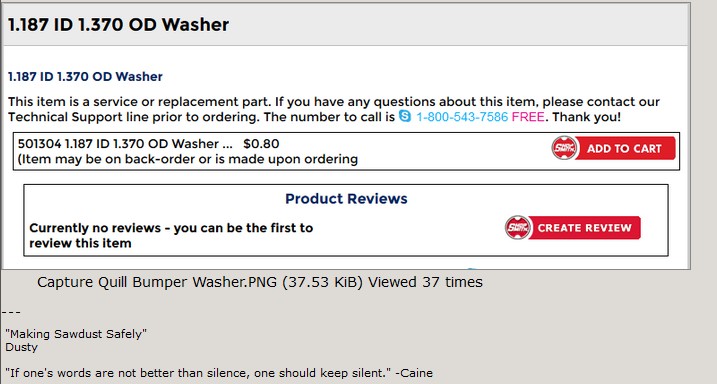
dusty wrote:Strange that you should mention that. I too have been looking at that. In the online drawings of the quill, that part (#63, Shim Washer, 501304) is missing. It also does not exist in the later PowerPro drawings.
I am not sure that this is the root cause of this problem but it seems logical.
Using Adobe Acrobat, I did a search of the new catalog for that part number (501304). It does not exist there.
Question for Malcolm. Does your quill have a rubber washer between the retaining ring and the headstock? The rubber washer on my two machines are about 1/16" thick. Without the rubber washer, my quill would retract that much further which could create your condition.
Note: Spindle Knob is pulled away for clarification (I hope).
I must caution everyone reading this. I believe I have erred on my conclusions. The retaining ring controls how far onto the quill the lower saw guard will go. The rubber gasket is on the opposite side of the retaining ring and in no way effects the lower saw guard position.
The lower saw guard gets pushed up against the outside of the retaining ring.
That was the point I was trying to make that the lower saw guard does get pushed up against the retaining ring but I have found on a couple of Shopsmiths that I purchased owners had put the Quill Bumper Ring on the wrong side of the retaining ring which moves the guard closer to the blade.
Re: Lower Saw Guard Trouble
Posted: Tue Dec 15, 2015 10:44 am
by MalcolmMor
Thanks for all the advice, guys. The washer is in place on the quill, but it seems that removing the blade stabilizer did the trick. The inner guard still seems really close to the blade, but I tried it out this morning and it is not contacting the blade while operating.
I am slightly disappointed about not being able to use the stabilizer, as the blade I am using is a Forrest Woodworker II thin-kerf. Does anyone else on here use thin-kerf blades, and if so, have they had problems with runout when not using a stabilizer? I figured with the Shopsmith's motor, thin kerf was the way to go, but not if I'm going to have excessive runout.
Re: Lower Saw Guard Trouble
Posted: Tue Dec 15, 2015 10:50 am
by Bruce
MalcolmMor wrote:I am slightly disappointed about not being able to use the stabilizer, as the blade I am using is a Forrest Woodworker II thin-kerf. Does anyone else on here use thin-kerf blades, and if so, have they had problems with runout when not using a stabilizer? I figured with the Shopsmith's motor, thin kerf was the way to go, but not if I'm going to have excessive runout.
Does your WWII have a 1 1/4 inch arbor hole? If so, SS says no stabilizer is needed, I believe. I also have a Hitachi thin kerf blade with a 5/8 hole and have not noticed a problem with it.
Re: Lower Saw Guard Trouble
Posted: Tue Dec 15, 2015 11:20 am
by dusty
Malcolm: I am pleased to hear that you have resolved your dimensional issue. I am confused as to how but that does not matter. What is confusing is that by removing the stabilizer (which I too do not believe you need) you have simply moved the inside face of the blade closer to the arbor by the thickness of the stabilizer.
Yes, the blade and the inner surface of the saw guard are very close to one another. I believe I posted a picture here of my lower guard and blade that shows that.
I too use thin kerf blades without the stabilizer and I have no evidence of excessive wobble or vibration.
Satisfy yourself by cutting a non-through kerf in a piece of hardwood and measure the width of the curve. If you have wobble (vibration) the kerf that is cut will be wider than the blade is thick.
Re: Lower Saw Guard Trouble
Posted: Tue Dec 15, 2015 11:23 am
by algale
I have used both full kerf (Forrest WWII) and thin-kerf (Shopsmith) blades. At the moment, I prefer the Shopsmith thin kerf. Shopsmith's thin-kerf's have a 1.25 inch arbor hole and use the Shopsmith 1.25 arbor. Bruce is correct that no additional stabilizer is needed with the 1.25 inch arbor because, Shopsmith says, the wider flange and nut that comes with that arbor acts as a stabilizer.
I would try the Forrest thin kerf you have on the 5/8 arbor you have and see if you like the quality of cut. If you are not satisfied with it, you could send it back to Forrest and have them re-drill it for a 1.25 inch arbor and then try the larger arbor from Shopsmith.
Re: Lower Saw Guard Trouble
Posted: Tue Dec 15, 2015 12:07 pm
by JPG
Seems kinda small for a 1 3/4" quill body.

- ScreenHunter_14 Dec. 15 11.54.jpg (63.11 KiB) Viewed 2236 times