Page 3 of 4
Re: How to Evaluate Air Flow w/o Instrumentation
Posted: Sun Jul 04, 2021 7:23 pm
by RFGuy
Just a word of caution...that $30 anemometer only goes up to 30m/s. For reference, we expect an airflow of 200CFM on one 2-1/2" port of the DC-6000/DC-3300 upgrade. The ID of 2-1/2" hose is 2-1/4" so using this area, we can calculate the airspeed to be 7243.32 fps, which is 2207.76m/s. I expect the $30 anemometer will be well over range if you get it anywhere near the inlet of the dust collector and there is a possibility that the bearings will become damaged with such a high airflow. If anyone wants to try it, I would be interested in the results, but just wanted to warn you this may damage your anemometer. This is why I splurged on the $130 one because I wanted specs that could potentially allow me to measure my dust collector as well as my HVAC, and so far it has worked well for me. For the Matthias video, he modified it to gain more resolution on the low airspeeds, not high airspeeds. In fact, I question that he can measure accurately at high air speeds. He ran a small, electric leaf blower into it and only measured like 16.88m/s at most, which doesn't seem correct (should have been much higher than that). My guess is the bearings are limiting the max RPM of the fan blade, or he has some issues with his Raspberry PI setup.
Re: How to Evaluate Air Flow w/o Instrumentation
Posted: Sun Jul 04, 2021 11:41 pm
by reible
Yes the meter I mentioned will be over range if you really get the 200cfm. It would appear the top will be 167 cfm for this unit. I have used it on a shop vac and it works for that but dust collectors have a higher cfm. It is really better for normal wind speeds below 67mph. As a minimum you will need one with about double what this one does. Sorry I didn't do the math before posting.
Ed
Re: How to Evaluate Air Flow w/o Instrumentation
Posted: Mon Jul 05, 2021 8:25 am
by dusty
If the RPM of a muffin fan, excited by the air flow created by the DC-3300 at the collection port, will provide a valid "relative" indicator - I have it.
I ordered the anemometer that reible suggested without doing any calculations and then canceled that order,
With no anemometer, there had to be another way. I feel that I must have a base line and the items shown here, items that naturally reside in my shop, will provide that base line.
Preliminary test results - 1 port open 6000rpm, two ports open 4000rpm and three ports open 2000rpm A more repeatable setup needs to be established before I rely on the numbers. These are not real numbers but rather gross estimates of what I saw. What I have done to date is all hand held application of the items shown.
Question for the Experts: Is there a
direct relationship between the fan rpm and air flow (cfm).
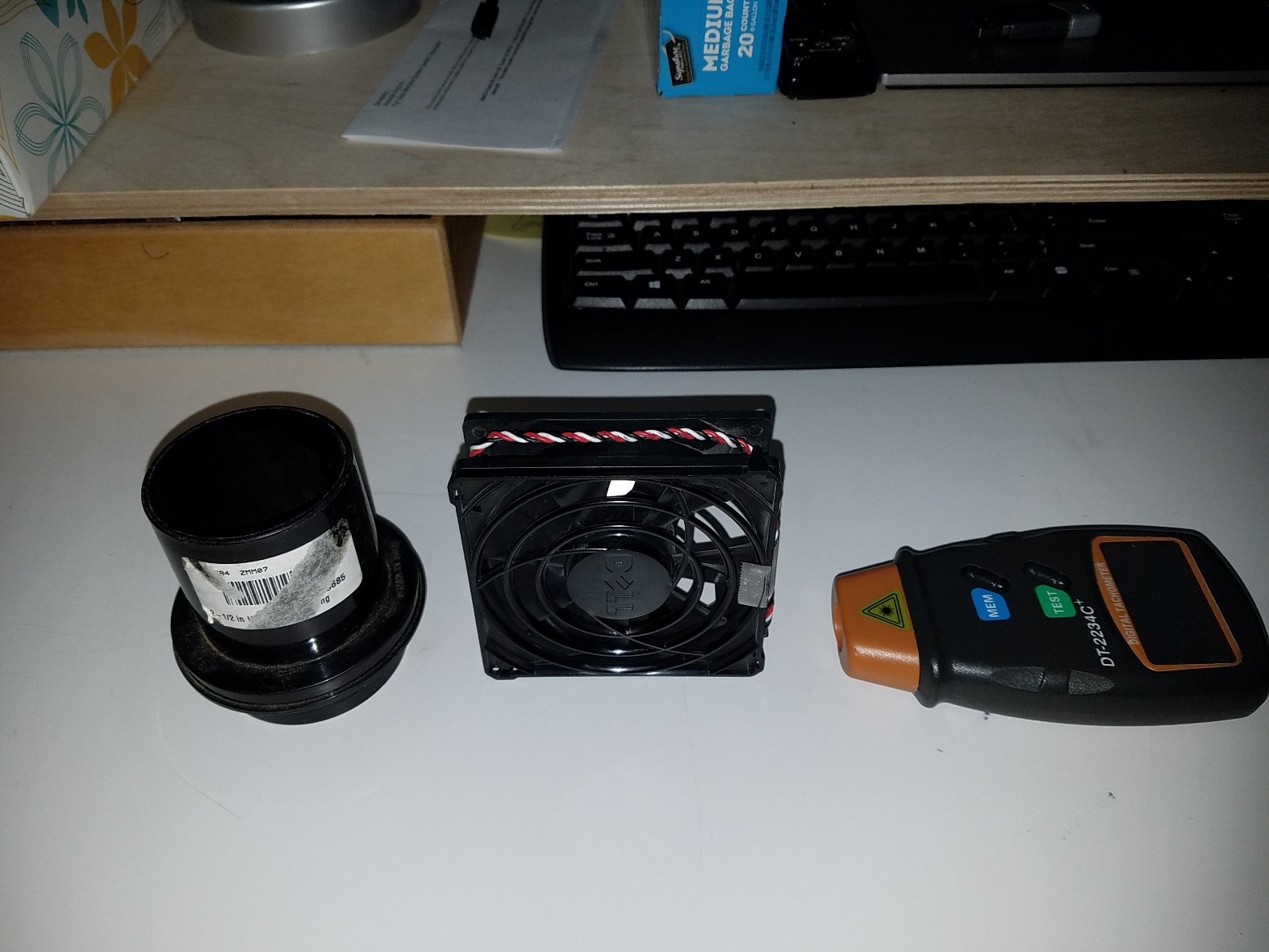
- From the Grab Bag. My Home Made Anenmometer
- 20210705_050829.jpg (204.4 KiB) Viewed 904 times

- United We Stand
- american-eagle-usa-flag (2).jpg (125.49 KiB) Viewed 904 times
Re: How to Evaluate Air Flow w/o Instrumentation
Posted: Mon Jul 05, 2021 9:52 am
by JPG
I think (ignoring losses from friction/turbulance etc.) that fan rpm is directly related to flow VELOCITY. Only when you introduce area of the flow will CFM be directly related.
I find the 6k/4k/2k 'measurements' interesting.
Re: How to Evaluate Air Flow w/o Instrumentation
Posted: Mon Jul 05, 2021 10:23 am
by dusty
JPG wrote: Mon Jul 05, 2021 9:52 am
I think (ignoring losses from friction/turbulance etc.) that fan rpm is directly related to flow VELOCITY. Only when you introduce area of the flow will CFM be directly related.
I find the 6k/4k/2k 'measurements' interesting.
Understand first that this numbers were taken with the components hand held. Repeatability is very questionable. Each time I changed the number of open points, the physical relationship of the components would change (enough to make them questionable).
All I was attempting to do is verify some level of functionality with the components I have.
That said - what do you find interesting?
Re: How to Evaluate Air Flow w/o Instrumentation
Posted: Mon Jul 05, 2021 11:01 am
by JPG
dusty wrote: Mon Jul 05, 2021 10:23 am
JPG wrote: Mon Jul 05, 2021 9:52 am
I think (ignoring losses from friction/turbulance etc.) that fan rpm is directly related to flow VELOCITY. Only when you introduce area of the flow will CFM be directly related.
I find the 6k/4k/2k 'measurements' interesting.
Understand first that this numbers were taken with the components hand held. Repeatability is very questionable. Each time I changed the number of open points, the physical relationship of the components would change (enough to make them questionable).
All I was attempting to do is verify some level of functionality with the components I have.
That said - what do you find interesting?
The values being linear. This differs from what Jim McCann said re the DC3300 1/2/3 port open(300/200/100)[IIRC***]. However the DC6000 was 200/400/600????
*** bad recollection - see post bu Algale below.
Re: How to Evaluate Air Flow w/o Instrumentation
Posted: Mon Jul 05, 2021 11:29 am
by dusty
JPG wrote: Mon Jul 05, 2021 11:01 am
dusty wrote: Mon Jul 05, 2021 10:23 am
JPG wrote: Mon Jul 05, 2021 9:52 am
I think (ignoring losses from friction/turbulance etc.) that fan rpm is directly related to flow VELOCITY. Only when you introduce area of the flow will CFM be directly related.
I find the 6k/4k/2k 'measurements' interesting.
Understand first that this numbers were taken with the components hand held. Repeatability is very questionable. Each time I changed the number of open points, the physical relationship of the components would change (enough to make them questionable).
All I was attempting to do is verify some level of functionality with the components I have.
That said - what do you find interesting?
The values being linear. This differs from what Jim McCann said re the DC3300 1/2/3 port open(300/200/100)[IIRC]. However the DC6000 was 200/400/600????
First of all...I believe that all of Jim's number are textbook theory; what the system was designed to do and not necessarily exactly what it does. My numbers are imperical rpm (not CFM) as measured by my crude setup. I won't believe my numbers until I have a device that I can move from port to port and get similar numbers. Actually, that may not happen because the physical characteristics of the three ports may not be identical. I see that variance when I sit at a single port and move the fan just a little bit.
I won't be creating any specifications or marketing documents based on these numbers. I just hope to see evidence that the $279 bought me something that I will be willing to talk about. Numbers that can be repeated when someone says "I don't believe it, show me".
Re: How to Evaluate Air Flow w/o Instrumentation
Posted: Mon Jul 05, 2021 11:35 am
by algale
JPG wrote: Mon Jul 05, 2021 11:01 am
[
The values being linear. This differs from what Jim McCann said re the DC3300 1/2/3 port open(300/200/100)[IIRC].
No, the document Dusty posted with McGann's write up said the DC3300 was 200, 150, and 100 cfm with one, two and three hoses, respectively.
Re: How to Evaluate Air Flow w/o Instrumentation
Posted: Mon Jul 05, 2021 1:44 pm
by dusty
I have a concept unit assembled and sort tested.
I tested all port combinations with 1, 2 or 3 ports open and the numbers are reasonably consistent. I don't know exactly how to interpret them yet but I have them to ponder.
I am only going to generalize the results for the moment but I will collect a complete set of numbers before I am done. I am driven to have this done with my existing DC-3300 before the upgrade kit arrives.
Here are my summary numbers.
Measuring any 1 port with 1 port open - 6700rpm......................spec'd at 200cfm
Measuring each of two ports with 2 ports open - 5500rpm.............spec'd at 150cfm
Measuring each port with 3 ports open - 4450rpm.....................spec'd at 100cfm
Notice that opening a port causes a reduction approximately 1100rpm
Re: How to Evaluate Air Flow w/o Instrumentation
Posted: Mon Jul 05, 2021 2:20 pm
by reible
When you have more then one port open then one of them is under test which should affect that port more then the others? Testing imposes restrictions to that port only, right?
Ed