Page 4 of 4
Re: Problem Ripping a Groove
Posted: Fri May 15, 2015 11:19 pm
by jsburger
reible wrote:Look, my cuts look the same way. As in I can reproduce the same issue. As I expected in is just plain as the nose on your face.
BTW both cuts have the same issue but it is very difficult to see on the short cut. I would expect if I cut even deeper it would be even more obvious but I'm done with this little experiment.
IMG_6915sc.jpg
Ed
Your cut is not even close to the OP's.
Re: Problem Ripping a Groove
Posted: Fri May 15, 2015 11:42 pm
by jsburger
JPG wrote:jsburger wrote:BuckeyeDennis wrote:Here's another thought. If the problem is harmonic motion, then it will probably go away if you change your spindle speed by 10 or 20 percent. That should be enough to get the tooth frequency away from the natural frequency of that particular blade vibrational mode.
Except, presumably he cut all the slots at the same speed and only one has a problem. I would still like to know which ones came first???
Clipboard01.jpg
Yes, I did see that after I posted. I have been on the road all day to Sacramento. BTW, snowing over Donner pass today, temp was 31 degrees on top and wet roads up and down. I would still like to see both ends of the pieces in question. I assume they look the same since the OP didn't show the other end.
Re: Problem Ripping a Groove
Posted: Fri May 15, 2015 11:53 pm
by JPG
I am guessing the problem exists at 'exit'. Although entry is possible.
Re: Problem Ripping a Groove
Posted: Fri May 15, 2015 11:54 pm
by Mike907
reible wrote:Look, my cuts look the same way. As in I can reproduce the same issue. As I expected in is just plain as the nose on your face.
BTW both cuts have the same issue but it is very difficult to see on the short cut. I would expect if I cut even deeper it would be even more obvious but I'm done with this little experiment.
IMG_6915sc.jpg
Ed
Maybe it's the picture perspective, but it looks more to me that the kerf is closing on the bottom of the deeper cut.
Mike
Re: Problem Ripping a Groove
Posted: Sat May 16, 2015 7:09 am
by robinson46176
The more I look at this thing the more I would have to rule out blade flutter as a cause of the "dovetail" look of the cut. For years I used a Shopsmith Dado cutter (still have it here somewhere) where you have legs with carbide teeth and you control the width of cut with what amounts to "wobble washers"... While it can produce a very slightly curved bottom of the dado the sides were always straight up and down as far as I could ever tell by checking the fit.
This cut is far too shallow for a 10" blade to ever deflect enough to widen the deepest part of the cut but then straighten out so quickly as to not also widen the the shallowest part of the cut (like when using wobble washer cutters).
In short, I think Reible is correct... (shrug)
Re: Problem Ripping a Groove
Posted: Sat May 16, 2015 12:50 pm
by berry
A couple have asked to see the beginning of the cut so here is a pic of the front of the piece I first posted...
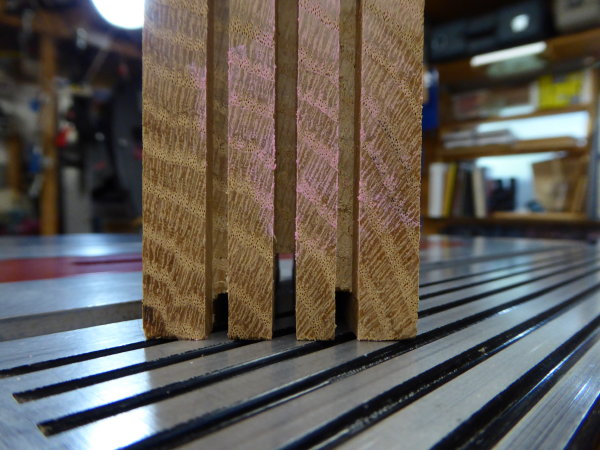
- JZ 010165.jpg (80 KiB) Viewed 2956 times
The sequence of cuts was the two shallow followed by the center, keeping the same edge to the fence for all grooves.
And just because, here's a couple pictures showing most of the parts and another detailing the corner block with the issue.
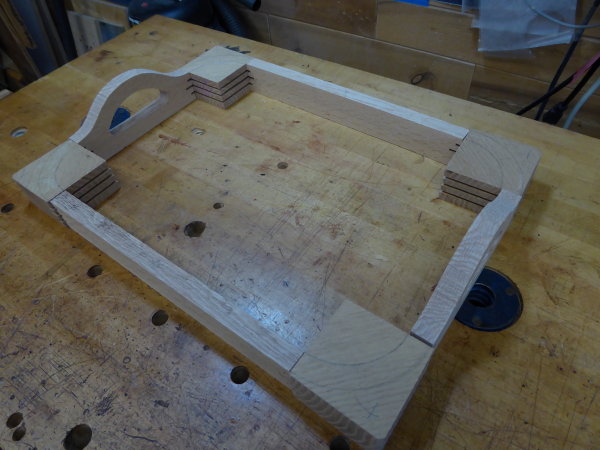
- JZ 010166.jpg (64.03 KiB) Viewed 2956 times
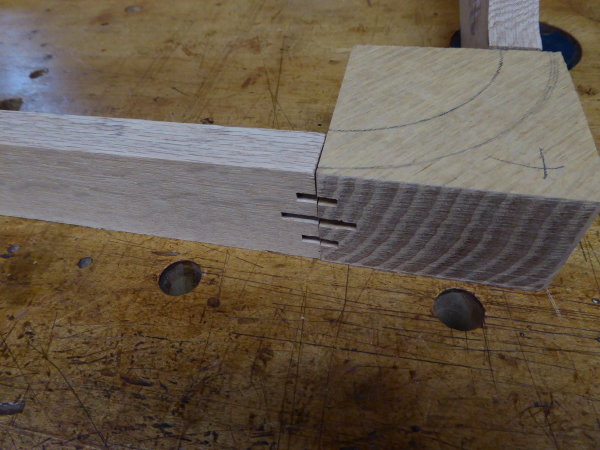
- JZ 010168.jpg (67.65 KiB) Viewed 2956 times
Thanks again for everyones comments. I guess I better be more careful.
Re: Problem Ripping a Groove
Posted: Sat May 16, 2015 1:01 pm
by JPG
I am agreeing with Ed also.
As for the different shape of the OP pix, the moving workpiece at exit could lean enough(both directions - i.e. workpiece wobbles)) to allow the side of a carbide tooth to scrape the sides of the kerf and create the keystone shape.
I say the following with a considerable degree of concern re the responses it may cause.
The wobble could have been eliminated or at least detected when it occurred IF the workpiece had been hand held. Granted that is risky behavior, but so be it. When one understands risk and accounts for it, harm is minimized if not totally prevented. Nothing is totally fail-safe, so we do take risk all the time.
Re: Problem Ripping a Groove
Posted: Sun May 17, 2015 12:17 pm
by masonsailor2
Well JPG you are correct about the responses and i will have to disagree with you on this one. Yes there are times in life we take risks but in this instance there is no reason to risk the digits. Not when a simple jig will eliminate the risk. Milling small pieces on a table saw is not a place for hand feeding. Even with push sticks and feather boards you run the risk of the flying missile in the shop. We have all had that one. Not necessarily a high risk but the piece of wood is ruined. An extra 10 minutes making a very simple jig completely eliminates the risk and also gives consistent results in the workpieces !
Paul
Re: Problem Ripping a Groove
Posted: Sun May 17, 2015 12:45 pm
by JPG
I totally agree with your response in principle, but that workpiece although 'small' is large enough to be held without placing digits in jeopardy. Since the pressure need be applied towards both the table and fence, the upper outer corner is well away from the blade.
The thing to keep in mind at all times is, where is the blade and where will it exit the workpiece.
The point I was trying to make was that push sticks, feather boards etc. do not provide 'good' tactile feed back.
I would suggest that push sticks and feather boards are a potential cause of flying workpieces. They press, but do not 'hold'.