Page 4 of 4
Re: Cracks in wide paneling boards
Posted: Sat Jun 18, 2016 10:59 pm
by BuckeyeDennis
moggymatt wrote:Can't tell by the one picture but watch to make sure it's not wood shake.
What's "wood shake"? I tried to Google it, but all I got were the wooden-shingle things.
As far as I know, the cutoff scrap that I used for the test piece basically just has a sideways knot, being quarter-sawn. Except the black punky part is a bit weird ... I assumed it was just rot. I positioned the larger inlay to eliminate one part of it.
The splits in the "keeper" paneling boards look very different, like the one in
this post.
Re: Cracks in wide paneling boards
Posted: Sat Jun 18, 2016 11:42 pm
by moggymatt
Wood shake is when the early wood and late wood want to separate. They used to say it was from excessive wind stress on trees but last I read they now think it's from a bacterial infection or something like that. The bacteria causes the growth rings to seperate.
Re: Cracks in wide paneling boards
Posted: Sun Jun 19, 2016 12:09 am
by BuckeyeDennis
moggymatt wrote:Wood shake is when the early wood and late wood want to separate. They used to say it was from excessive wind stress on trees but last I read they now think it's from a bacterial infection or something like that. The bacteria causes the growth rings to seperate.
Ah, so! I well recall my Dad once telling me that the oak trees in the part of Tennessee where I grew up had little commercial value, because they tended to be "wind-whipped", with internal cracks. Sounds like a slightly different name for the same thing.
I'm now almost certain that my Sycamore lumber had the splits before I bought it. In addition to the sawmill throwing the extra board-footage in for free, I've measured the board widths with dial calipers, and the width of the split boards is consistent to a few thou along their entire length. The splits are significantly wider, so that tells me that the splits were there before the mill straight-line edged them.
But I think Ed's butterfly-inlay suggestion will both solve the problem and add aesthetic interest. Plus, I learned a new skill, designed and built an OPR guide jig, reinvented router-inlay joinery, bought a plane-iron sharpening jig, at long last have a nicely-tuned block plane, and got almost two months older!
Re: Cracks in wide paneling boards
Posted: Sun Jun 19, 2016 12:14 pm
by charlese
BuckeyeDennis wrote:
What's "wood shake"? I tried to Google it, but all I got were the wooden-shingle things.
moggy gave you a good definition of shake and I'll add to it by giving you this web page.
https://www.google.com/?ion=1&espv=2#q= ... fect+shake
BTW what I saw in your photo was a split from severe shrinkage in stressed wood grain from a knot (overgrown limb sawn at at angle)
Re: Cracks in wide paneling boards
Posted: Sun Jun 19, 2016 12:41 pm
by charlese
moggymatt wrote:Wood shake is when the early wood and late wood want to separate. They used to say it was from excessive wind stress on trees but last I read they now think it's from a bacterial infection or something like that. The bacteria causes the growth rings to separate.
Back in the old days we found lots of shake in Western larch trees. Much of the shake was filled by Laricifomes officinalis. (brown crumbly rot) This fungus gave a wide mycelial felt of the fungus in the separation. The felt pads,sometimes over a 1/4" thick, were removed from the tree (log) were kept by sawyers and other loggers and used as excellent bandages for wounds. The reason they (felts) were so effective is because they were very absorptive. We also thought they contained quinine. (now disproved)
The fruiting body of that fungus are called quinine conks. We collected them and sold them to a dealer who then sold them to medical community. Some days with 3 or so big conks we could get $25 bucks for them. Real good money in those days!!!!
P.S/ I was surprised when I now read that neither the conks nor the felts contain quinine. Wonder why those guys paid so much for those conks

PP.SS: Shake is a defect in logs and when scaled at a sawmill all defects are not counted in the amount of wood. So a mill doesn't pay for shake, but sometimes they go ahead an saw it up and put it into boards. This is something to look for when buying lumber.

Re: Cracks in wide paneling boards
Posted: Sat Oct 28, 2017 8:14 am
by KetchikanFungus
Morning: I am searching for more information about Laricifomes officinalis being used as a logger's bandage. The Hood Museum of Art has a pouch made in Ketchikan, Alaska in 1903 which is made from L. officinalis felt from a larch.
Does anyone have more examples of how this felt was used?
Thanks for any help you can give me.
Deb
deborah.t.haynes@dartmouth.edu
Re: Cracks in wide paneling boards
Posted: Sat Oct 28, 2017 8:53 am
by algale
KetchikanFungus wrote:Morning: I am searching for more information about Laricifomes officinalis being used as a logger's bandage. The Hood Museum of Art has a pouch made in Ketchikan, Alaska in 1903 which is made from L. officinalis felt from a larch.
Does anyone have more examples of how this felt was used?
Thanks for any help you can give me.
Deb
deborah.t.haynes@dartmouth.edu
Deb,
I can't help with your specific question, but I wanted to say "hi" because I am a Dartmouth '86 and did my work-study as an Exhibitions Assistant at the Hood Museum (back when it was still basically in the Hopkins Center), helping to set up and take down exhibits and also learned how to matt and frame there.
Hope you get an answer to your question.
Alan
Re: Cracks in wide paneling boards
Posted: Sat Oct 28, 2017 1:36 pm
by Hobbyman2
KetchikanFungus wrote:Morning: I am searching for more information about Laricifomes officinalis being used as a logger's bandage. The Hood Museum of Art has a pouch made in Ketchikan, Alaska in 1903 which is made from L. officinalis felt from a larch.
Does anyone have more examples of how this felt was used?
Thanks for any help you can give me.
Deb
deborah.t.haynes@dartmouth.edu
============================================
You refer to a conk this may help .
https://en.wikipedia.org/wiki/Laricifomes_officinalis
KetchikanFungus is a different thing all together
Re: Cracks in wide paneling boards
Posted: Sun Oct 29, 2017 7:24 am
by KetchikanFungus
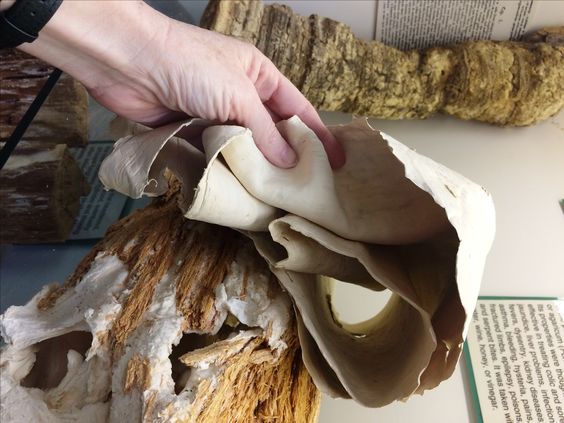
- L.Officinalis
- ad38fcc4fccced486be0f0e909b847cf.jpg (46.74 KiB) Viewed 11165 times
The conk of L. Officinalis, depicted in the Wikipedia reference, is the visible fruiting body. The mycelium felt, however, is only visible if you peel the rotting wood away from the tree. This interior felt is what the fungus bag is made from.
Re: Cracks in wide paneling boards
Posted: Mon Oct 30, 2017 6:38 am
by Hobbyman2
Neat ,,I learn something every day.