Page 5 of 5
Posted: Tue May 11, 2010 5:06 pm
by robinson46176
JPG40504 wrote:WHAT is a double board?????

I have a mental picture (I think)

Maybe more of a guess. I'm pretty sure it is an Aussie / New Zealand term. Google was no help.
I suspect that it is where a 250' line shaft would maybe be split into shorter lengths due to the likely elevation change surely required in a 250' rough building. A double joist might occur at each elevation change??
Another possibility would be that it refers to the "board" where the shear drive units are mounted and maybe a "double board" means a set of drive units mounted on boards on both sides of the building???
--------------------
Back when I was a kid a fellow would come to shear the sheep each year and he used a small electric motor driven shear drive mounted on a little trailer behind his old car. He would flop the sheep up on the trailer and shear it. His unit was one of those gear drive jointed shaft units. He was terrible at it and when he would leave the sheep were all splotched with blood from all of the nicks. He was cheap and about the only one shearing in the area. He kept his cost down by not wasting a lot of money on bathing.

The sheep used to complain about his smell...

When Diana and I raised sheep some years back (about 80 ewes + lambs) the shearers we hired were much better at it and even smelled OK.
------------------------
I intended to mention another flexible shaft factor to consider. Rotation... Most flexible shafts are made to carry a load in one direction. The "innards" normally try to get smaller (tighter) under load. If you turn it backward to what it was made for the innards will try to unwind under load...
Posted: Tue May 11, 2010 5:35 pm
by JPG
robinson46176 wrote:I have a mental picture (I think)
Maybe more of a guess. I'm pretty sure it is an Aussie / New Zealand term. Google was no help.
I suspect that it is where a 250' line shaft would maybe be split into shorter lengths due to the likely elevation change surely required in a 250' rough building. A double joist might occur at each elevation change??
Another possibility would be that it refers to the "board" where the shear drive units are mounted and maybe a "double board" means a set of drive units mounted on boards on both sides of the building???
--------------------
Back when I was a kid a fellow would come to shear the sheep each year and he used a small electric motor driven shear drive mounted on a little trailer behind his old car. He would flop the sheep up on the trailer and shear it. His unit was one of those gear drive jointed shaft units. He was terrible at it and when he would leave the sheep were all splotched with blood from all of the nicks. He was cheap and about the only one shearing in the area. He kept his cost down by not wasting a lot of money on bathing.
The sheep used to complain about his smell...
When Diana and I raised sheep some years back (about 80 ewes + lambs) the shearers we hired were much better at it and even smelled OK.
------------------------
I intended to mention another flexible shaft factor to consider. Rotation... Most flexible shafts are made to carry a load in one direction. The "innards" normally try to get smaller (tighter) under load. If you turn it backward to what it was made for the innards will try to unwind under load...
I rescanned the tool forum thread, and believe a 'board' refers to the area where the sheep are sheared. Thus a double board house has shearing 'stations' on two sides. Station is not to be construed as a reference to their 'ranches'!]origin[/B] of the term describing the shearing 'area').
Re: Flexible shaft
Posted: Fri Sep 21, 2018 11:09 am
by tucsonguy
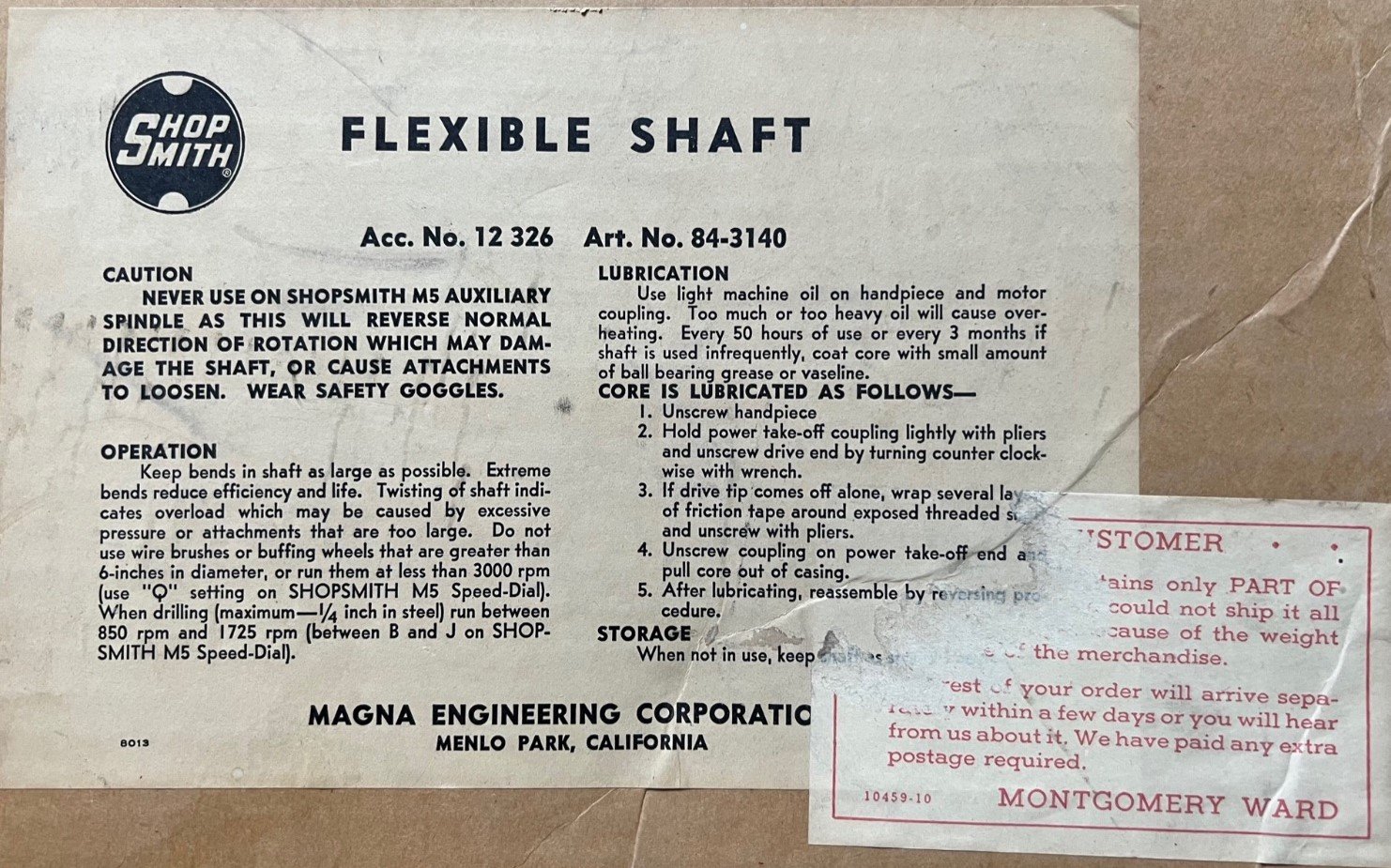
I purchased a flexible shaft off ebay, seems to work just fine. Lets not get into 'safety' issues - the flexible shaft is as safe as any other woodworking tool, and isn't designed for high speed applications (I will use it mostly for sanding with the drum sander attachment)… my question is maintenance. Does anybody have the instruction manual? I see there is a spot oiler point (I think, there is a ball detent), and I'm wondering if I should strip it down for maintenance and inspection and would love more information from anyone who might have done this. You just don't know what the condition is of a tool purchased off ebay….
Re: Flexible shaft lubrication
Posted: Tue May 28, 2024 3:10 pm
by hkp7fan
My question is also on lubrication. Too bad this six-year-old question was never answered in this thread. I have my grandfather's 1950's vintage flexible shaft (still has the Montgomery Ward price tag attached - $10.50!). I also have his 1955 Montgomery Ward tool catalog that includes the Shopsmith.
What I don't have are any instructions on maintenance/lubrication of the shaft. It started to bind up just now after about an hour of use (cumulative). First time I ever used it, so I suspect it needs lubrication.
I'll keep looking, but if anyone sees this thread and has an answer, please help. Thanks!
Re: Flexible shaft
Posted: Tue May 28, 2024 5:47 pm
by JPG
Look for a 'bump' with a spherical raised center(top third of a ball bearing) See if the raised center can be depressed. If so put some oil in it. #10 oughta do.
Re: Flexible shaft
Posted: Wed May 29, 2024 1:34 pm
by chapmanruss
Below are the only instructions I have for the Shopsmith Flexible Shaft. They came attached to the box.
_
- 12 326 84-3140 Flexable Shaft Instructions.jpeg (371.89 KiB) Viewed 19444 times
.
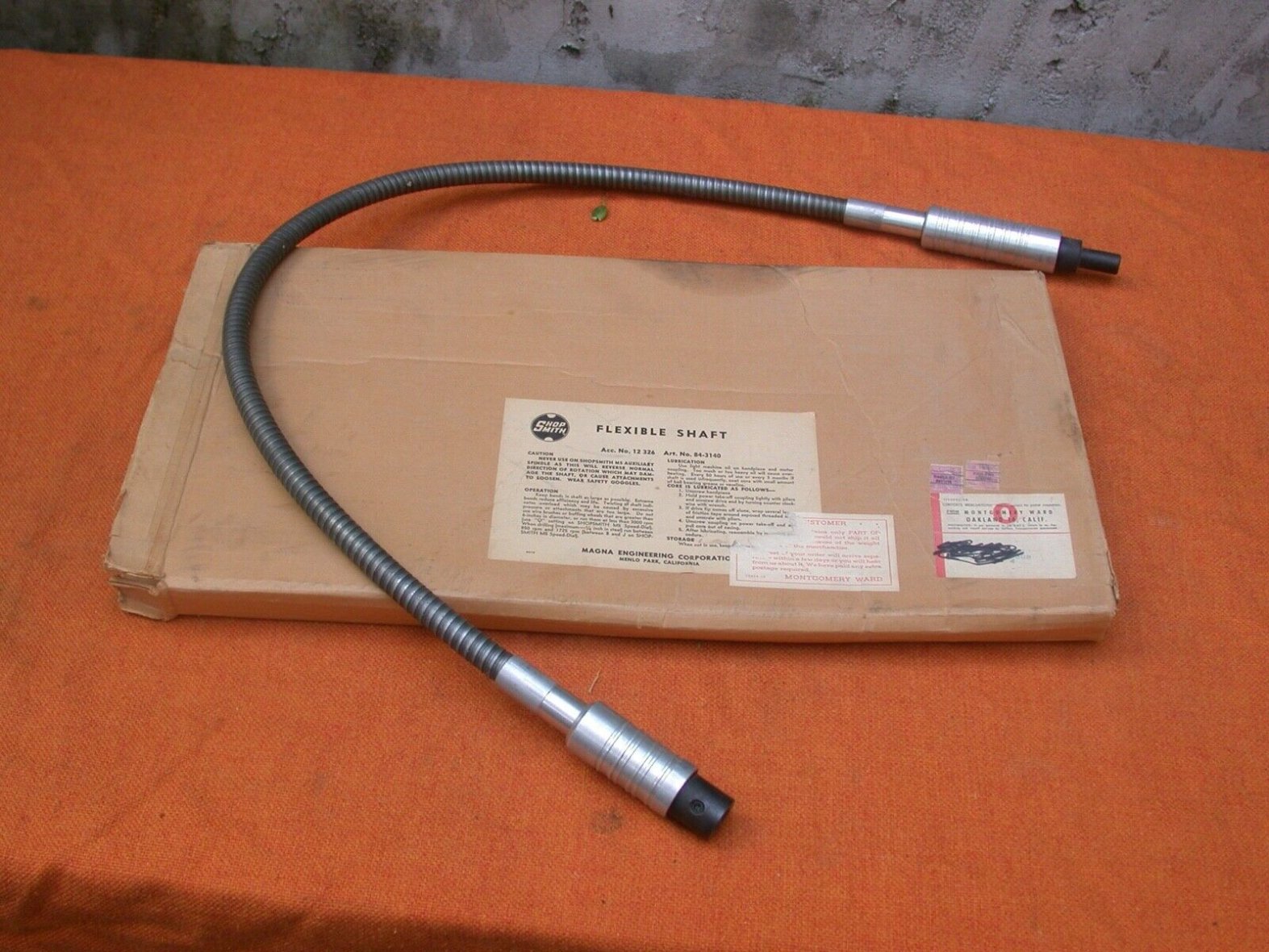
Below is a picture of the Shopsmith Flexable Shaft on that box for reference.
_
- 12 326 Flexible Shaft w- box.jpg (308.3 KiB) Viewed 19444 times
.
Do take note of the additional core lubrication not mentioned by JPG. Also check that your Flexible Shaft is the Shopsmith one as pictured above. There were other Flexible Shafts made by other companies that differ from the Shopsmith one having a threaded shaft end to attach items to while the Shopsmith Flexible Shaft has the same end as the spindle. These Flexible Shafts made by other companies generally had a 1/2" bore and required the Shopsmith Flexible Shaft Adapter show in the picture on the 1st page of this topic.
