Page 6 of 7
Re: Preping for the Double Tilt
Posted: Sat May 14, 2016 3:04 pm
by dusty
I have yet to do a complete alignment and I have not yet changed out the Table Legs for the new ones but I did a cursory check of alignments. I did blade to miter track and it was within .003". I checked alignment of one Extension Table on the right hand side and it was close enough (close enough for Government work) that I would not normally mess with changing anything. I moved the Extension Table to the left hand side, moved the headstock and carriage as far left as possible and checked Extension Table against the Main Table. The outfeed/right corner was about 1/16" low. Good enough for what I would normally use that configuration for. Good enough that I am here to tell the world that the work I did over the past three days and the money I spent for the Double Tilt Upgrade was well worth every penny AND I have not done anything yet to make use of the double tilt feature. Just tightening up the table alignments made my day.
Re: Preping for the Double Tilt
Posted: Sat May 14, 2016 3:31 pm
by algale
Congrats! Very happy for your success. I hope there will be a subsequent post or posts with more documentation of the final results.
Re: Preping for the Double Tilt
Posted: Sat May 14, 2016 5:19 pm
by dusty
I will comment on the results of the alignment procedure when I do it but for right now I have done what alignment I intend to do. It is as good, right now, as my machine is normally. What is interesting to me is that I got these results after tearing the old machine down into its many parts and then putting at all back together.
It believe that this says a lot for what the Base and Pivot Arm Assemblies work together. It is my contention that the Ways Tubes are in perfect alignment due to the new Pivot Arms.
My machine was finely tuned before but I expect a lot less tweaking, in the future, to keep it that way.
In all fairness, it is important for me to point out that I use my Mark V primarily as a table saw and permanent residence for my jointer.
The Shorty provides for the sanding tasks and the drill press. All my band saw work is done on a stand alone Power Stand.
For anyone that might be interested, the documentation that comes with the kit is available online. It is a well written package and should be reviewed by anyone who is thinking about the Double Tilt upgrade. It is truly an UPGRADE.
Re: Preping for the Double Tilt
Posted: Sat May 14, 2016 7:08 pm
by robinson46176
I'm a little surprised that it had never occurred to me to use the double diagonal measurement when aligning a Shopsmith, I have used it hundreds of times on other stuff like concrete forms etc. I also have often used the "6-8-10" (or 3-4-5 or what ever other combination you like to square with). On my SS's I just used a big square with the long leg along the way-tube and the short leg across the post of an extension table stuck in the mounts. I've not seen any problems but then I don't use an SS as a table saw a lot and I do make regular use of a hatchet when roughing in on a few things.


SHHHHHH... I also use a chain saw sometimes


and I have been known to make re-saw cuts with a sawmill.
I have a broad-ax, a broad hatchet, a foot adze and a hand adze or two and I'm not afraid to use them...

Well, I am a little afraid of that foot adze.
My father always said they called them a foot adze because that was what you would eventually end up chopping into if you used one long enough.
.
Re: Preping for the Double Tilt
Posted: Sat May 14, 2016 9:01 pm
by JPG
As a workaround for measuring the diagonals(verifying squareness) -
Mount the main table. We assume the miter slot(s) are 'normal' to the bench tubes.
Mount the aux table at either end.
Measure the straight line distance from the aux table to the end of the miter slot at both front and rear of the main table. If not equal, this is a waste of time.(or at least the tables are not 'parallel').
Move the aux table to the opposite end.
Again measure the the straight line distance from the aux table the the end of the miter slot at both the front and rear of the main table. If not equal, the base is not square.
Essentially verifying the table will be consistent on both ends(the main goal to begin with).
Re: Measuring the Tables for Squareness
Posted: Sun May 15, 2016 6:41 am
by dusty
At first I did not understand what you were advocating. Then I set out to show how I would do it my way only to realize that you are doing the same thing but with different reference points.
My way: Left hand Extension Table offset from the Main Table (centered between Extension Table Locations). The dotted diagonals are the reference lines.
The short coming with this is that measuring at this level only tells you that the tables are square to one another. If the measurements are different, where do you start to fix that problem.
This is why I was so pleased when I had just the Way Tubes and Bases installed. That measure confirmed that the base was square. Now build up from there.
Re: Preping for the Double Tilt
Posted: Sun May 15, 2016 8:58 am
by dusty
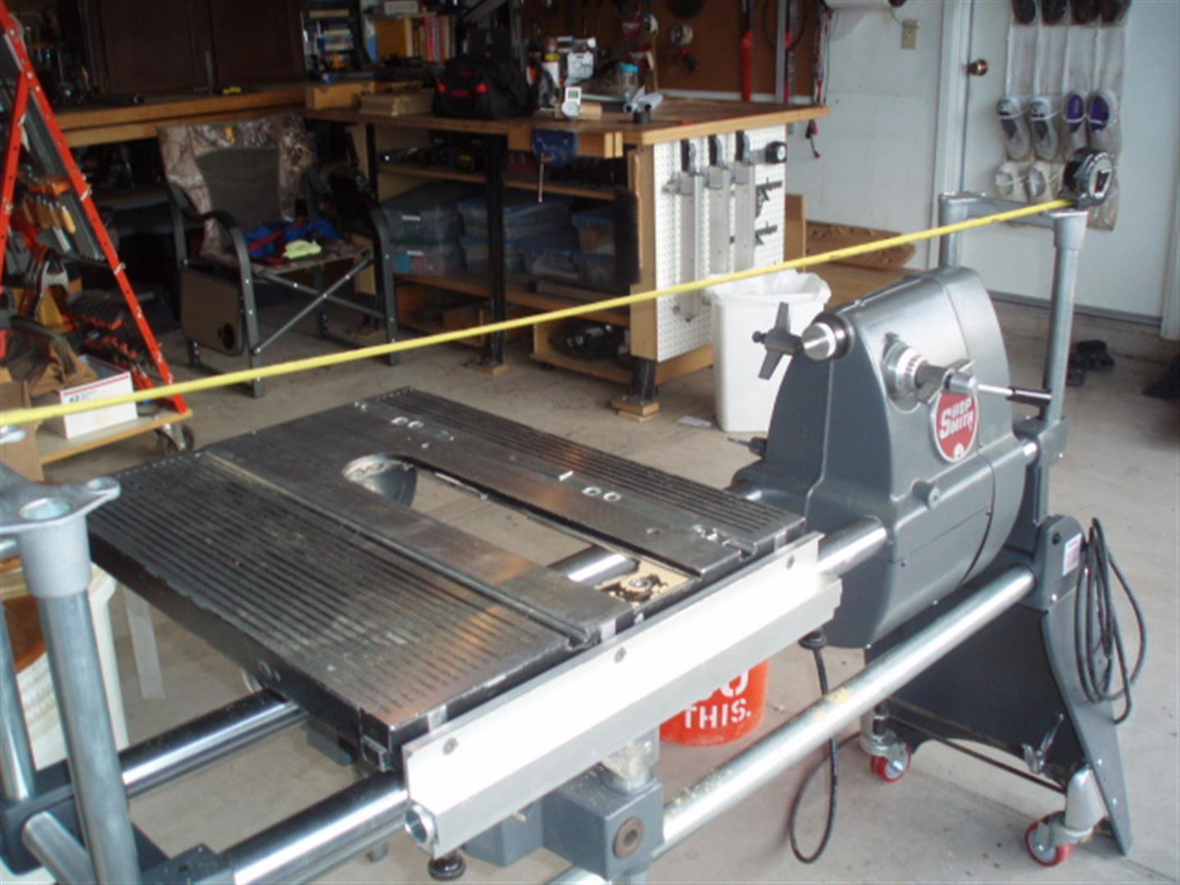
- Diagonals 004 (Large).JPG (840.68 KiB) Viewed 2469 times
Here is another way to judge the squareness of the Bases and the Way Tubes. The Extension Table risers introduce still another variable, however.
Measured this way, I get 53 3/4" vs 53 11/16".
Do not compare these numbers with those previously reported. Recall that I had to relocate the Pivot Arms at final assembly. Relative squareness, however, is still comparable.
I now regret that I did not permanently record all of these same measurements on the original configuration. I made measurements but did not log my observations. This is not the way I was trained. There should be a log book that tells it all.
An addendum: I found my story board (made using two wooden yardsticks) to make this measurement. The yard stick storyboard (cheap at Lowes) is a better device for this sort of measurement than the tape measure. Again, I got slightly different numbers but still equals (indicating degree squareness).
Re: Preping for the Double Tilt
Posted: Sun May 15, 2016 12:14 pm
by JPG
How would you have 'fixed' the differing diagonal distance before adding the carriage and headstock?
Only thing 'new' is they are an obstacle in measuring the diagonals.
In a way, measuring with a single table compensates for much and uses that which actually matters(the same table at either end).
One thing I did not make clear was to use the same miter slot side when measuring both sides. i.e. the center reference points are common and the carriage is not moved. Also the same points on the aux table are also common.
Your use of diagonals is preferable - verifies two rectangles.
Do realize the aux table tubes/base bores have some slop so the distance can be altered by slight pressure. Use the mean readings.
All this preliminary tweaking is good, but may require later tweaking when it all comes together(that is when it really matters, but preliminary tweaking will minimize that).
Re: Preping for the Double Tilt
Posted: Sun May 15, 2016 12:42 pm
by dusty
I have been making these measurements in hopes of identifying where the variables are originated. It is not with the Way Tubes and Pivot Arms or the Base Assemblies and Bench Tubes..
Re: Preping for the Double Tilt
Posted: Tue May 17, 2016 9:34 am
by dusty
Well, having said all of that, I am here to tell you that my initial tests of Extension Table interchangeability is a failure.
I very meticulously aligned two extension tables on the right hand end of the Shopsmith. I then moved them to the other end and though they did not perform exactly the same - they are both miserable failures.
Thinking that this MIGHT have something to do with the tilt of the shop floor, I spun the Mark V end for end. I won't say exactly the same because I did not pay that much attention to detail but both tables are excessively low on the outfeed side.
I say excessively low because I would not use they the way they are.
What is strange to me is the the infeed side checks out OK.
I am still convinced that this is not an equipment issue but rather a procedural thing. More to come. I have to go to rehab. I'll think about this while on the tread mill.