Page 1 of 4
Problem Ripping a Groove
Posted: Thu May 14, 2015 5:14 pm
by berry
Here are a couple pics of pieces for a serving tray I'm making. The grooves for spline joints pieces. The blade is a SS 1/8" rip blade the stock is really old oak, the cut 1/2" deep. I'm sure you can see the differences between the two cuts on the center grooves. What is happening here?
This happened on 2 of 8 cuts. The 2nd pic shows how I made the cuts.
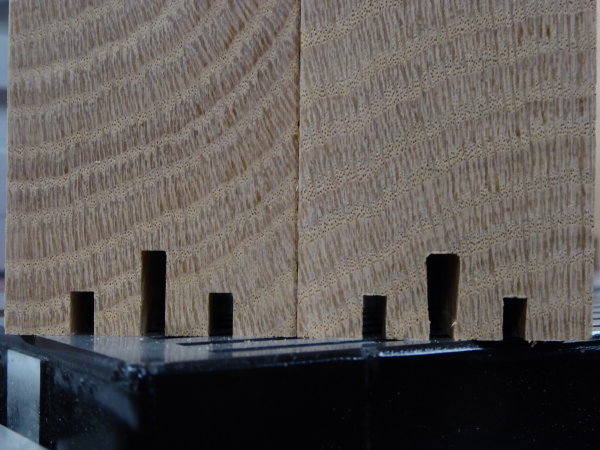
- JZ job problem0158.jpg (72.63 KiB) Viewed 3429 times
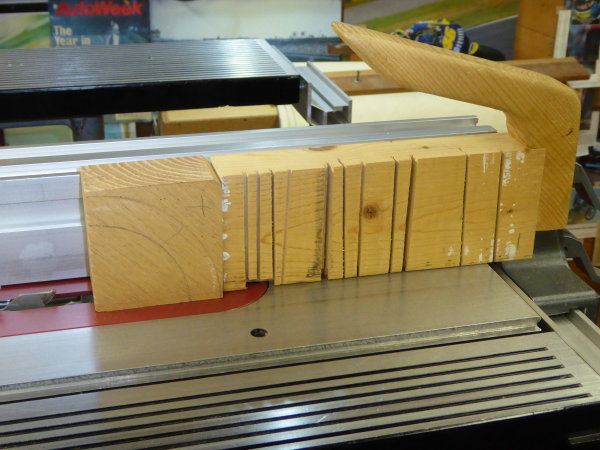
- JZ job problem161.jpg (72.59 KiB) Viewed 3429 times
Thanks for reading, I appreciate your observations/suggestions.
Re: Problem Ripping a Groove
Posted: Thu May 14, 2015 6:18 pm
by wa2crk
Berry
The rounded corners of the center groove in the picture on the right indicates that the edge of the blade may have gone into an oscillation. This condition would also serve to widen the groove somewhat like an adjustable dado blade produces a slightly rounded bottom of a dado.
Also with the center cuts being somewhat deeper than the others it may have introduced more stress at the edge of the edge of the blade and caused the wobble
I would try to cut the groove in two separate passes.
Bill V
I also noted that the bottom of the center groove in the right pic has a slight step on the wall near the face of the board. It resembles the profile of the tooth on the blade and if that is true the blade was set too deep
Re: Problem Ripping a Groove
Posted: Thu May 14, 2015 6:34 pm
by reible
I see two issues here. One is that the table insert you have would be better off with a ZCI and the second is that you need to have pressure forcing the work piece into the fence.
Root cause is the piece is moving (tilting).
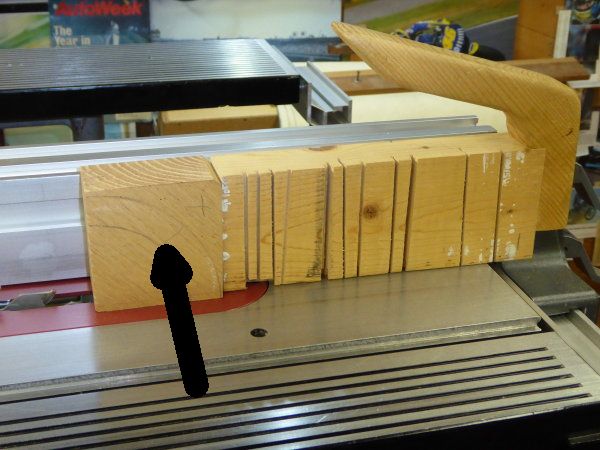
- Clipboard02.jpg (50.91 KiB) Viewed 3407 times
I might add that the block size is rather small, better to have a large piece and then cut it into pieces later.
Ed
Re: Problem Ripping a Groove
Posted: Thu May 14, 2015 7:02 pm
by JPG
My first thoughts were blade wobble caused by heat buildup, but the second pix revealed the shortness of the workpiece. If the funky one cut was the second one cut, that may be so.
However Ed's comment presented a different possibility(the workpiece was wobbling).
Likely both.
Re: Problem Ripping a Groove
Posted: Thu May 14, 2015 8:00 pm
by rcplaneguy
Dull/dirty blade requiring you to press harder on the deeper cut? Causing tipping/vibration? I see brown pitch on the carbide tip in the photo.
Re: Problem Ripping a Groove
Posted: Thu May 14, 2015 9:05 pm
by berry
I did have a single level feather board in place for the cuts. ( I took pictures after the fact and failed to put in back on the table).
Second, I cleaned the blade immediately prior to making these cuts.
Re: Problem Ripping a Groove
Posted: Thu May 14, 2015 10:45 pm
by BuckeyeDennis
I have absolutely no experience with this, but my money is on Bill V's diagnosis. If the workpiece were tipping, why are the shallow grooves nice and straight? The deformed center groove is symmetrical about a vertical axis, which is inconsistent with a tilted workpiece, but is consistent with harmonic oscillation of the blade.
What kind of blade are you using? I have a hunch that you are experiencing a (hitherto unknown to me) downside of a thin-kerf blade.
Re: Problem Ripping a Groove
Posted: Thu May 14, 2015 11:01 pm
by jsburger
BuckeyeDennis wrote:I have absolutely no experience with this, but my money is on Bill V's diagnosis. If the workpiece were tipping, why are the shallow grooves nice and straight? The deformed center groove is symmetrical about a vertical axis, which is inconsistent with a tilted workpiece, but is consistent with harmonic oscillation of the blade.
What kind of blade are you using? I have a hunch that you are experiencing a (hitherto unknown to me) downside of a thin-kerf blade.
I have never seen it either. He did say it was an 1/8" blade so it is not thin kerf. I agree with Bill V except the top of the slot is flat. I don't think it is wobbling of the work piece. If the workpiece is up against the fence (single feather board) it can tilt away from the fence but not into the fence. It is a perfectly symmetrical cut just like it was cut with a cutter designed to do that.
Suppose the arbor nut came loose for some reason and the blade wobbled? When was the cut in question made compared to the other cuts in the pics?
Re: Problem Ripping a Groove
Posted: Fri May 15, 2015 6:19 am
by tdubnik
I don't see how this could really be blade oscillation. I think if it were blade oscillation it would make the entire groove wider not just the top. How can the blade just oscillate at the top of the groove?
When cutting the blade enters the wood where the workpiece contacts the table and continues the cut to the top of the groove and then exits again where the workpiece contacts the table. So how can the blade "only" oscillate at the top of the groove?
Re: Problem Ripping a Groove
Posted: Fri May 15, 2015 7:15 am
by BuckeyeDennis
tdubnik wrote:I don't see how this could really be blade oscillation. I think if it were blade oscillation it would make the entire groove wider not just the top. How can the blade just oscillate at the top of the groove?
When cutting the blade enters the wood where the workpiece contacts the table and continues the cut to the top of the groove and then exits again where the workpiece contacts the table. So how can the blade "only" oscillate at the top of the groove?
That's a good question. One possible answer is that there was a standing wave in the saw teeth with an antinode (maximum deflection) at the top of the teeth, and a node (minimum deflection) in a line running parallel to the table slot. Strange, but harmonics can do funny things.
Another thing to consider is that we can only see the shape of the groove at the end of the workpiece, be it entry or exit. It may have a different shape in the middle, where the entire arc of the blade is in the workpiece.
But the main reason that I suspect harmonic motion is that nothing else makes sense, and harmonics do indeed do strange things.
Take a close look at the sloped sides of the "dovetail". Extrapolate those lines, and they will intersect well before they reach the center of the blade. Now imagine that they were formed by tipping the workpiece (which would have to be done in both directions). One edge of the workpiece would lift off the table a fair amount at that angle. But that would reduce the depth of cut considerably, forming an arc with its centerpoint at the edge of the workpiece that is still on the table. That's not the shape that I see.
The rounded corners at the top of the "dovetail" tell me that the saw teeth were in the proper plane when at top dead center, and deflected laterally on one or both sides of top dead center (when not reaching the top of the groove).