Page 1 of 2
If Shopsmith Is Seeking Low Cost Improvement
Posted: Sat Sep 03, 2016 8:50 am
by dusty
it could be had by simply milling the left and right edges of the Main Table to be parallel to the miter tracks.
I have been toying with table alignment methods AGAIN and I have come to a conclusion that (based on a sample of four table) that no two of them are the same. Now my tables are not all of the same vintage but I feel that that should not make a difference (except maybe for the much older tables vs the newer).
Re: If Shopsmith Is Seeking Low Cost Improvement
Posted: Sat Sep 03, 2016 9:19 am
by Ed in Tampa
dusty wrote:it could be had by simply milling the left and right edges of the Main Table to be parallel to the miter tracks.
I have been toying with table alignment methods AGAIN and I have come to a conclusion that (based on a sample of four table) that no two of them are the same. Now my tables are not all of the same vintage but I feel that that should not make a difference (except maybe for the much older tables vs the newer).
I agree that is one upgrade I would buy in a heartbeat. Having the sides milled to the miter slot would make alignment very simple. Just push table against the sanding disk and tighten. WOW!
Also I don't know but I'm guessing Shopsmith probably has an alignment jig that they use. If it could be reproduced I would buy one.
I think this is one area Shopsmith is missing a ton of business in. Who doesn't want their machine in perfect alignment and woodworkers are always willing to spend money to do that as seen by the various OEM alignment gauges and such that are on the market. Shopsmith is in a unique postion on this issue due to the way the SS is constructed.
If Shopsmith is looking for a new product to market a main table ground or with stand offs manufactured to align the table by owners would be it.. IMHO
Re: If Shopsmith Is Seeking Low Cost Improvement
Posted: Sat Sep 03, 2016 9:35 am
by BuckeyeDennis
It would be pretty easy to make a precision alignment jig. Attach a miter-slot runner to a piece of sheet material, as if you were making a crosscut sled. Cut the sheet material to overhang the left side of the table a bit. Then dress the overhanging edge with a conical sanding disk, and you're done.
With two Shopsmiths, you could even dress the side of the tables themselves, to get Dusty's precision-ground table edges. I personally did this true up the bottom of a cheap aluminum router fence. I used 50-grit paper, went slow, and it worked just fine.
Re: If Shopsmith Is Seeking Low Cost Improvement
Posted: Sat Sep 03, 2016 9:52 am
by dusty
BuckeyeDennis wrote:It would be pretty easy to make a precision alignment jig. Attach a miter-slot runner to a piece of sheet material, as if you were making a crosscut sled. Cut the sheet material to overhang the left side of the table a bit. Then dress the overhanging edge with a conical sanding disk, and you're done.
With two Shopsmiths, you could even dress the side of the tables themselves, to get Dusty's precision-ground table edges. I personally did this true up the bottom of a cheap aluminum router fence. I used 50-grit paper, went slow, and it worked just fine.
I have done sorta the same thing using the left miter track and a piece of baltic birch plywood with an affixed miter bar.
I have a Sketchup drawing somewhere. My computer filing system has really been abused lately. I can't seem to find anything.
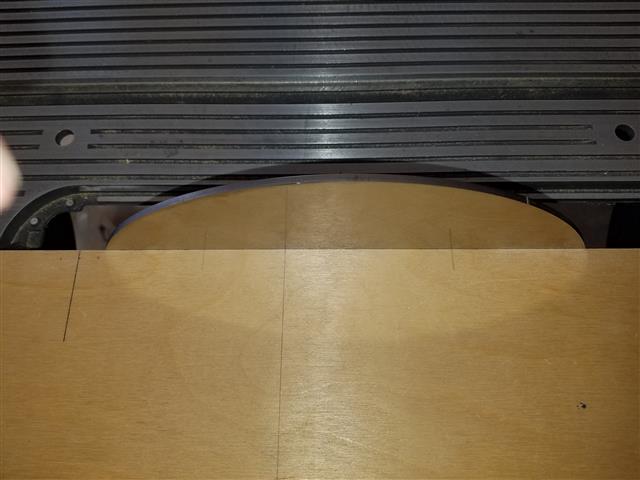
- Blade to Table Alignment Jig 003 (Small).jpg (53.14 KiB) Viewed 11005 times
When I sanded the edge I set the conical disk just a tiny bit off so as to create a cut back on the lower edge. This provides a nice crisp edge for checking alignment.
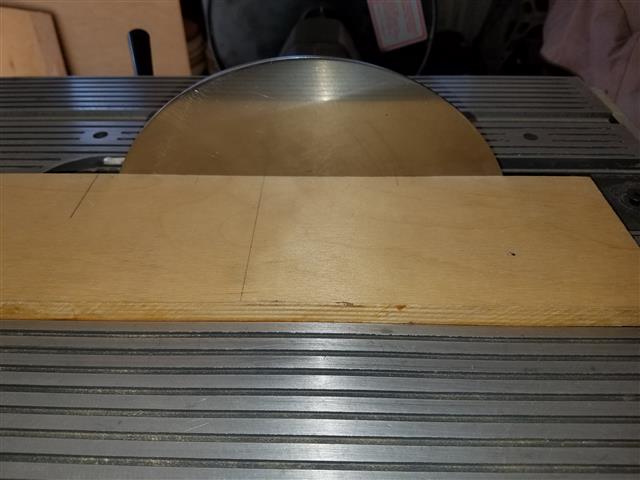
- Blade to Table Alignment Jig 004 (Small).jpg (54.66 KiB) Viewed 11005 times
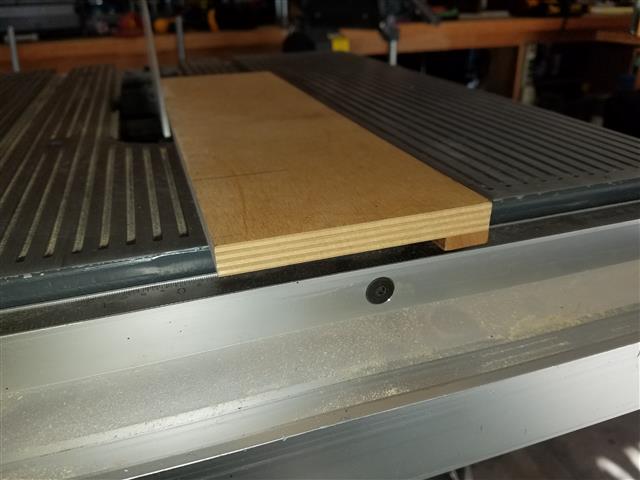
- Blade to Table Alignment Jig 005 (Small).jpg (51.8 KiB) Viewed 11005 times
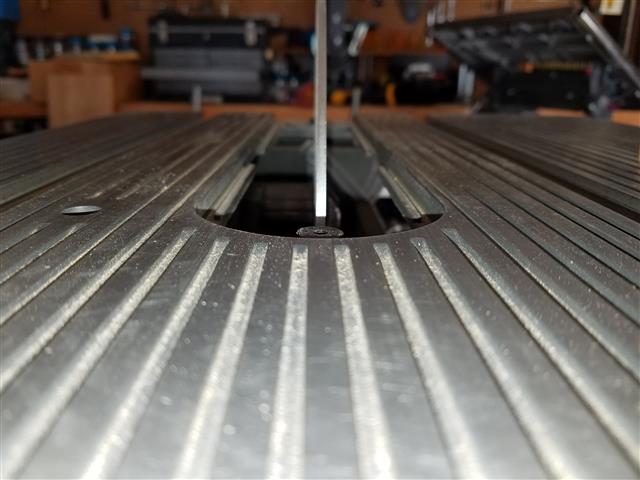
- Blade to Table Alignment Jig 006 (Small).jpg (59.6 KiB) Viewed 11005 times
If the jig was cut to the right dimension the blade (or in this case the alignment plate) would be centered in the table cutout. In this pictures the plate is close to center but that is due to some trickery.
A cheap and I think effective toy (I mean tool) that might reduce the need for one from Shopsmith.
Re: If Shopsmith Is Seeking Low Cost Improvement
Posted: Sat Sep 03, 2016 10:07 am
by JPG
Double thick miter bar.
Two tables
Invert table(to be ground) onto the other table(mounted to the carriage).
Conical disc.
Pass inverted table past disc.
Remember to tilt.
Re: If Shopsmith Is Seeking Low Cost Improvement
Posted: Sat Sep 03, 2016 10:37 am
by ChrisNeilan
JPG wrote:Double thick miter bar.
Two tables
Invert table(to be ground) onto the other table(mounted to the carriage).
Conical disc.
Pass inverted table past disc.
Remember to tilt.
Agreed, presuming a good fit miter bar...
Re: If Shopsmith Is Seeking Low Cost Improvement
Posted: Sat Sep 03, 2016 11:05 am
by Ed in Tampa
Don't all the above methods depend on a perfectly aligned table to start with?
I want something that is aligned to .0001 perfection that will allow me to align my table to
0 plus or minus less than .001 tolerance.
Re: If Shopsmith Is Seeking Low Cost Improvement
Posted: Sat Sep 03, 2016 11:13 am
by BuckeyeDennis
Ed in Tampa wrote:Don't all the above methods depend on a perfectly aligned table to start with?
I want something that is aligned to .0001 perfection that will allow me to align my table to
0 plus or minus less than .001 tolerance.
The conical sanding disc only contacts the workpiece in a single vertical line. So if the miter slot is not perfectly perpendicular to the spindle axis, no problem.
That said, there's no way you will hold 0.0001" on a Shopsmith. It's not rigid enough.
Re: If Shopsmith Is Seeking Low Cost Improvement
Posted: Sat Sep 03, 2016 11:25 am
by dusty
Ed in Tampa wrote:Don't all the above methods depend on a perfectly aligned table to start with?
I want something that is aligned to .0001 perfection that will allow me to align my table to
0 plus or minus less than .001 tolerance.
This is unusual for me to say but .0001" tolerance factor is a bit anal. Most of us will probably accept wood working projects that are within 1/64" (.0156") and be proud of the work. Striving for .001" accuracy is a challenge. I now accept .005" setup tolerances and have not gotten any comments about how my joints look. And you can believe that the critics in my family would say something if they did not like it.
Re: If Shopsmith Is Seeking Low Cost Improvement
Posted: Sat Sep 03, 2016 1:09 pm
by wa2crk
I try to get the error factor in my woodworking gear to about .001 or better if I can achieve it. The better the machines are aligned the better the chances of achieving the 1/64 consistency for woodworking. Then the error in the woodworking becomes more a matter of technique rather than inherent machine shortcomings.
JMHO
BillV