Page 1 of 1
DC-6000 Thermal Performance
Posted: Mon Aug 30, 2021 9:55 am
by DLB
In the DC-6000 Tool Review we've had some discussions regarding DC-6000 thermal performance, air leaks, and cooling fan efficacy. I'm starting a separate thread on those topics. There is no new information in this first post other than the time/temp table below. For my first thermal evaluation I sealed the leaks that were allowing positive pressure flow into the motor housing using duct tape. I placed two thermocouples, both on the top of the motor, under two layers of a foam insulating tape. The placement reflects my subjective bias, in looking at the design I felt the cooling fan would be relatively ineffective and that the primary cooling effect would be the conductive path to the motor housing and impeller, both steel, both fairly large and cooled by air movement. The thermocouples were about 3" apart, intending to determine thermal gradient. I don't have a full set of instrumentation that would be more compelling, two thermocouples and two DMMs that include the function are my upper limit.
I stopped the test at 235F. It was not intended as a destructive test and I felt this was getting too hot. Presumably the windings were somewhat hotter than my max measured temperature. They certainly would have experienced a temperature rise greater than the 80C (144F, based on Class B) they were rated for, and possibly a greater absolute temp than the 120C (248F) I presume they are rated for (80C rise above 40C ambient).
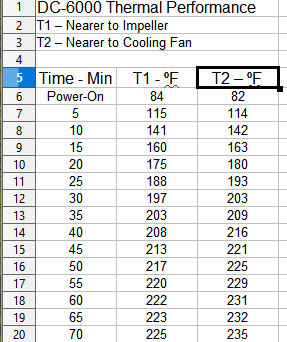
- DC6K Thermal (2).png (18.37 KiB) Viewed 1025 times
- David
Re: DC-6000 Thermal Performance
Posted: Mon Aug 30, 2021 10:20 am
by RFGuy
David,
Thanks for posting this. It is definitely interesting. I would say that after only 20minutes, that motor is getting hotter than I would like, so it rises fairly quickly...faster than I would have thought. Any DC-6000 owner could have an extended session of sawing/sanding/lathe, etc. that could easily last 20 minutes. So, I really don't think you are asking too much of Shopsmith here. I mean if you were trying to run the upgrade continuously for 24 hours and then it got hot, that would be different, but you are getting very elevated temps after only 15-20 minutes of use.
Re: DC-6000 Thermal Performance
Posted: Mon Aug 30, 2021 12:02 pm
by dusty
I don't have thermo couples and I have not had the DC-6000 running continuously for near that long a time but I do not sense that level of temperature increase.
If you have not already done so, I would suggest that you give Shopsmith Engineering this input.
Where do you have the thermocouples attached. You say "on the motor". Is that on the cooling fins which are intended to draw heat away from the motor interior in and into the air flow?
What is the temperature of the exhausted air?
Re: DC-6000 Thermal Performance
Posted: Mon Aug 30, 2021 2:14 pm
by DLB
dusty wrote: Mon Aug 30, 2021 12:02 pm
I don't have thermo couples and I have not had the DC-6000 running continuously for near that long a time but I do not sense that level of temperature increase.
If you have not already done so, I would suggest that you give Shopsmith Engineering this input.
Working on it. I think I finally got a call scheduled for Thursday. About two weeks after I reported the air leaks and damage to the motor housing. 
Where do you have the thermocouples attached. You say "on the motor". Is that on the cooling fins which are intended to draw heat away from the motor interior in and into the air flow?
On the top, between cooling fins. Both were in the same valley between fins. It would be fair to say that I impeded a small percentage of the airflow if there was any present, if that's your meaning. In my opinion there was little to no airflow present where I measured. I tried to block the leaks from the fan housing /motor housing interface. IMO the raw data confirms the ineffectiveness of the fan. (Thermal gradient would be in the other direction and temperatures would be reasonable.) I'm not suggesting the fan is not pulling any heat out. Heat would exit the grill with no fan. Unquestionably more heat would exit with the fan.
What is the temperature of the exhausted air?
Not hot enough! I don't have the equipment for a comprehensive thermal test. Two test points is my limit. I've seen tests with hundreds of TPs and a controlled atmosphere, you probably have too. This, as they say, ain't that.
My original questions were answered by this first thermal evaluation: If I stop the leaks, will the motor get too hot. Yes, IMO. Is the cooling fan, as implemented, effective? No, IMO. Does the advertised high efficiency of the motor and the availability of a fair conductive cooling path negate the need for a cooling fan? No, IMO. Once I thought through all of that I realized I should have also measured the cool-down rate to establish how the machine can be used in a non-continuous application instead of just determining that I won't use it continuously. I'm trying to decide if I can do that without full installation, I really don't want to tear my 3300 down again.
- David
Re: DC-6000 Thermal Performance
Posted: Fri Sep 03, 2021 1:11 pm
by DLB
DLB wrote: Mon Aug 30, 2021 2:14 pm
My original questions were answered by this first thermal evaluation:
If I stop the leaks, will the motor get too hot. Yes, IMO.
No, per Jim. He believes there may be something wrong with my motor causing excessive heat to be generated. He said the max temperature should be 184F IIRC. In the 180's for sure.
Is the cooling fan, as implemented, effective? No, IMO.
Yes, per Jim. It is a Totally Enclosed Fan Cooled (TEFC) Motor. The enclosure (motor housing and main housing?) provides the functionality of the normal fan cover on typical TEFCs.
Does the advertised high efficiency of the motor and the availability of a fair conductive cooling path negate the need for a cooling fan? No, IMO.
We didn't specifically discuss this. I think he would say that fan cooled is the primary cooling source.
Once I thought through all of that I realized I should have also measured the cool-down rate to establish how the machine can be used in a non-continuous application instead of just determining that I won't use it continuously. I'm trying to decide if I can do that without full installation, I really don't want to tear my 3300 down again.
Not needed, per Jim. There is adequate cooling for continuous operation of the DC-6000.
Quoting myself here so I can interject Jim McCann's responses from our engineering call as I understand them. SS engineering will be looking at my entire upgrade so any lingering questions (I have some) should be resolved.
- David
Re: DC-6000 Thermal Performance
Posted: Fri Sep 03, 2021 3:36 pm
by dusty
DLB wrote: Fri Sep 03, 2021 1:11 pm
DLB wrote: Mon Aug 30, 2021 2:14 pm
My original questions were answered by this first thermal evaluation:
If I stop the leaks, will the motor get too hot. Yes, IMO.
No, per Jim. He believes there may be something wrong with my motor causing excessive heat to be generated. He said the max temperature should be 184F IIRC. In the 180's for sure.
Is the cooling fan, as implemented, effective? No, IMO.
Yes, per Jim. It is a Totally Enclosed Fan Cooled (TEFC) Motor. The enclosure (motor housing and main housing?) provides the functionality of the normal fan cover on typical TEFCs.
Does the advertised high efficiency of the motor and the availability of a fair conductive cooling path negate the need for a cooling fan? No, IMO.
We didn't specifically discuss this. I think he would say that fan cooled is the primary cooling source.
Once I thought through all of that I realized I should have also measured the cool-down rate to establish how the machine can be used in a non-continuous application instead of just determining that I won't use it continuously. I'm trying to decide if I can do that without full installation, I really don't want to tear my 3300 down again.
Not needed, per Jim. There is adequate cooling for continuous operation of the DC-6000.
Quoting myself here so I can interject Jim McCann's responses from our engineering call as I understand them. SS engineering will be looking at my entire upgrade so any lingering questions (I have some) should be resolved.
- David
Was he alarmed at the report of dust within the motor casing?
Re: DC-6000 Thermal Performance
Posted: Sat Sep 04, 2021 9:30 am
by DLB
dusty wrote: Fri Sep 03, 2021 3:36 pm
Was he alarmed at the report of dust within the motor casing?
I failed to mention it. I had sent a list of things and photos to discuss and the dust in the motor came up after I sent it. But I personally don't see it as a problem for those DC motor housings that are properly sealed at both the fan housing and main housing interfaces. The motor is enclosed, not sealed, so keeping dust out of the motor housing is what will keep it out of the motor. And with no mechanical start switch there isn't much in there to cause a problem for the life of the bearing seals. Someone (Ed in Tampa?) did mention improving the seal of the electrical cable penetrations and I think that is a good idea, along with improving the motor housing to fan housing seal.
- David
Re: DC-6000 Thermal Performance
Posted: Sat Sep 04, 2021 10:46 am
by dusty
DLB wrote: Sat Sep 04, 2021 9:30 am
dusty wrote: Fri Sep 03, 2021 3:36 pm
Was he alarmed at the report of dust within the motor casing?
I failed to mention it. I had sent a list of things and photos to discuss and the dust in the motor came up after I sent it. But I personally don't see it as a problem for those DC motor housings that are properly sealed at both the fan housing and main housing interfaces. The motor is enclosed, not sealed, so keeping dust out of the motor housing is what will keep it out of the motor. And with no mechanical start switch there isn't much in there to cause a problem for the life of the bearing seals.
Someone (Ed in Tampa?) did mention improving the seal of the electrical cable penetrations and I think that is a good idea, along with improving the motor housing to fan housing seal.
- David
I did notice that the rubber grommets on the two motor cables are very loose fitting. I'd bet that there are better fitting grommets available. If not, a tight wrap of electrical tape where the grommets fit would do the trick.