Page 1 of 2
Edge jointing cupping re-visited
Posted: Fri Jan 26, 2024 2:29 pm
by Matanuska
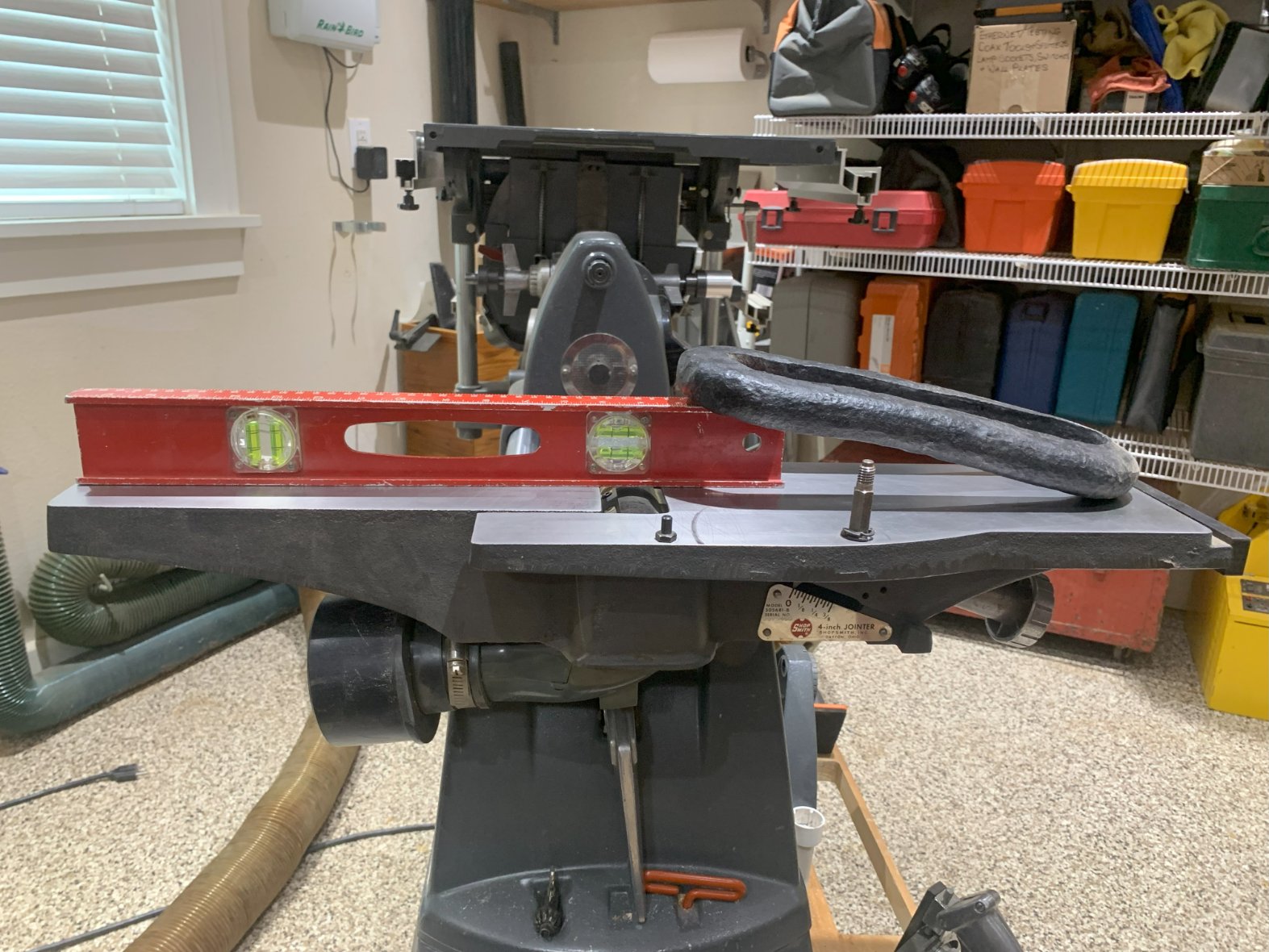
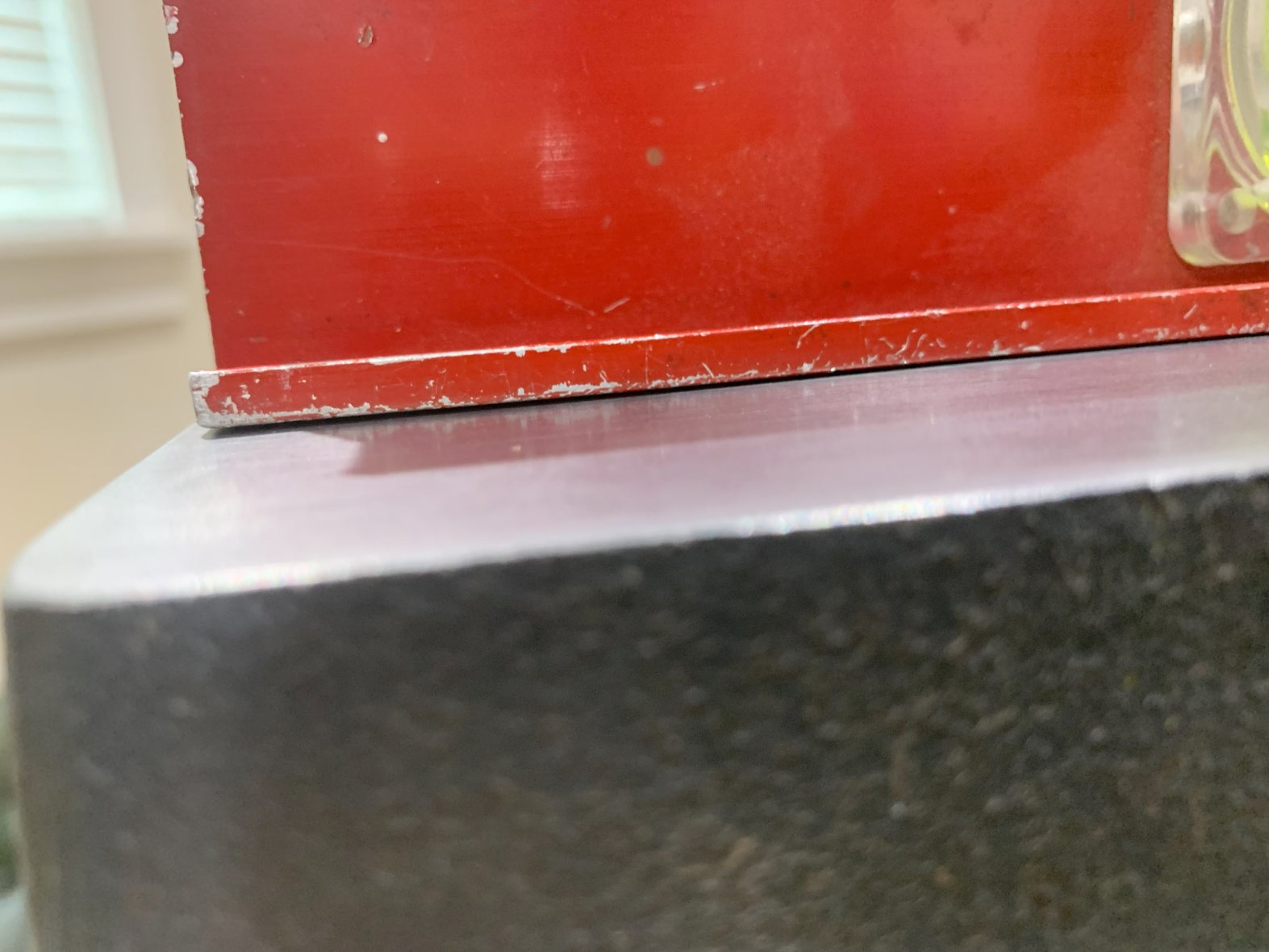
I'm experiencing concave cupping when edge jointing (there is a slight gap in the middle of two edge jointed boards put side by side for glue up). I've read through previous forum discussions and ruled out blade height setup (mine are bang on the 1/8" of drag recommendation) and jointing technique (I'm carefully transitioning pressure to the outfeed during the cut). Then I saw a note about checking infeed/outfeed table alignment and discovered that my infeed and outfeed tables are slightly lower at the far ends than in the middle when set at a zero cut height (the tables are not coplanar). I figured this out by first adjusting the infeed table height until a straight edge on the infeed table would just slide on to the outfeed table without catching. Then I anchored one end of the straight edge on the infeed using a heavy weight and extended the other end over the length of the outfeed table (see attached pictures).There is a gap of about 0.015" between the far end of the outfeed table and the straight edge. Interestingly, this is just about the same gap that I'm seeing in the middle of two 16" boards placed jointed edge to jointed edge. Following previous forum advice I removed the infeed table and cleaned out the sawdust and other crud on the mating surfaces before re-assembling, but the slight outfeed table droop remains.
Going back to jointing technique I reasoned that if table droop is the cause of the gap I should be able to minimize it by (carefully) maintaining pressure on the infeed table as long as possible during the cut rather than smoothly transitioning to outfeed table pressure as soon as the board moves past the cutter head. I tried it and the gap essentially went away, but it definitely wasn't optimum from a safety perspective and would be difficult with longer boards.
The gap is not huge and I can get rid of it by ripping the jointed edge but with a properly aligned jointer I shouldn't have to do that. A few years ago someone (Bill Mayo?) mentioned he had taken a couple of his jointers to a local machine shop and had the tables re-milled together to ensure they were coplanar. That's my next step unless anyone has any other good ideas. I am the originial owner of this 1985 jointer, have never dropped it, and both tables are original so they should have been milled flat together when it was manufactured.
Does anyone else's jointer have this issue?
- Jointer.jpg (318.82 KiB) Viewed 2516 times
- Jointer closeup.jpg (169.67 KiB) Viewed 2516 times
Re: Edge jointing cupping re-visited
Posted: Fri Jan 26, 2024 2:43 pm
by algale
The outfeed table obviously is immobile. I guess I'd set up the straight edge on the outfeed table and work on shimming the infeed table co planar.
"We prefer to shim the outfeed table, because its adjustment range is very small, but if your jointer has a fixed outfeed table, you have no choice but to work with the infeed side."
https://www.woodmagazine.com/tuning-up-your-jointer
Re: Edge jointing cupping re-visited
Posted: Fri Jan 26, 2024 3:21 pm
by chapmanruss
Matanuska,
As you said,
I am the original owner of this 1985 jointer, have never dropped it, and both tables are original so they should have been milled flat together when it was manufactured.
You are correct that they should have been milled flat together when assembled at the factory. It is why they say the Infeed and Base/Outfeed Tables should be replaced as a set.
My primary Shopsmith 4" Jointer was made in June 1979 about 6 years before yours. Mine is Model Number 505681 whereas yours would be Model Number 505681B. Only one small difference between the models. I am the third owner. I have upgraded it adding the Dust chute, feather board, rear blade and safety guards. It is and always has been flat between the Infeed and Base/Outfeed Tables since I received it from my father-in-law. Besides it I have restored a 1953 Magna Model 4E 4" Jointer, a "Greenie" 1954 Magna Model 620 4" Jointer and a "Goldie" 1960 Magna Model 620-C 4" Jointer. The 4E and the 620-C were flat checking with a long straight edge rule across the tables but the 1954 620 was not when checked across the Infeed and Base/outfeed similar to your problem. I use a straight edge rule longer than the combined table length to check them. It took a lot of assembling, dis-assembling and re-assembling while filing down the contact points between the Base/Outfeed Table and the Infeed Table to get it flat again. It can be done this way but having it milled back to flat would be the better way to go.
Before making any changes to the tables I suggest dis-assembling the Infeed Table from the Base/Outfeed Table and check the contact points for any buildup of gunk there. Clean the contact points, wax the bare metal there, lubricate the contact points (graphite works well without attracting dust lubricating it more than wax alone) and re-assemble it. Apply enough tension to the bolt/washer stack to keep the Infeed Table attached correctly to the Base/Outfeed Table but still allow it to slide for depth of cut adjustments.
The Jointer shown in the link algale provided is different than the Shopsmith/Magna Jointer which doesn't have the table adjustment shown there.
Re: Edge jointing cupping re-visited
Posted: Fri Jan 26, 2024 4:25 pm
by JPG
I'm gonna climb out on a weak limb and say the following:
A spirit level is a poor reference straight line.
Adjusting so the blade height drags the 'straight line' 1/8" is IMO excessive(I prefer just kiss).
Having the blade thus too high referenced to the outfeed table likely is causing the issue(too much removal of board in the center due the rocking motion the board experiences when downward force is moved from the infeed to the outfeed.
The the end 'droop' is affecting it, but I thing setting the blade height closer to the out feed table plane will help.
Finally, is a 0.015 gap over 8" something to fret over?
Re: Edge jointing cupping re-visited
Posted: Fri Jan 26, 2024 5:47 pm
by Matanuska
Al - Thanks for the link. I like the double triangle method suggested for checking table alignment because it eliminates the need to have the tables at the same height. I'm not sure about shimming though. I'll have to take another look, but I'm not sure what would hold the shims in place.
Re: Edge jointing cupping re-visited
Posted: Fri Jan 26, 2024 5:53 pm
by Matanuska
chapmanruss wrote: Fri Jan 26, 2024 3:21 pm
Before making any changes to the tables I suggest dis-assembling the Infeed Table from the Base/Outfeed Table and check the contact points for any buildup of gunk there. Clean the contact points, wax the bare metal there, lubricate the contact points (graphite works well without attracting dust lubricating it more than wax alone) and re-assemble it. Apply enough tension to the bolt/washer stack to keep the Infeed Table attached correctly to the Base/Outfeed Table but still allow it to slide for depth of cut adjustments.
Thanks Russ - I've already tried taking off the infeed table to clean and lubricate the bearing surfaces. The table height adjusts much more smoothly now but I still have the same table droop issue.
Re: Edge jointing cupping re-visited
Posted: Fri Jan 26, 2024 6:24 pm
by Matanuska
JPG wrote: Fri Jan 26, 2024 4:25 pm
A spirit level is a poor reference straight line.
Adjusting so the blade height drags the 'straight line' 1/8" is IMO excessive(I prefer just kiss).
Having the blade thus too high referenced to the outfeed table likely is causing the issue(too much removal of board in the center due the rocking motion the board experiences when downward force is moved from the infeed to the outfeed.
JPG - I had the same concerns about using the level to check table alignment so I double checked it using the steel rule from a combination square & got the same result. The level just has a wider base and was easier to hold in place with the iron weight while I fiddled around trying to get the tables aligned. I'm convinced the table droop is real, but as you point out the more important question is whether it is significantly contributing to the cupping problem.
I like your idea of trying a reduced blade height before I spend a bunch of money to get the tables milled. I had seen the "less than 1/8 inch of drag" a few different places here and figured I was OK.
I'm pretty sure my jointer hasn't had this problem all along because I would have noticed cupping when gluing up boards, so I thought back through what might have changed. Then I remembered I had the blades out a year ago to sharpen them for the first time. I didn't check the blade drag distance before I removed them so it's quite possible it was previously less than 1/8" (head slap). I'll have a sit down session with my jointer soon and see how small I can get the drag distance, then report back.
Re: Edge jointing cupping re-visited
Posted: Fri Jan 26, 2024 8:50 pm
by JPG
Before sharpening the drag was likely < 0.
Re: Edge jointing cupping re-visited
Posted: Sun Jan 28, 2024 6:37 pm
by Matanuska
JPG wrote: Fri Jan 26, 2024 4:25 pm
I'm gonna climb out on a weak limb and say the following:
Adjusting so the blade height drags the 'straight line' 1/8" is IMO excessive(I prefer just kiss).
Having the blade thus too high referenced to the outfeed table likely is causing the issue(too much removal of board in the center due the rocking motion the board experiences when downward force is moved from the infeed to the outfeed.
The the end 'droop' is affecting it, but I thing setting the blade height closer to the out feed table plane will help.
JPG
Problem fixed - thanks!
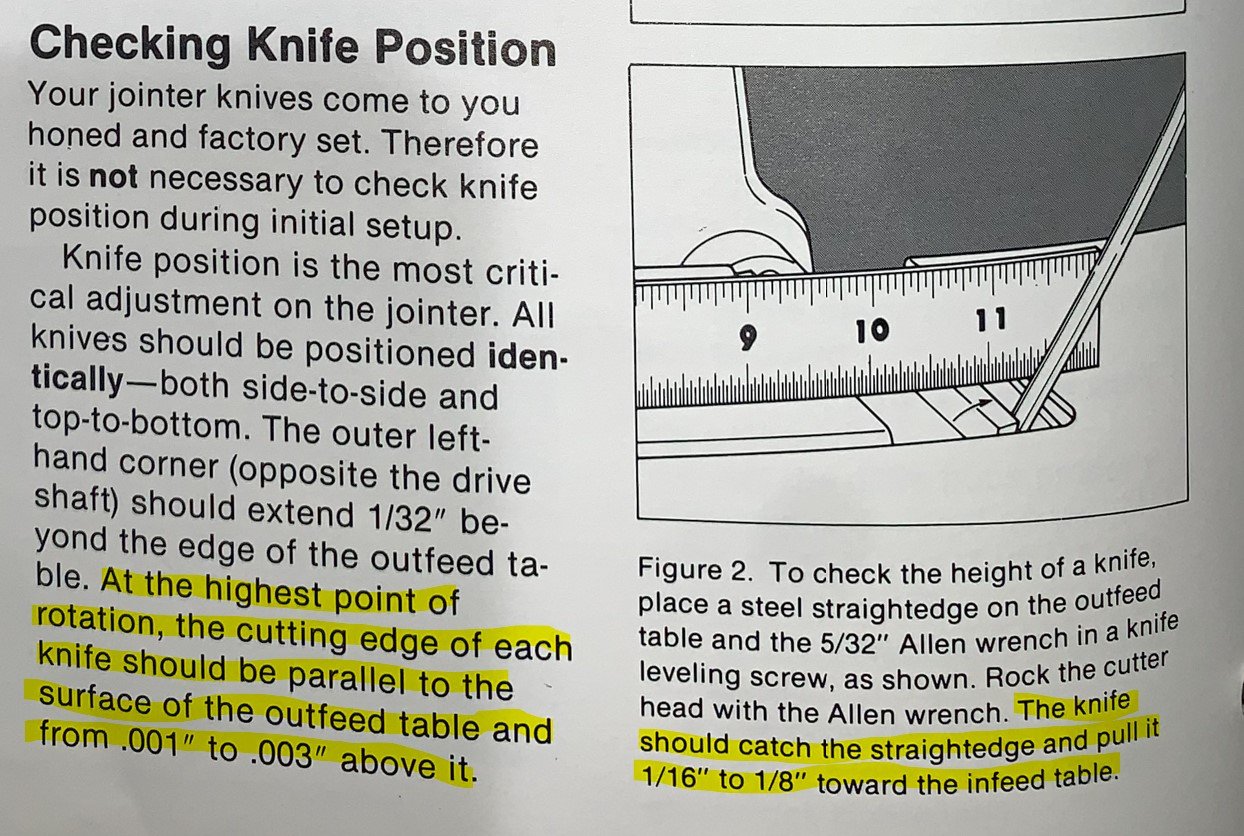
I spent some quality time with my jointer yesterday and today adjusting the knife height. I had forgotten how fiddly that process is. Before I started I thought to check the user manual and found the recommended height above the outfeed table was 0.001" to 0.003" or a drag of 1/16" to 1/8". Then I checked to see how much the 1/8" drag on my jointer was actually elevating the knives by jointing one end of a board and measuring the gap above the outfeed table. At 0.009" it was 3 times larger than the recommended upper limit so I reset the knife heights to give 1/16" drag max, jointed the end of another board, and found the gap above the outfeed table too small to measure with my feeler gauge. Then I edge jointed two boards, put the jointed edges together, and found the cupping had completely disappeared. All is now well with the world!
I'm not sure why an 1/8" drag on my jointer gives such a large outfeed gap, but now I know to shoot for no more than 1/16" of drag. I'm glad I didn't go the milling route!
Matanuska
- Jointer knife position.jpg (261.32 KiB) Viewed 2296 times
Re: Edge jointing cupping re-visited
Posted: Sun Jan 28, 2024 6:48 pm
by algale
Excellent!