RFGuy wrote
I think you missed my point.
I don't believe that I did -- I merely thought that you were being overly broad in your recommendations against using "long" extension cords. Can we agree that total supply-voltage drop is the real issue here?
I agree completely with you that the fixed house wiring causes part of the total voltage drop, and the extension cord contributes another part. But a blanket recommendation against "long" extension cords may preclude someone from using one in a situation where it solves a real machine-supply challenge, without causing either excessive voltage drop or additional safety concerns.
I'll use my own basement shop as a case in point. I recently installed a new subpanel in it, connected it to the main load center using a pre-existing 6AWG feeder cable, and protected that feeder with a 50A breaker. (I'll pull a new 100A feeder in the future, but 50A will suffice in the short term.) I plan to run a single new 12 AWG branch circult from the subpanel to supply a number of manually-operated woodworking machines that draw 15A or less, including my Mark V. It's a one-man shop, so only one of these machines will be powered on at any given time. I plan to set up that new branch circuit as a "bus" that supplies all those machines, and install a 15A breaker as external motor overload protection (for the reasons discussed previously). Any machine that could be operating independently (CNC router, air compressor, dust collector, etc.) is already powered from separate branch circuits.
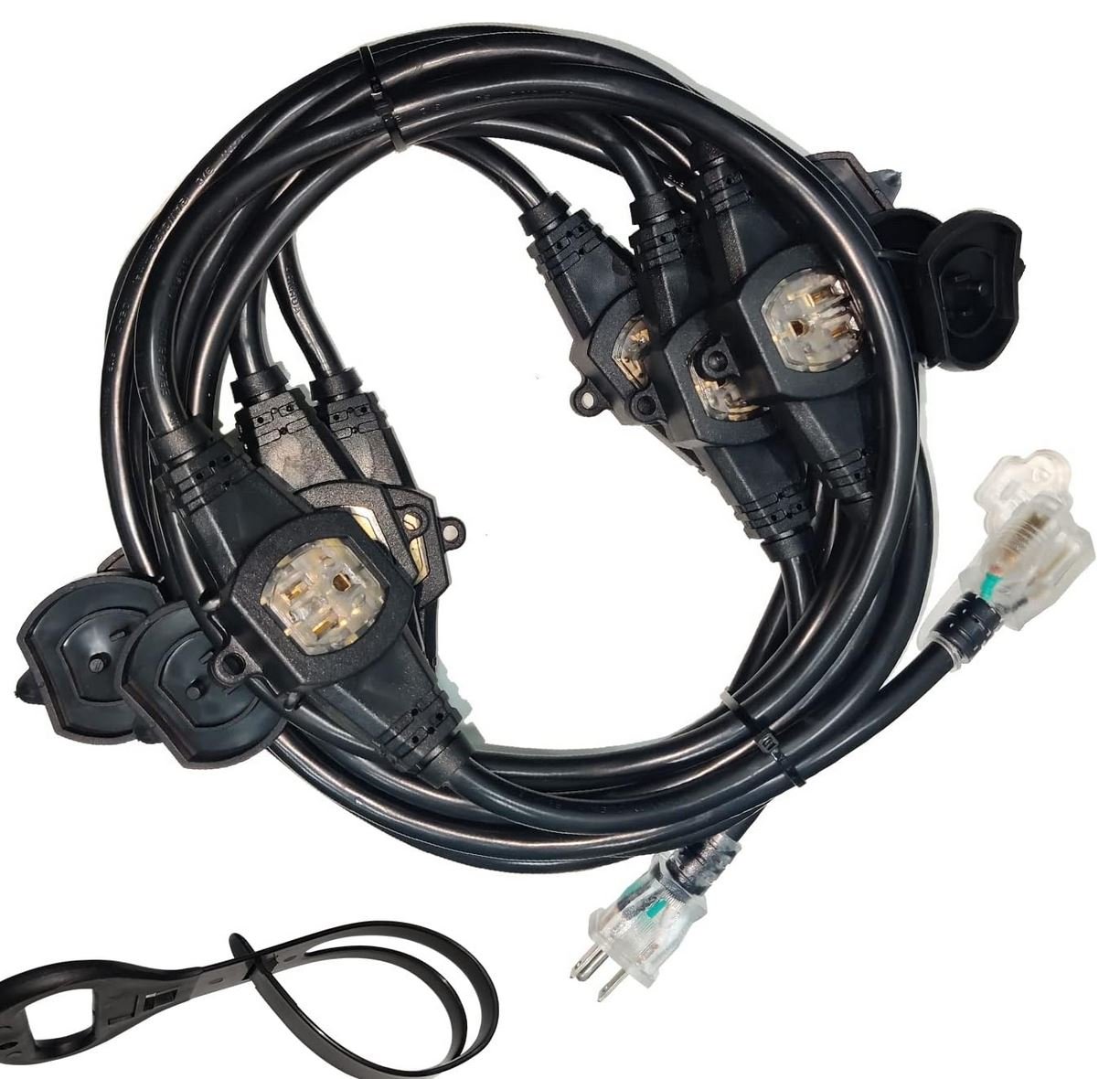
The dozen or so "small" manually-operated machines in question are all positioned around the periphery of my workshop, where it's convenient to plug them into wall receptacles. But it would be a huge PITA to install a bunch of new branch receptacles. While pondering that, I ran across some 25-foot,12AWG heavy-duty multiple-outlet extension cords on Amazon. They have a receptacle about every four feet, and each receptacle has a pair of mounting-screw lugs molded in.
My current plan is to mount a single duplex receptacle for that new "bus" circuit very near the subpanel, but strategically located so that one of the 25' multi-outlet cords can serve all the small manually-operated machines on one side of the duplex receptacle, and two of them in series can serve the ones the other side of the receptacle. Thus the longest total wire run is less than 60' (from the subpanel) of 12 AWG wire. The individual outlets will each be screwed to either the tops of the walls or to ceiling joists, high up where the risk of mechanical damage is exceedingly remote. This setup will give me outlets about every four feet around the entire perimeter of my shop, maximizing flexibility in machine positioning. It's less expensive, and far less labor intensive, than installing discrete recepticles in the conventional manner, and the cords are UL certified.
I've already purchased the multi-outlet cords, but haven't installed them yet. Can you think of any reason why I should not?