A year or so ago I saw someone selling a Shopsmith on Craigslist that had been extended. I don't recall the exact capacity between centers, but when I contacted the guy he told me he had purchased new, longer tubes from a metal supplier and simply swapped them for the standard tubes on the Shopsmith. So that's a possibility.
At one time I gave some thought to expanding the capacity by connecting two Shopsmiths end-to-end and removing the headstock from the one on the right. My thinking at the time was to use 10' (or longer) 2x4s or 2x6s and bolt them to the legs using the holes already there for mounting a shelf. If more stiffening was needed, auxiliary tables could be inserted in the mounts of the two adjacent machines with a board bolted to them to provide additional rigidity or for alignment purposes. One could also tie the bench tubes together with 2x4s or 2x6s and u-bolts. For a tool rest, one could cobble up one using hardwood that straddles the two machines and mounts to the two carriages, using a strip of metal to prevent damage from lathe tools. Or, one could weld up an all metal rest.
Whole lot of shortening going on!
Moderator: admin
-
dusty

- Platinum Member
- Posts: 21530
- Joined: Wed Nov 22, 2006 6:52 am
- Location: Tucson (Wildcat Country), Arizona
I saw somewhere that the capacity had been extended by mounting the tailstock on the shop wall and locating the Mark V according to the required capacity. Setup might be a bit tricky but once done I see no reason why that would not work.pennview wrote:A year or so ago I saw someone selling a Shopsmith on Craigslist that had been extended. I don't recall the exact capacity between centers, but when I contacted the guy he told me he had purchased new, longer tubes from a metal supplier and simply swapped them for the standard tubes on the Shopsmith. So that's a possibility.
At one time I gave some thought to expanding the capacity by connecting two Shopsmiths end-to-end and removing the headstock from the one on the right. My thinking at the time was to use 10' (or longer) 2x4s or 2x6s and bolt them to the legs using the holes already there for mounting a shelf. If more stiffening was needed, auxiliary tables could be inserted in the mounts of the two adjacent machines with a board bolted to them to provide additional rigidity or for alignment purposes. One could also tie the bench tubes together with 2x4s or 2x6s and u-bolts. For a tool rest, one could cobble up one using hardwood that straddles the two machines and mounts to the two carriages, using a strip of metal to prevent damage from lathe tools. Or, one could weld up an all metal rest.
"Making Sawdust Safely"
Dusty
Sent from my Dell XPS using Firefox.
Dusty
Sent from my Dell XPS using Firefox.
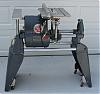
Longer Shopsmith
I spent a few weeks, years ago, just seeing what problems would be encounted with longer tubes. I could add up to 18" (SHORTY cutoffs) to the tubes using a machined mating coupler and still live with any flexing encounted. Beyond that length had varies results that I did not like. This was for a person making a few baseball bats. As a later additional change at that time, I machined thick end plates for the tubes and drilled the end plates and mating couplers with 5/8" centered holes. I used an 80" long 5/8" rod threaded on each end for nuts to compress the end plates and mating coupler into each tube. This maybe overkill but it seemed to give me the added strenght I needed to prevent any flexing or vibration of the tubes. I would assume this machine still exists somewhere.
At that time, I built a 10' Shopsmith to turn 100 8' 4X4 porch columns for a home builder. Many problems quickly occured. The final setup was a 2X4 upright stand bolted to both the way and bench tubes in the middle (60"), 2 500 carraiges and lathe rests and as many 80 pd. concrete bags (few dozen) that could be placed on the 2 3/4" plywood platforms built between the legs and center stand. I used face plates on each end of the posts. I used my "Poor Man's Speed Reducer" to get the RPMs to the 225-250 RPM range. We mounted a finished porch post behind the turning area as a guide. Close counted. Still we had to only use straight 4X4s for this task. Finding a 100 straight 4X4s took as long as the actual project. Took a few lumber places to visit. I believe we use cedar or fir. Big box store 4X4s would not work.
Those were fun days for me.
At that time, I built a 10' Shopsmith to turn 100 8' 4X4 porch columns for a home builder. Many problems quickly occured. The final setup was a 2X4 upright stand bolted to both the way and bench tubes in the middle (60"), 2 500 carraiges and lathe rests and as many 80 pd. concrete bags (few dozen) that could be placed on the 2 3/4" plywood platforms built between the legs and center stand. I used face plates on each end of the posts. I used my "Poor Man's Speed Reducer" to get the RPMs to the 225-250 RPM range. We mounted a finished porch post behind the turning area as a guide. Close counted. Still we had to only use straight 4X4s for this task. Finding a 100 straight 4X4s took as long as the actual project. Took a few lumber places to visit. I believe we use cedar or fir. Big box store 4X4s would not work.
Those were fun days for me.
Bill Mayo bill.mayo@verizon.net
Shopsmith owner since 73. Sell, repair and rebuild Shopsmith, Total Shop & Wood Master headstocks, SPTs, attachments, accessories and parts. US Navy 1955-1975 (FTCS/E-8)
Shopsmith owner since 73. Sell, repair and rebuild Shopsmith, Total Shop & Wood Master headstocks, SPTs, attachments, accessories and parts. US Navy 1955-1975 (FTCS/E-8)
-
chipmaster
- Gold Member
- Posts: 97
- Joined: Wed Nov 23, 2011 10:35 pm
- Location: Yorktown, VA
I assumed it was common knowledge, but there is someone marketing these extension kits that he has cobbled from old parts--I found his video on YouTube. I'll have to look it up again to see if he used full-length tubes. Since the 10ER tubes are open on the end, you just slide the extension onto the existing machine and there you have it. You don't have to replace the existing tubes.
v/r,
Rick
v/r,
Rick

-
dusty
- Platinum Member
- Posts: 21530
- Joined: Wed Nov 22, 2006 6:52 am
- Location: Tucson (Wildcat Country), Arizona
That is a good idea. Wish I had thought about it. I think I have a pencil like laser that would fir right in the arbor.pennview wrote:Dusty, I think you could use a laser pointer mounted in the headstock to locate the spot to mount the tailstock on the wall or post.
If I do, I'll post some pictures and a report of how it worked..
"Making Sawdust Safely"
Dusty
Sent from my Dell XPS using Firefox.
Dusty
Sent from my Dell XPS using Firefox.
-
chipmaster
- Gold Member
- Posts: 97
- Joined: Wed Nov 23, 2011 10:35 pm
- Location: Yorktown, VA
Yep, that's the one. I contacted the guy who makes these:
"Scott Grune" <carrera_lemans247@yahoo.com>
He sells them for $225 plus shipping, and he does, in fact, cut down old tubes to make them. I have everything I need to make my own except the plug inserts and a willingness to cut the old tubes. Thanks for the guilt trip, guys!
-
chipmaster
- Gold Member
- Posts: 97
- Joined: Wed Nov 23, 2011 10:35 pm
- Location: Yorktown, VA