The other day I clipped the left end of the tool rest with the jaw of my Talon chuck. The chuck survived, the rest has an eighth inch deep, quarter inch long chunk taken out of the inner face.
When I try to work to the end of the rest there is now a catch there.
What is the best way to fix this?
a. Grind off the left end of the rest, shortening it by about a quarter inch?
b. Grind the inner face of the rest making it thinner and sharper?
c. Replace the rest?
d. Avoid that end?
Jim in Bakersfield
Lathe Tool Rest Boo Boo
Moderator: admin
Lathe Tool Rest Boo Boo
Jim in Bakersfield:D
-
a1gutterman

- Platinum Member
- Posts: 3653
- Joined: Tue Jan 09, 2007 12:45 am
- Location: "close to" Seattle

The tool rest is cast, so you won't be able to weld it. But any good welder should also be able to fill it in with braze. The brazing metal won't be as hard as the iron, but it will still be serviceable.
In fact you can do it yourself with some Mapp gas and flux-coated brazing rod, if you're up for learning a new skill. The trick to brazing a casting is to heat up the entire piece. If you don't, the heated area of the casting will expand more than the cooler areas and the casting may warp or crack. A casting this small, I'd put in the oven at 450 F for a half hour.
Clamp the casing in a vice by its shank and continue to heat the broken arm of the rest with the Mapp torch. Touch the brazing rod to the chipped surface of the casting and heat until the surface is a dull red. The brazing will "flow" that same way solder flows when you sweat a joint in copper pipe. Make sure that the entire surface where tool rest is chipped has been coated with braze and that the braze has flowed rather than collected in globs or puddles.
Back the torch off a little to reduce the heat and let the braze become semi-solid. Apply more braze to fill in the chipped area, but don't get it so hot that it flows. Toward the end, I usually make a few close passes with the torch to get the globs of braze to run together in a puddle, but I'm careful to back off before the braze goes liquid and flows. And even if it does, all you have to do is back off the torch and rebuild the braze puddle.
This same brazing skill, by the way, comes in handy for filling in rust pits and restoring old tools.
With all good wishes,
In fact you can do it yourself with some Mapp gas and flux-coated brazing rod, if you're up for learning a new skill. The trick to brazing a casting is to heat up the entire piece. If you don't, the heated area of the casting will expand more than the cooler areas and the casting may warp or crack. A casting this small, I'd put in the oven at 450 F for a half hour.
Clamp the casing in a vice by its shank and continue to heat the broken arm of the rest with the Mapp torch. Touch the brazing rod to the chipped surface of the casting and heat until the surface is a dull red. The brazing will "flow" that same way solder flows when you sweat a joint in copper pipe. Make sure that the entire surface where tool rest is chipped has been coated with braze and that the braze has flowed rather than collected in globs or puddles.
Back the torch off a little to reduce the heat and let the braze become semi-solid. Apply more braze to fill in the chipped area, but don't get it so hot that it flows. Toward the end, I usually make a few close passes with the torch to get the globs of braze to run together in a puddle, but I'm careful to back off before the braze goes liquid and flows. And even if it does, all you have to do is back off the torch and rebuild the braze puddle.
This same brazing skill, by the way, comes in handy for filling in rust pits and restoring old tools.
With all good wishes,
Nick Engler
http://www.workshopcompanion.com
http://www.workshopcompanion.com
Thanks, guys.
This sounds like a real opportunity for one of my students to give me some payback. I'm a high school counselor in an academy that contains a metalworking track. I do them lots of favors, and I can give one of the advanced students a chance to show off.
I can braze, I'm just chicken to start on cast iron and no longer have a vise to properly control things. They have a pretty complete metal shop to play in.
This sounds like a real opportunity for one of my students to give me some payback. I'm a high school counselor in an academy that contains a metalworking track. I do them lots of favors, and I can give one of the advanced students a chance to show off.
I can braze, I'm just chicken to start on cast iron and no longer have a vise to properly control things. They have a pretty complete metal shop to play in.
Jim in Bakersfield:D
-
a1gutterman
- Platinum Member
- Posts: 3653
- Joined: Tue Jan 09, 2007 12:45 am
- Location: "close to" Seattle

-
pinkiewerewolf

- Platinum Member
- Posts: 526
- Joined: Mon Jan 07, 2008 10:13 pm
- Location: Ca. Eureka area.
I agree, that is a great idea to get the class involved in the repair.
I learned many valuable skills in "metals" and "industrial Arts" classes.
Nick, great advice on heating the cast iron in the oven.
I learned many valuable skills in "metals" and "industrial Arts" classes.
Nick, great advice on heating the cast iron in the oven.
John, aka. Pinkie. 1-520, 1-510 & a Shorty, OPR. 520 upgrade, Band Saw, Jig Saw, scroll saw, Jointer, Jointech Saw Train. Delta Benchtop planer, Makita LS1016L 10" sliding compound miter saw, Trojan manf. (US Made)Miter saw work center, MiniMax MM16 bandsaw.
Squire of the Shopsmith. ...hmmmm, maybe knave, pawn, or wretch would be more appropriate for me.
Delta Benchtop planer, Makita LS1016L 10" sliding compound miter saw, Trojan manf. (US Made)Miter saw work center, MiniMax MM16 bandsaw.Squire of the Shopsmith. ...hmmmm, maybe knave, pawn, or wretch would be more appropriate for me.
Don't Laugh....
Hi,
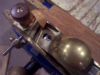
I had noticed my old used 500-tool-rest was worn/ground way thinner than my newer 510-tool-rest.
(I was using the 500 to turn a pen with my visiting niece tonight; the 500 carriage geometry can get the 8"-tool-rest closer to a pen mandrel than the wider-stance 510 carriage normally can. But I digress. The topic-threads of tailstock extensions for this challenge were beat to death for the 510 prior to now.)
For kicks, I "filled" the top of the worn 500 tool-rest with about 3/32" of J-B Weld. Once I block-sanded that stuff, you could see the steel granules throughout it. It actually held up just fine for the pen-turning session tonight.
Probably this won't be my long-term fix, I'll get a new rest one day. But it was a fun experiment since I'm reasonably equipped for woodwork but 0% equipped for welding arts. J-B Weld has helped me in a couple of instances lately.
"Metal Renegade"
I had noticed my old used 500-tool-rest was worn/ground way thinner than my newer 510-tool-rest.
(I was using the 500 to turn a pen with my visiting niece tonight; the 500 carriage geometry can get the 8"-tool-rest closer to a pen mandrel than the wider-stance 510 carriage normally can. But I digress. The topic-threads of tailstock extensions for this challenge were beat to death for the 510 prior to now.)
For kicks, I "filled" the top of the worn 500 tool-rest with about 3/32" of J-B Weld. Once I block-sanded that stuff, you could see the steel granules throughout it. It actually held up just fine for the pen-turning session tonight.
Probably this won't be my long-term fix, I'll get a new rest one day. But it was a fun experiment since I'm reasonably equipped for woodwork but 0% equipped for welding arts. J-B Weld has helped me in a couple of instances lately.
"Metal Renegade"
Chris