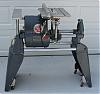
I always believed the lack of air circulation in the headstock was the reason for excessive sawdust accumulation and excessive heating of the headstock under a heavy load.
Years ago when installing DC motors in Mark V headstocks, I had to cut a round hole in the motor pan end to extend the longer DC motor. After many failures due to heating and mounting problems, I stored all my DC motor and control equipment. Since I had several motor pans with round holes in the end, I installed a 4" louvered cover over the hole and used the motor pan on a regular headstock. It was amazing how much cooler the headstock operated. I found no sawdust in the headstock after several years of operation when I checked one of the headstocks. These headstocks are sold with no response from the buyers since then. The cutting of the round holes in the motor pan was extemely difficult job due the hardness of the metal. I ended up using a small grinder with a diamond wheel to rough out a some what round hole.
My major DC motor conversion problem was overheating of the motor and circuit board inside the closed headstock. I used large heat sinks and muffin fans on the control board without a lot of success. With the introduction of the PowerPro, I obtained the drilling jig for the motor. After much throught, I obtained a few 1/2" aluminum plates cut the same size as the PowerPro motor mount. I had planned to mount the DC motor under the aluminum plate and the control board on top with the heat sink and muffin fan. My health for the past year has prevented me from any additional work on this design which I believed would have worked. Contact me if anyone is interested or have questions as I still have the equipment and many files from that time. My health may prevent a quick response but I will try.
New PowerPro Issues
Moderator: admin
Headstock Heating Problems
Bill Mayo bill.mayo@verizon.net
Shopsmith owner since 73. Sell, repair and rebuild Shopsmith, Total Shop & Wood Master headstocks, SPTs, attachments, accessories and parts. US Navy 1955-1975 (FTCS/E-8)
Shopsmith owner since 73. Sell, repair and rebuild Shopsmith, Total Shop & Wood Master headstocks, SPTs, attachments, accessories and parts. US Navy 1955-1975 (FTCS/E-8)
Bill,
Thank you for inviting me to visit the second largest Shopsmith factory in the U.S.- your huge warehouse last year- March, I believe. Sorry to hear about your health. I have a Power Pro I'm about to install within the next week. I would love to discuss your findings/observations/suggestions on heat mitigation. Prior to my retirement from the FAA, I maintained both long- and short-range radars used for air traffic control. The older systems used either a huge klystron tube or a magnetron to amplify the radar pulse that was ultimately transmitted out the large rotating orange parabolic dish antenna I'm sure you and most everyone else has seen near major airports or not seen if enclosed inside a radome that looks like a huge golf ball in areas subject to cold winters and snow.
Heat was a huge problem in those old systems. Especially the systems that were all vacuum tubed. To prevent a transmitter from overheating, they would be could cooled either by a constant circulating antifreeze solution which flowed through heat exchangers or the smaller systems used an oil bath which the lower section of the klystron would be immersed in or had a jacket which acted as a heat exchanger. Special oil was used to prevent arcing in the pulse forming network which would reach around 100,000 volts to create the short half microsecond pulse.
People who are into over-clocking PCs around 10-15 years ago started using radiator-type systems where a heat sink with a pathway for a cooling system to be mounted directed a top the CPU and draw the heat away from the CPU and be directed to a small radiator which a muffin fan blew air through in the same way a car idling is kept from overheating & kept cool. I caught the over-clocking bug back then and had a Celeron 300A CPU running at twice it's rated speed by using a huge heat sink which had a several hundred 4-5" long circular fins to increase the surface area and with a muffin fan blowing on it, We used that computer for 5-6 years while my daughters were in high school. I had a $50 CPU performing faster than a $300 Pentium II CPU. But I got bored with that after doing one otherwise I would never of caught the Shopsmith addiction which had me bad. I almost everything Shopsmith ever made except for the ( I just found an old catalog) the radial arm saw, the jointmatic, and the crafter's station. I have stand alone planer, scroll saw, OPR, and a powerstation I haven't figured out what I'll do with. I have the ringmaster, lathe duplicator and many, many other things. Today I called and ordered the Mark VII upgrade kit as I had a 20% off coupon code & figured, I'd be taking my 520 apart, so why not. I also ordered all the missing parts for my old stand alone OPR. Eye, ye, ye... I asked Linda to wrap it in a plain brown wrapper....
Many people shutter when they heat of water, antifreeze, or an oil fluid running through electronic components. But these radar systems have worked well since the early 50's and the development of long-range, high-power radar systems. Well the same principles are being applied to PCs by many manufacturers that make some CPUs run twice the speed they might they operate with a fancy aluminum heat sink or a heat sink that looks like a bed of nails.
All that being said really doesn't help as I recall from watching the installation video, there is not much space in the PowerPro headstock. I was one of the first 10 people to receive the Power Pro, but have been too busy with a remodeling project of our 50 year old home which included ripping out the HVAC system and the installation of a geothermal heat pump along with a 10KW solar panel power system and the addition of a wood work shop which my wife will kill me for if I complete that before the rest of the house. <smile>. I have a bad back, but not as bad as yours as I recall as I've been able to avoid being cut on by a surgeon. Getting some type of air flow or perhaps making a more efficient heat sink might be the answer, but I'll share what I find and any suggestions once I complete the DIY upgrade of my Mark V headstock. I have a great excuse to complete the upgrade so I can build extension jambs for all the new construction windows we had installed as well. Well, I think it won't create any spousal issues if momma knows it's for the house...<lol>
I only used DC motors on 10E/ERs as the used treadmill 1.5 hp motors I found came from a treadmill which fit perfectly on the 10E/ER motor plate. But the project started on the house in the latter part of 2007 and we've been "under construction" ever since. But all I have to do is run some CSST gas lines and I can complete the upstairs and hopefully by the end of this summer be ready to lay out my workshop with all my Shopsmiths. I have 5 or 6 MArk V's and 5 10E/ERs. I found a Model 10ER Metal Mill Conversion article while web surfing today. Looks to be interesting as I planned to use one of my 10E/ERs as a dedicated drill press. Here is the link: http://www.pdfgeni.com/book/shopsmith-pdf.html I like the way they designed a way of moving the headstock up & down (Z-axis control). I believe I will adopt that for my drill press.
Take care of yourself Bill,
Tony
Thank you for inviting me to visit the second largest Shopsmith factory in the U.S.- your huge warehouse last year- March, I believe. Sorry to hear about your health. I have a Power Pro I'm about to install within the next week. I would love to discuss your findings/observations/suggestions on heat mitigation. Prior to my retirement from the FAA, I maintained both long- and short-range radars used for air traffic control. The older systems used either a huge klystron tube or a magnetron to amplify the radar pulse that was ultimately transmitted out the large rotating orange parabolic dish antenna I'm sure you and most everyone else has seen near major airports or not seen if enclosed inside a radome that looks like a huge golf ball in areas subject to cold winters and snow.
Heat was a huge problem in those old systems. Especially the systems that were all vacuum tubed. To prevent a transmitter from overheating, they would be could cooled either by a constant circulating antifreeze solution which flowed through heat exchangers or the smaller systems used an oil bath which the lower section of the klystron would be immersed in or had a jacket which acted as a heat exchanger. Special oil was used to prevent arcing in the pulse forming network which would reach around 100,000 volts to create the short half microsecond pulse.
People who are into over-clocking PCs around 10-15 years ago started using radiator-type systems where a heat sink with a pathway for a cooling system to be mounted directed a top the CPU and draw the heat away from the CPU and be directed to a small radiator which a muffin fan blew air through in the same way a car idling is kept from overheating & kept cool. I caught the over-clocking bug back then and had a Celeron 300A CPU running at twice it's rated speed by using a huge heat sink which had a several hundred 4-5" long circular fins to increase the surface area and with a muffin fan blowing on it, We used that computer for 5-6 years while my daughters were in high school. I had a $50 CPU performing faster than a $300 Pentium II CPU. But I got bored with that after doing one otherwise I would never of caught the Shopsmith addiction which had me bad. I almost everything Shopsmith ever made except for the ( I just found an old catalog) the radial arm saw, the jointmatic, and the crafter's station. I have stand alone planer, scroll saw, OPR, and a powerstation I haven't figured out what I'll do with. I have the ringmaster, lathe duplicator and many, many other things. Today I called and ordered the Mark VII upgrade kit as I had a 20% off coupon code & figured, I'd be taking my 520 apart, so why not. I also ordered all the missing parts for my old stand alone OPR. Eye, ye, ye... I asked Linda to wrap it in a plain brown wrapper....
Many people shutter when they heat of water, antifreeze, or an oil fluid running through electronic components. But these radar systems have worked well since the early 50's and the development of long-range, high-power radar systems. Well the same principles are being applied to PCs by many manufacturers that make some CPUs run twice the speed they might they operate with a fancy aluminum heat sink or a heat sink that looks like a bed of nails.
All that being said really doesn't help as I recall from watching the installation video, there is not much space in the PowerPro headstock. I was one of the first 10 people to receive the Power Pro, but have been too busy with a remodeling project of our 50 year old home which included ripping out the HVAC system and the installation of a geothermal heat pump along with a 10KW solar panel power system and the addition of a wood work shop which my wife will kill me for if I complete that before the rest of the house. <smile>. I have a bad back, but not as bad as yours as I recall as I've been able to avoid being cut on by a surgeon. Getting some type of air flow or perhaps making a more efficient heat sink might be the answer, but I'll share what I find and any suggestions once I complete the DIY upgrade of my Mark V headstock. I have a great excuse to complete the upgrade so I can build extension jambs for all the new construction windows we had installed as well. Well, I think it won't create any spousal issues if momma knows it's for the house...<lol>
I only used DC motors on 10E/ERs as the used treadmill 1.5 hp motors I found came from a treadmill which fit perfectly on the 10E/ER motor plate. But the project started on the house in the latter part of 2007 and we've been "under construction" ever since. But all I have to do is run some CSST gas lines and I can complete the upstairs and hopefully by the end of this summer be ready to lay out my workshop with all my Shopsmiths. I have 5 or 6 MArk V's and 5 10E/ERs. I found a Model 10ER Metal Mill Conversion article while web surfing today. Looks to be interesting as I planned to use one of my 10E/ERs as a dedicated drill press. Here is the link: http://www.pdfgeni.com/book/shopsmith-pdf.html I like the way they designed a way of moving the headstock up & down (Z-axis control). I believe I will adopt that for my drill press.
Take care of yourself Bill,
Tony
One Greenie, Two Mark 7s,Three 510s and much more…
An awful lot of good information and suggestions seem to be emerging.
I'd like to say that I was not trying to cast a bad light on the new PowerPro. I am really glad that I got it and I will be even more glad when my credit card is paid off.
I think it is a great machine and I am thankful that Shopsmith was able to get it designed and on the market.
I think that we all would admit that the adaptation of the new motor technology to a machine that is over 50 years old is quite an accomplishment. I really appreciate the fact that they were able to make the new motor backward compatible and at the same time provide more power and greater range of speed and also reversibility.
I do, by the way, believe that the advertising on the new unit is pretty accurate. The older(last generation) conventional motor was 1.125 hp and the PowerPro is 1.75 hp. The thing is that the Powerpro has the control circuitry that continuously matches the power and torque to the operation and the result is a much greater efficiency. Conventional a.c. motors are not very efficient and I think that even getting close to 80% is considered to be exceptionally good. I think that the new PowerPro is probably somewhere around 90% or better. Of course, the load of the belts and the bearings and shafting reduces the overall efficiency of the system, but when you compare the drive train to the old one with the variable pulleys, I think the new one would be a lot less load than the old. It's too bad that my old motor is shot. If it was operational, I could try to get some test figures to compare it with the new one.
Well I just started this string hoping to alert others to this possible heat issue and to offer an idea that I thought would lessen the problem.
Now that I am aware of the issue, I don't think it will be a great problem for me.
Using the machine at maximum speed for such a long time is not something I would expect to do very often and now that I know more about the operation of the machine, I will know what to be aware of and what precautions to take.
By the way, while I'm thinking of it, I forgot to mention that when I was talking to Dave at Shopsmith, I also told him that I thought that an audible alarm could be very helpful to alert that a problem existed. Even when I 'm wearing my best ear muffs, a high-pitched sonalert would be easy to hear. He said that he would also bring that up at the meeting. With the size and position of the display and with safety glasses on and all the dust, it's not easy to see a little message on an LCD screen.(I HATE LCD screens!!) Anyway, I will pay more attention to the screen from now on.
I don't expect my muffin fan to solve the problem completely but I do think that anything that I can do to keep things cooler will prolong the life of my machine.
I am just an amateur hobbyist and usually don't operate very frequently or for very long periods of time.
Most of the time I will be operating well below 5000 rpm and I don't think the heating will be very critical.
I think that if I were doing something more like production as someone mentioned in regards to shaping, I would have a stand-alone, dedicated shaper or whatever. To me, the shopsmith is not a production machine, it is made to be versatile and compact and adaptable to a lot of different operations in a relatively small space. For me it has been a great tool for almost 30 years.
Of course, it has required a fair amount of maintenance over the years, but most of that was centered around the mechanical speed-changing hardware. I sure won't miss any of that and I'm hoping that I can keep the new electronics cool enough that it will be more reliable.
I don't know how well my fan will work. I know that dust accumulates inside the housing, even when it seems relatively sealed. I don't think that I can make it much worse. I am hoping to flow air through the housing, and not create a vacuum, but create a draft.
I had thought about blowing filtered air into the housing, but that would require more space and a lot more work and more power to adapt a sealed intake. In the end, I don't think I could keep a very good air flow and I think I will be just as happy to open the case up periodically and blow it out with my compressor as I would to have to keep an air filter clean.
I'd like to say that I was not trying to cast a bad light on the new PowerPro. I am really glad that I got it and I will be even more glad when my credit card is paid off.
I think it is a great machine and I am thankful that Shopsmith was able to get it designed and on the market.
I think that we all would admit that the adaptation of the new motor technology to a machine that is over 50 years old is quite an accomplishment. I really appreciate the fact that they were able to make the new motor backward compatible and at the same time provide more power and greater range of speed and also reversibility.
I do, by the way, believe that the advertising on the new unit is pretty accurate. The older(last generation) conventional motor was 1.125 hp and the PowerPro is 1.75 hp. The thing is that the Powerpro has the control circuitry that continuously matches the power and torque to the operation and the result is a much greater efficiency. Conventional a.c. motors are not very efficient and I think that even getting close to 80% is considered to be exceptionally good. I think that the new PowerPro is probably somewhere around 90% or better. Of course, the load of the belts and the bearings and shafting reduces the overall efficiency of the system, but when you compare the drive train to the old one with the variable pulleys, I think the new one would be a lot less load than the old. It's too bad that my old motor is shot. If it was operational, I could try to get some test figures to compare it with the new one.
Well I just started this string hoping to alert others to this possible heat issue and to offer an idea that I thought would lessen the problem.
Now that I am aware of the issue, I don't think it will be a great problem for me.
Using the machine at maximum speed for such a long time is not something I would expect to do very often and now that I know more about the operation of the machine, I will know what to be aware of and what precautions to take.
By the way, while I'm thinking of it, I forgot to mention that when I was talking to Dave at Shopsmith, I also told him that I thought that an audible alarm could be very helpful to alert that a problem existed. Even when I 'm wearing my best ear muffs, a high-pitched sonalert would be easy to hear. He said that he would also bring that up at the meeting. With the size and position of the display and with safety glasses on and all the dust, it's not easy to see a little message on an LCD screen.(I HATE LCD screens!!) Anyway, I will pay more attention to the screen from now on.
I don't expect my muffin fan to solve the problem completely but I do think that anything that I can do to keep things cooler will prolong the life of my machine.
I am just an amateur hobbyist and usually don't operate very frequently or for very long periods of time.
Most of the time I will be operating well below 5000 rpm and I don't think the heating will be very critical.
I think that if I were doing something more like production as someone mentioned in regards to shaping, I would have a stand-alone, dedicated shaper or whatever. To me, the shopsmith is not a production machine, it is made to be versatile and compact and adaptable to a lot of different operations in a relatively small space. For me it has been a great tool for almost 30 years.
Of course, it has required a fair amount of maintenance over the years, but most of that was centered around the mechanical speed-changing hardware. I sure won't miss any of that and I'm hoping that I can keep the new electronics cool enough that it will be more reliable.
I don't know how well my fan will work. I know that dust accumulates inside the housing, even when it seems relatively sealed. I don't think that I can make it much worse. I am hoping to flow air through the housing, and not create a vacuum, but create a draft.
I had thought about blowing filtered air into the housing, but that would require more space and a lot more work and more power to adapt a sealed intake. In the end, I don't think I could keep a very good air flow and I think I will be just as happy to open the case up periodically and blow it out with my compressor as I would to have to keep an air filter clean.
I have been monitoring this thread and I have found it very informative. I went to the Tucson Demo today which was also very informative. Not only did I get to actually see the new Powerpro in action, I got to meet a few of the folks that I have been reading their posts over the past several months. I must admit, that after waying all the pros and cons, the pros won and a new Martk 7 will soon make it's way to a new home:eek: For some reason I also had the forsight to "plan ahead" and ordered the lift assist to go with it. My old abused 500 will still get taken care of and will serve out it's time running SPT's and other uses as needed. Does this mean I have caught "Dusty's Disease":D I should have known he was contagious. I guess there could be things worse than ShopSmith Addiction:rolleyes: 

Personally I think we addicts should all have an "Addict" Icon to display like Dusty's, then again Dusty is in many ways our leader. Jim2bits wrote:I have been monitoring this thread and I have found it very informative. I went to the Tucson Demo today which was also very informative. Not only did I get to actually see the new Powerpro in action, I got to meet a few of the folks that I have been reading their posts over the past several months. I must admit, that after waying all the pros and cons, the pros won and a new Martk 7 will soon make it's way to a new home:eek: For some reason I also had the forsight to "plan ahead" and ordered the lift assist to go with it. My old abused 500 will still get taken care of and will serve out it's time running SPT's and other uses as needed. Does this mean I have caught "Dusty's Disease":D I should have known he was contagious. I guess there could be things worse than ShopSmith Addiction:rolleyes:
F. Jim Parks
Lakewood, Colorado:)
When the love of power is replaced by the power of love the world will have a chance for survival.
Lakewood, Colorado:)
When the love of power is replaced by the power of love the world will have a chance for survival.
It is amazing that since Sept of 2009 when I received my Power Pro- I received one of the first ones shipped. Well, in all that time I forgot what the inside of the headstock looked like with the motor control assy & the new motor installed.
So Bill's post above motivated me to go ahead with my conversion. I have 3 headstocks I had rebuilt to factory new condition. Yesterday I couldn't find then as they were MIB- missing in basement. Well last night, lo & behold, I opened up some taped boxes and found my headstocks, extra new bearings and some other parts. But my Power Pro DVD in the box was missing. I located that in a stack of software boxes just around midnight when it dawned me my wife (have to blame someone) may have put it with my other software DVDs & voila. I just watched the video again.
I see the motor is essentially encased by a heat sink as is the lower part of the motor control. Getting air circulation over the fins of the heat sinks will help in mitigating the heat and keeping the temperature down.
But before jumping in head first, I figured we need to know what was overheating. About 15 years ago, I could of easily designed a circuit that would use multiple thermocouples mounted to different parts of the headstock and monitor the temps using a rotary switch. That would at least help in determining where the heat issue(s) were at. I've seen heat sinks of many different sizes & shapes over almost 40 years in electronic work and their design was based on keeping the high power components from burning up. In my post above, I realize now those methods I mentioned would not be practical at all.
I think the designers of this headstock modification did a great job in making the mod backwards compatible & applicable to all Mark V's. The only think I didn't care for was the hole left open on the motor cover. It just seemed sloppy. But then perhaps that might help in the solution of maybe cutting on louvers to allow air flow from simply convection air flow that would definitely help in keeping the motor cooler, but to be effective, since heat rises, there would need to be a place for the heat flow to exit. So that seems not likely being the headstocks don't look to be easily modified without compromising the integrity of the part the motor control is attached to. The motor control seems to be almost completely blocked by the motor. The engineers who designed this I am sure figured this heat issue into their design which is the reason there are heat sinks there to begin with.
I've worked in major projects where we designed, tested & retested, then would go out into the field and test in every configuration we had and yet over time, a situation would pop up occasionally because we overlooked something that was unique to a particular location because of factors unique to that field site. Out of 300 sites we might have just one experience this problem, but usually it might just effect another site, so we'd get back to the drawing board and come up with a fix. To my knowledge only one person has mentioned his Power Pro overheating.
Bill mentioned in his Mark V DC motor modification, he had to cut holes which did not seem to cause any issues. I know there are machine shops that can cut louvers on car hoods and anyplace else that might just look nice. But in this case, I would if cutting louvers on each side the motor cover would be enough to solve this heat issue. But until more information is known- if someone already wrote that- I apologize as my memory is not as good as it use to be. I must exercise my brain cells more...
But as in any problem solution, one first has to figure out what the problem really is. In my Mark V buying days, I chose to rebuild three headstocks and can't say they were all that filled up with wood particles or that word Nick Engler used to use which was the result of oil & wood dust combining. I need to look some more & read the manual, but I do not believe the Power Pro requires any lubrication like the old sheave headstock did. So perhaps more holes/louvers might be the way to go & KIS- keep it simple.
My first thought was why have a motor cover at all, but that is rather obvious and someone would get hurt and it would really look bad. But if you look at an old 10E/ER- there were many exposed places one could easily get injured with the exposed belts, etc.
I need to do my upgrade and look for places where holes/louvers and possible a small muffin fan might go. The fans available today are extremely small when compared to what was available 15 years ago. But before going half cocked on an idea, I think it's best to know what's getting hot and just focus on that to allow more time for wood working and other fun things. I'm retired now since 2003 and I have cobwebs filling up my head. It's long overdue that I finally finish the renovation on my home and then get my workshop up in operation. I found an article yesterday on transforming a 10ER into a machine mill. I am definitely going to use a 10E/ER as a permanent drill press, but I was't sure how to raise or lower it other than using a tiny hydraulic jack like Nick showed on one of his tip videos. Well, the other day, I say what is called a Z-axis control (moving up & down) using a 3/8 threaded rod & some other things to allow precise vertical movement of the 10ER headstock that I would power with a DC motor out of an old treadmill. A very easy solution that would look better than just using a jack without much cost. But whatever it takes...
Tony
So Bill's post above motivated me to go ahead with my conversion. I have 3 headstocks I had rebuilt to factory new condition. Yesterday I couldn't find then as they were MIB- missing in basement. Well last night, lo & behold, I opened up some taped boxes and found my headstocks, extra new bearings and some other parts. But my Power Pro DVD in the box was missing. I located that in a stack of software boxes just around midnight when it dawned me my wife (have to blame someone) may have put it with my other software DVDs & voila. I just watched the video again.
I see the motor is essentially encased by a heat sink as is the lower part of the motor control. Getting air circulation over the fins of the heat sinks will help in mitigating the heat and keeping the temperature down.
But before jumping in head first, I figured we need to know what was overheating. About 15 years ago, I could of easily designed a circuit that would use multiple thermocouples mounted to different parts of the headstock and monitor the temps using a rotary switch. That would at least help in determining where the heat issue(s) were at. I've seen heat sinks of many different sizes & shapes over almost 40 years in electronic work and their design was based on keeping the high power components from burning up. In my post above, I realize now those methods I mentioned would not be practical at all.
I think the designers of this headstock modification did a great job in making the mod backwards compatible & applicable to all Mark V's. The only think I didn't care for was the hole left open on the motor cover. It just seemed sloppy. But then perhaps that might help in the solution of maybe cutting on louvers to allow air flow from simply convection air flow that would definitely help in keeping the motor cooler, but to be effective, since heat rises, there would need to be a place for the heat flow to exit. So that seems not likely being the headstocks don't look to be easily modified without compromising the integrity of the part the motor control is attached to. The motor control seems to be almost completely blocked by the motor. The engineers who designed this I am sure figured this heat issue into their design which is the reason there are heat sinks there to begin with.
I've worked in major projects where we designed, tested & retested, then would go out into the field and test in every configuration we had and yet over time, a situation would pop up occasionally because we overlooked something that was unique to a particular location because of factors unique to that field site. Out of 300 sites we might have just one experience this problem, but usually it might just effect another site, so we'd get back to the drawing board and come up with a fix. To my knowledge only one person has mentioned his Power Pro overheating.
Bill mentioned in his Mark V DC motor modification, he had to cut holes which did not seem to cause any issues. I know there are machine shops that can cut louvers on car hoods and anyplace else that might just look nice. But in this case, I would if cutting louvers on each side the motor cover would be enough to solve this heat issue. But until more information is known- if someone already wrote that- I apologize as my memory is not as good as it use to be. I must exercise my brain cells more...
But as in any problem solution, one first has to figure out what the problem really is. In my Mark V buying days, I chose to rebuild three headstocks and can't say they were all that filled up with wood particles or that word Nick Engler used to use which was the result of oil & wood dust combining. I need to look some more & read the manual, but I do not believe the Power Pro requires any lubrication like the old sheave headstock did. So perhaps more holes/louvers might be the way to go & KIS- keep it simple.
My first thought was why have a motor cover at all, but that is rather obvious and someone would get hurt and it would really look bad. But if you look at an old 10E/ER- there were many exposed places one could easily get injured with the exposed belts, etc.
I need to do my upgrade and look for places where holes/louvers and possible a small muffin fan might go. The fans available today are extremely small when compared to what was available 15 years ago. But before going half cocked on an idea, I think it's best to know what's getting hot and just focus on that to allow more time for wood working and other fun things. I'm retired now since 2003 and I have cobwebs filling up my head. It's long overdue that I finally finish the renovation on my home and then get my workshop up in operation. I found an article yesterday on transforming a 10ER into a machine mill. I am definitely going to use a 10E/ER as a permanent drill press, but I was't sure how to raise or lower it other than using a tiny hydraulic jack like Nick showed on one of his tip videos. Well, the other day, I say what is called a Z-axis control (moving up & down) using a 3/8 threaded rod & some other things to allow precise vertical movement of the 10ER headstock that I would power with a DC motor out of an old treadmill. A very easy solution that would look better than just using a jack without much cost. But whatever it takes...
Tony
One Greenie, Two Mark 7s,Three 510s and much more…
-
JPG

- Platinum Member
- Posts: 35598
- Joined: Wed Dec 10, 2008 7:42 pm
- Location: Lexington, Ky (TAMECAT territory)
I am assuming the 'Inverter Heat' message was referring the the input power inverter. Makes sense(other than the words) since it consumes more power at high rpm and would therefore need to dissipate more heat. I be guessing that heat sink is located on the control board.
And the motor itself will be running the ambient temperature up!
A 'new' dust issue will be the accumulation of fine dust on the heatsinks which will gradually reduce their heat transfer efficiency.
I am not aware if there is any fan causing air circulation inside the motor pan like there was with the old motors. That exhaust louver is still there!
And the motor itself will be running the ambient temperature up!
A 'new' dust issue will be the accumulation of fine dust on the heatsinks which will gradually reduce their heat transfer efficiency.
I am not aware if there is any fan causing air circulation inside the motor pan like there was with the old motors. That exhaust louver is still there!
╔═══╗
╟JPG ╢
╚═══╝
Goldie(Bought New SN 377425)/4" jointer/6" beltsander/12" planer/stripsander/bandsaw/powerstation /Scroll saw/Jig saw /Craftsman 10" ras/Craftsman 6" thicknessplaner/ Dayton10"tablesaw(restoredfromneighborstrashpile)/ Mark VII restoration in 'progress'/ 10E[/size](SN E3779) restoration in progress, a 510 on the back burner and a growing pile of items to be eventually returned to useful life. - aka Red Grange
╟JPG ╢
╚═══╝
Goldie(Bought New SN 377425)/4" jointer/6" beltsander/12" planer/stripsander/bandsaw/powerstation /Scroll saw/Jig saw /Craftsman 10" ras/Craftsman 6" thicknessplaner/ Dayton10"tablesaw(restoredfromneighborstrashpile)/ Mark VII restoration in 'progress'/ 10E[/size](SN E3779) restoration in progress, a 510 on the back burner and a growing pile of items to be eventually returned to useful life. - aka Red Grange
Power Pro Cooling
I finished my Power Pro conversion yesterday- just prior to kick off. I had a few issues. My power cord ground wire with the spade lug to connect on the motor was only 4 inches long.
My countersink started spinning on me around halfway through the 4th hole. I ended up stripping the Allen set screws to get them tight enough- but I ended up having to remove the countersink from the guide & learned the problem- the guide pin had oil on it. In talking with Shopsmith, I learned the early countersinks were shipped that way.
I had one of the first Power Pros ever shipped. Well it turns out mine had the incorrect calibration info loaded. So working with Wes, we corrected the numbers and I attached a sanding disc and we ran it up to speed & had to shut it down. I'll be getting a new idler shaft as the early units apparently had a bearing issue.
So I hope to have the parts in a couple of days and get back to getting to use my new Mark 7 (well upgraded). In going through the calibration table data, I saw the temp was actually one of the monitored parameters. I could see the heat sink temp toggling back & forth between 22/23/24 degrees C. But I'm not sure which heatsink. The motor is essentially surrounded by a heatsink. But I will ask.
I did learn there are two ( I believe Wes told me) cooling fans inside the motor assembly. I wrote down the names of some of the adjustable parameters and despite working with stuff like this for almost 40 years, most of is meaningless to me excess for temp, V= Voltage. There were things like Kp, Ki, s/n- that was easy= serial number, T htsink, V Kint, V Kprop, Ir gain, Ir offset, Spd Ramp, Trq Rmp, Curr Lim, etc.
But I was too busy trying to find out why my headstock was making such a racket to recall how to access these parameters. One needs a manual in my opinion to know what one is doing in order not to shoot one's self in the foot. I've worked with radar systems with 2-3,000 parameters which were called SAPs- site adaptable parameters and it took a few days of analysis to streamline the operation of the radar system to the terrain and other things like radar reflective surfaces such as a chain link fence. Believe it or not at 1000 Mhz, a chain-link fence appears as a solid plane almost because of the frequency wavelength of 1040 MHz.
Anyhow, in my Power Pro upgrade, despite a perfectly outside clean headstock which I hit with compressed air before bringing in the house- I only took the belt cover off and blew it out. But the amount of dust/dirt build up inside after removing the guts was amazing. So be sure to clean your headstocks as often as you can- lol . I bet there are some that have never been cleaned or lubed. But nobody on this forum would be guilty of that. Some people are handed down Shopsmiths without literature & just don't know.
If I find out more about cooling, I will report back.
My countersink started spinning on me around halfway through the 4th hole. I ended up stripping the Allen set screws to get them tight enough- but I ended up having to remove the countersink from the guide & learned the problem- the guide pin had oil on it. In talking with Shopsmith, I learned the early countersinks were shipped that way.
I had one of the first Power Pros ever shipped. Well it turns out mine had the incorrect calibration info loaded. So working with Wes, we corrected the numbers and I attached a sanding disc and we ran it up to speed & had to shut it down. I'll be getting a new idler shaft as the early units apparently had a bearing issue.
So I hope to have the parts in a couple of days and get back to getting to use my new Mark 7 (well upgraded). In going through the calibration table data, I saw the temp was actually one of the monitored parameters. I could see the heat sink temp toggling back & forth between 22/23/24 degrees C. But I'm not sure which heatsink. The motor is essentially surrounded by a heatsink. But I will ask.
I did learn there are two ( I believe Wes told me) cooling fans inside the motor assembly. I wrote down the names of some of the adjustable parameters and despite working with stuff like this for almost 40 years, most of is meaningless to me excess for temp, V= Voltage. There were things like Kp, Ki, s/n- that was easy= serial number, T htsink, V Kint, V Kprop, Ir gain, Ir offset, Spd Ramp, Trq Rmp, Curr Lim, etc.
But I was too busy trying to find out why my headstock was making such a racket to recall how to access these parameters. One needs a manual in my opinion to know what one is doing in order not to shoot one's self in the foot. I've worked with radar systems with 2-3,000 parameters which were called SAPs- site adaptable parameters and it took a few days of analysis to streamline the operation of the radar system to the terrain and other things like radar reflective surfaces such as a chain link fence. Believe it or not at 1000 Mhz, a chain-link fence appears as a solid plane almost because of the frequency wavelength of 1040 MHz.
Anyhow, in my Power Pro upgrade, despite a perfectly outside clean headstock which I hit with compressed air before bringing in the house- I only took the belt cover off and blew it out. But the amount of dust/dirt build up inside after removing the guts was amazing. So be sure to clean your headstocks as often as you can- lol . I bet there are some that have never been cleaned or lubed. But nobody on this forum would be guilty of that. Some people are handed down Shopsmiths without literature & just don't know.
If I find out more about cooling, I will report back.
One Greenie, Two Mark 7s,Three 510s and much more…
My thoughts are slow these days. Thanks to backhertz posts, I would believe a 2 1/2"-4" 110V muffin fan with a cover in place of the LOGO cover blowing into the headstock would cool both the control box and the motor on the PowerPro. The cutout in the motor pan leaves plenty of room for the exhaust. The muffin fan woulds have to mounted ourside or just in the hole as there is no room inside the headstock. I would place the air intake at the bottom of the fan and covering the fan to prevent sawdust/dirt from entering. Like an old fashion dryer vent without a flap door. My other idea is a louvered plate in place of the LOGO cover as heat rises. Taking breaks when using the PowerPro is a better idea.
Bill Mayo bill.mayo@verizon.net
Shopsmith owner since 73. Sell, repair and rebuild Shopsmith, Total Shop & Wood Master headstocks, SPTs, attachments, accessories and parts. US Navy 1955-1975 (FTCS/E-8)
Shopsmith owner since 73. Sell, repair and rebuild Shopsmith, Total Shop & Wood Master headstocks, SPTs, attachments, accessories and parts. US Navy 1955-1975 (FTCS/E-8)
-
dusty

- Platinum Member
- Posts: 21530
- Joined: Wed Nov 22, 2006 6:52 am
- Location: Tucson (Wildcat Country), Arizona
This entire discussion of excess heat being generated by the PowerPro confuses me.billmayo wrote:My thoughts are slow these days. Thanks to backhertz posts, I would believe a 2 1/2"-4" 110V muffin fan with a cover in place of the LOGO cover blowing into the headstock would cool both the control box and the motor on the PowerPro. The cutout in the motor pan leaves plenty of room for the exhaust. The muffin fan woulds have to mounted ourside or just in the hole as there is no room inside the headstock. I would place the air intake at the bottom of the fan and covering the fan to prevent sawdust/dirt from entering. Like an old fashion dryer vent without a flap door. My other idea is a louvered plate in place of the LOGO cover as heat rises. Taking breaks when using the PowerPro is a better idea.
Nearly all of the heat generating "friction" devices have been eliminated and the motor is now a low power, high efficiency device.
Why excess heat? Is the headstock packed too tight to allow air circulation? Why only some PowerPro's and not all of them? Is it a duty cycle issue; if so, why hasn't Shopsmith spoken up?
"Making Sawdust Safely"
Dusty
Sent from my Dell XPS using Firefox.
Dusty
Sent from my Dell XPS using Firefox.