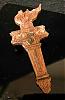
This is my first attempt at inlaying rock into a project. I've often admired rock or metal inlay in work at various shows, so I decided to give it a try. The belt was purchased at NFR in Las Vegas, so I followed the eagle design. The outside wood is Myrtle and the eagle is Maple. The entire process was by far more difficult than I expected trying to get a uniform distribution of stone with CA glue.
[ATTACH]16713[/ATTACH]
My first try at rock inlay
Moderator: admin
My first try at rock inlay
- Attachments
-
- DSC01324 (600x450).jpg (210.3 KiB) Viewed 1608 times
Gary Kalyn
Kalynzoo Productions
Woodworking
Porter Ranch/Northridge
Los Angeles, CA
Kalynzoo Productions
Woodworking
Porter Ranch/Northridge
Los Angeles, CA
-
judaspre1982
- Platinum Member
- Posts: 1237
- Joined: Tue Jul 08, 2008 10:10 pm
=============================
Last edited by judaspre1982 on Thu Apr 27, 2017 5:15 pm, edited 1 time in total.
I used to do a lot of lapidary (gemstone cutting) and my choice for the glue has always been Hughes Laboratories Epoxy 330. It takes about a day to cure, but it is rock hard and can be ground and polished same as the gemstones. When it's done you cannot see the glue at all (if the inlays are cut tightly). Some folks use CA for Intarsia work, but I've never tried that yet.
Hand Engraver of Metals; Maker of Exquisite Kindling; 1955 Greenie Mark V (NOW with a 1989 Headstock); Magna Band Saw; Magna 4" Jointer; Miscellaneous Craftsman & Porter-Cable electric woodworking tools.
3D CADCAM Designs - Gemstone Facetor
3D CADCAM Designs - Gemstone Facetor
Another technique along those lines is to use stone powders/dust and glue it into cracks or defects in wood using CA glue or epoxy. I've used powdered turquoise and CA in the past to fill in the segmented void in walnut pith and though it made a nice contrast. Simply fill the void with the stone powder and then add thin CA sparingly and allow to dry naturally (without the accelerator).
Some years back I talked to a craftsperson at an Arts and Craft festival about the technique being used to fill the voids in rollings pins with stone powder and was told that CA was better because it didn't fall out like epoxy would if the rolling pin was repeatedly washed with water.
I used a small electric coffee bean grinder to pulverize the turquoise, which is soft enough to be done this way. Any stone that you can crush easily would likely work in the grinder. Or you could simply pulverize it with a small hammer and light tapping.
Some years back I talked to a craftsperson at an Arts and Craft festival about the technique being used to fill the voids in rollings pins with stone powder and was told that CA was better because it didn't fall out like epoxy would if the rolling pin was repeatedly washed with water.
I used a small electric coffee bean grinder to pulverize the turquoise, which is soft enough to be done this way. Any stone that you can crush easily would likely work in the grinder. Or you could simply pulverize it with a small hammer and light tapping.
Art in Western Pennsylvania
Like Pennview, I prefer stones crushed to near powder for the smaller inlays. However, yours looks just great. Your time and effort paid off. Good looking buckle!
I usually lay down a little CA in the void and then place the powder or shards, then dribble in more CA. I often add a little powdered "Fools Gold" to the shards. The process of laying in the shards on a bed of CA allows the Fools gold to sift into the spaces between the shards and the final application of CA stabilizes it all.
I usually lay down a little CA in the void and then place the powder or shards, then dribble in more CA. I often add a little powdered "Fools Gold" to the shards. The process of laying in the shards on a bed of CA allows the Fools gold to sift into the spaces between the shards and the final application of CA stabilizes it all.
Gene
'The true soldier fights not because he hates what is in front of him, but because he loves what is behind him.' G. K. Chesterton
'The true soldier fights not because he hates what is in front of him, but because he loves what is behind him.' G. K. Chesterton