I probably should have sought a previous thread to add this to because I know this subject has been discussed many times BUT I get so frustrated trying to find posts that I know exist. This is easier on my blood pressure.
In previous threads, users have commented that table alignment can be frustrating and time consuming and I agree it is. Well, at least it was. I think I have developed a tool that should speed things up and maybe even help to get well aligned Mark 5/V tables to become common place.
This is what I am now using (trial period).
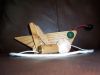
[ATTACH]17223[/ATTACH]
Yup, it just looks like a table insert on steroids.
It's a piece of 3/4" mdf that I shaped as an insert. With my table well aligned, I simply cut the kerf through the 3/4" insert.
Now, when I need to align the table I simply loosen the 4 trunnion bolts, remove the normal insert, set the table height for a deep cut and slide the insert down over the blade. If the insert does not fit into the cutout, I simply move the table around until the cutout and the insert align. Seat the insert in the cutout and tighten the two trunnion bolts that can be reached with the table flat.
Don't forget the other two trunnion bolts.
I just finished doing this and when I double checked the alignment with a dial indicator I found it to be well within my self imposed criteria of +-.005".
The table did shift slightly when I tightened the bolts but not enough to necessitate a repeat.
Main Table Alignment
Moderator: admin
-
dusty

- Platinum Member
- Posts: 21530
- Joined: Wed Nov 22, 2006 6:52 am
- Location: Tucson (Wildcat Country), Arizona
Main Table Alignment
- Attachments
-
- Alignment Tool for Main Table 001 (Custom).JPG (65.83 KiB) Viewed 8737 times
"Making Sawdust Safely"
Dusty
Sent from my Dell XPS using Firefox.
Dusty
Sent from my Dell XPS using Firefox.
Seems to me that wood work, as long as ya cut the orginal slot on a perfectly aligned table and always used the same blade.
SS 500(09/1980), DC3300, jointer, bandsaw, belt sander, Strip Sander, drum sanders,molder, dado, biscuit joiner, universal lathe tool rest, Oneway talon chuck, router bits & chucks and a De Walt 735 planer,a #5,#6, block planes. ALL in a 100 square foot shop.
.
.
Bob
.
.
Bob
-
dusty
- Platinum Member
- Posts: 21530
- Joined: Wed Nov 22, 2006 6:52 am
- Location: Tucson (Wildcat Country), Arizona
Main Table Alignment
Absolutely, you could use the miter tracks and that may be a better universal solution.greitz wrote:Great idea for aligning the table, Dusty!
If you wanted to dedicate two miter bars to the alignment jig, you could use a larger piece of MDF with the two miter bars attached. Or you could use a crosscut table with a zero clearance insert, couldn't you? Same principle, different jig.
Gary
If this proves to be viable, I will probably rebuild my ZCI Sled to incorporate this alignment function.
"Making Sawdust Safely"
Dusty
Sent from my Dell XPS using Firefox.
Dusty
Sent from my Dell XPS using Firefox.
-
dusty
- Platinum Member
- Posts: 21530
- Joined: Wed Nov 22, 2006 6:52 am
- Location: Tucson (Wildcat Country), Arizona
Main Table Alignment
I agree, beeg but I must add a comment or a question if you will. Just what is a "perfectly aligned table". To some, a close enough approach will work. To others, "close enough" is not good enough.beeg wrote:Seems to me that wood work, as long as ya cut the orginal slot on a perfectly aligned table and always used the same blade.
Before I cut my "Insert on Steroids", I tweaked the alignment. In fact I tweaked it and tweaked it and then tweaked it again. Every time I had the problem that others have commented about. The table would shift ever so slightly when I tightened the trunnion bolts.
Having this insert in place did not eliminate that tendency but it greatly reduced it.
When I got done, a test with the dial indicator shows the table to be aligned parallel with the blade to within .002".
Side comment: If you are curious just how closely your table is aligned simply make two inserts. After they are cut, stack them on top of one another and peer through the kerf. Now flip one of them over and peer through the kerf again. Any error in alignment will become obvious.
With regard to using the same blade - I don't think so. One would have to use a blade that is the same thickness but I don't believe it needs to be the same blade.
If one used a blade with excessive run out, that would adversely effect the over all results but I would assume those blades already culled out.
Again - that word excessive. What is excessive?
"Making Sawdust Safely"
Dusty
Sent from my Dell XPS using Firefox.
Dusty
Sent from my Dell XPS using Firefox.
That wood be whatever ya set for yourself.dusty wrote:I agree, beeg but I must add a comment or a question if you will. Just what is a "perfectly aligned table". To some, a close enough approach will work. To others, "close enough" is not good enough.
SS 500(09/1980), DC3300, jointer, bandsaw, belt sander, Strip Sander, drum sanders,molder, dado, biscuit joiner, universal lathe tool rest, Oneway talon chuck, router bits & chucks and a De Walt 735 planer,a #5,#6, block planes. ALL in a 100 square foot shop.
.
.
Bob
.
.
Bob
-
dusty
- Platinum Member
- Posts: 21530
- Joined: Wed Nov 22, 2006 6:52 am
- Location: Tucson (Wildcat Country), Arizona
Main Table Alignment
And I believe that +- .005" is relatively easy to achieve and provides excellent results. However, I have a feeling that this new method will give even better results more easily. Only time and a couple realignments will show for certain.beeg wrote:That wood be whatever ya set for yourself.
"Making Sawdust Safely"
Dusty
Sent from my Dell XPS using Firefox.
Dusty
Sent from my Dell XPS using Firefox.


You say you are worried about alignment. I don't think you can/should make Dusty's alignment jig until you are certain your table is in alignment. Otherwise when you make the kerf for the alignment jig you will just end up reproducing your alignment error. Once in alignment you can make the jig and use it to reset alignment when it gets out of alignment again.missfixit wrote:hmmm how would i make one of these insert guide things? I'm worried about table alignment and the shopsmith is my only table saw now... I could use my dad's table saw ..
Here's a pretty simply test you can do to check to see if you need to perform an alignment.
First, unplug the saw. Mount a saw blade. Pick a gullet on the right side of the blade. Put a dot on it with a magic marker. Using the upper auxiliary spindle on the back side of the headstock, slowly rotate the blade by hand until the dot is at the front of the table and close to the table surface. Now put the miter gauge in the right side miter slot. At the base of the miter gauge casting you will see a hole that goes all the way through. Place the long allen wrench through this hole, long side toward the blade. Adjust the allen wrench so it is just barely touching that dot. Now secure the allen wrench in the miter gauge with a set screw that's inserted through one of the two holes in the top of the miter gauge casting (there's probably a spare set screw in one of holes; otherwise temporarily scavenge one off of the sanding disc arbor).
Now, once again using the auxiliary spindle, rotate the blade until the dot is at the rear of the table and close to the table surface. Slide your miter gauge (with the Allen wrench still locked in the same position) until you reach that dot. If the wrench binds against the blade before getting to the dot, you are significantly out of alignment. Ideally you will reach the dot and the wrench will just touch it. If there's a gap, try to fit a dollar bill between the blade and the wrench. A dollar bill is slightly more than 0.004 (4 thousandths of an inch). If you can't fit the dollar bill between the blade and the wrench, you are good to go, your gap is less than 0.004. If the dollar bill fits in the gap with room to spare, fold the bill over. If there's still a gap with the folded bill, you've got more than 0.008+ alignment error and I'd realign.
Al