Apparently this time they had a jury that could read and write and they found against the plaintiff. Also the suit that was found against Ryobi is under appeal.
Another Sawstop type lawsuit
Moderator: admin
- Ed in Tampa
- Platinum Member
- Posts: 5834
- Joined: Fri Jul 21, 2006 12:45 am
- Location: North Tampa Bay area Florida
Another Sawstop type lawsuit
http://www.woodmagazine.com/blogs/woodw ... wood081612
Apparently this time they had a jury that could read and write and they found against the plaintiff. Also the suit that was found against Ryobi is under appeal.

Apparently this time they had a jury that could read and write and they found against the plaintiff. Also the suit that was found against Ryobi is under appeal.
Ed in Tampa
Stay out of trouble!
- trainguytom
- Gold Member
- Posts: 324
- Joined: Sat Feb 10, 2007 7:22 pm
- Location: Central WI
Just curious
I'm just wondering if there's anyone here who has never removed the blade guard on their table saw? I don't mean that they're currently using the guard, but rather, that they have ALWAYS used the available blade guard ever since they started woodworking.
I suppose it would also be interesting to see how many don't ever use the guards.
I'll start.
I don't.
I never have.
Actually tried it & found to be a pain in the a_ _, never used it since
Still have all my fingers (am currently knocking on wood just to be safe)
I suppose it would also be interesting to see how many don't ever use the guards.
I'll start.
I don't.
I never have.
Actually tried it & found to be a pain in the a_ _, never used it since
Still have all my fingers (am currently knocking on wood just to be safe)

My dad's 1951 10er, 2 more 10er's, same vintage, a Goldie MK5, a 510 shortie with 34inch tubes, bandsaw, jointer, jigsaw, belt sander, a ton of small SS goodies and still looking...you just can't have enough Shopsmith stuff
I have used guards on every table style saw I have ever owned. Yeah at least the first few times I used the machine. After that I read these stories and try them again. Nope the use of such never lasts. Accidents, you bet. In fact I have a hole in a peg board behind my Power Pro to prove it. One member here sent me scurrying to the shop one evening to see the marvelous measurements on the saw guard. Hard to see and even harder to figure out how to use. The older I get the more time I invest in safety. That saw guard is not the answer in my shop. Jimtrainguytom wrote:I'm just wondering if there's anyone here who has never removed the blade guard on their table saw? I don't mean that they're currently using the guard, but rather, that they have ALWAYS used the available blade guard ever since they started woodworking.
I suppose it would also be interesting to see how many don't ever use the guards.
I'll start.
I don't.
I never have.
Actually tried it & found to be a pain in the a_ _, never used it since
Still have all my fingers (am currently knocking on wood just to be safe)
F. Jim Parks
Lakewood, Colorado:)
When the love of power is replaced by the power of love the world will have a chance for survival.
Lakewood, Colorado:)
When the love of power is replaced by the power of love the world will have a chance for survival.
As I am still cleaning my Shopsmith, this applies to my current table saw. If I am ripping a board, you better believe I have the saw guard and anti-kickback on. If I am cross-cutting, it depends on the cross-cut sled I use. If it is just the one that is attached to the miter gauge, then yes the saw guard is one. If I am cutting a wider piece of wood and using my bigger table size cross-cut sled, I do have to take the saw guard off, but I sort of built a guard into it as shown below.

Also while the picture shows the saw blade raised high, that is for demo purposes only. I always set the blade at the appropriate height based on wood thickness.

Also while the picture shows the saw blade raised high, that is for demo purposes only. I always set the blade at the appropriate height based on wood thickness.
- cincinnati
- Platinum Member
- Posts: 1172
- Joined: Sun Apr 15, 2007 6:40 pm
- Location: Cincinnati, Ohio
Back in the home shop as I was growing up none of the saws or other tools had any guards on them. It was like we were not using them, they didn't even come with any.
When I first got a shopsmith it had this metal cover over the blade and I did not like it much an so didn't use it. Some years later shopsmith offered an upgrade guard system and it work well enough so I felt it was a useful portion of the system. So what ever that year was I have been using them ever since.
If shopsmith were to offer a new system of sorts I would look at it but I'm not sure I'd spend the money to get it as I'm pretty happy with what I have.
Ed
When I first got a shopsmith it had this metal cover over the blade and I did not like it much an so didn't use it. Some years later shopsmith offered an upgrade guard system and it work well enough so I felt it was a useful portion of the system. So what ever that year was I have been using them ever since.
If shopsmith were to offer a new system of sorts I would look at it but I'm not sure I'd spend the money to get it as I'm pretty happy with what I have.
Ed
- dusty
- Platinum Member
- Posts: 21530
- Joined: Wed Nov 22, 2006 6:52 am
- Location: Tucson (Wildcat Country), Arizona
There are safety guards and then there are safety guards.
I use some of them some of the time but there is only one that I use all of the time. That one is on the jointer. I never remove it and I almost always use push blocks when working with the jointer.
Ironically, the worst shop injury I have had was while using that power tool which most of you probably consider to be one of our safest. The band saw, and it has no safety guards, can really cut you open. If you need a live demonstration to be convinced - go to any meat market.

I use some of them some of the time but there is only one that I use all of the time. That one is on the jointer. I never remove it and I almost always use push blocks when working with the jointer.
Ironically, the worst shop injury I have had was while using that power tool which most of you probably consider to be one of our safest. The band saw, and it has no safety guards, can really cut you open. If you need a live demonstration to be convinced - go to any meat market.
"Making Sawdust Safely"
Dusty
Sent from my Dell XPS using Firefox.
Dusty
Sent from my Dell XPS using Firefox.
I have been woodworking since I was 16 years old in my dads furniture factory. I worked on table saws shapers overhead routers upholstery equipment band saw and drill presses. the only power tool I was injured on was a band saw. I ran my thumb into the blade.dusty wrote:There are safety guards and then there are safety guards.
I use some of them some of the time but there is only one that I use all of the time. That one is on the jointer. I never remove it and I almost always use push blocks when working with the jointer.
Ironically, the worst shop injury I have had was while using that power tool which most of you probably consider to be one of your safest. The band saw, and it has no safety guards, can really cut you open. If you need a live demonstration to be convinced - go to any meat market.
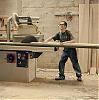
Back in the late 70's our table saw had to 5 horse motor on it. No guards or splitter. Today I would never consider running I saw this size without them. A shopsmith on the other hand would stall if the blade pinched, but I 5 horse table saw would kick back.
If I were purchasing a cabinet grade table saw today for my workers to use I would buy a sawstop.
Jerry
Harrison, AR
Shopsmith Mk V 520
SPT's: jointer, band saw
Harrison, AR
Shopsmith Mk V 520
SPT's: jointer, band saw
I will probably get some negative comments from this post but here goes anyhow.
Why do people have to watch the cut line when using a table saw? The focal point should be where the work contacts the fence. Freehand cuts should NEVER be attempted on any table saw. Either the fence or the miter gauge should be used.
Watching the cut line when ripping on a table saw will tempt the operator to make an adjustment to the cut and invite a kickback.
I had an injury last year that could have been much worse but would have been completely avoided if I used the upper saw guard.
I was getting tired and had a few cuts to go and decided, against my better judgement, to make one last cut. I made the rip cut and then lifted the completed piece off the table and when moved it back to my position the piece caught the top of the saw blade. The piece spun around in my hand, jammed my thumb so hard I thought I broke it and the far end of the piece hit me in the ribs and literally took the wind out of me. No permanent damage but I carried the bruises for several weeks.
My three mistakes,
1. Working when overtired
2. Being inattentive
3. NO UPPER SAW GUARD
My three bads but I didn't sue anybody.
I did the math on this once before and found that a 10" saw blade revolving at 3600 RPM has the teeth moving at over 100 MPH. Bad things happen fast folks so be careful and you won't make red sawdust.
Bill V
Why do people have to watch the cut line when using a table saw? The focal point should be where the work contacts the fence. Freehand cuts should NEVER be attempted on any table saw. Either the fence or the miter gauge should be used.
Watching the cut line when ripping on a table saw will tempt the operator to make an adjustment to the cut and invite a kickback.
I had an injury last year that could have been much worse but would have been completely avoided if I used the upper saw guard.
I was getting tired and had a few cuts to go and decided, against my better judgement, to make one last cut. I made the rip cut and then lifted the completed piece off the table and when moved it back to my position the piece caught the top of the saw blade. The piece spun around in my hand, jammed my thumb so hard I thought I broke it and the far end of the piece hit me in the ribs and literally took the wind out of me. No permanent damage but I carried the bruises for several weeks.
My three mistakes,
1. Working when overtired
2. Being inattentive
3. NO UPPER SAW GUARD
My three bads but I didn't sue anybody.
I did the math on this once before and found that a 10" saw blade revolving at 3600 RPM has the teeth moving at over 100 MPH. Bad things happen fast folks so be careful and you won't make red sawdust.
Bill V