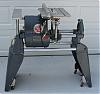
dusty wrote:I think that the reason jointing longer pieces cause a problem is because longer pieces are more difficult to keep in constant contactwith the outfeed table. An extension table for the jointer may be something that would help.
After doing more work on the jointer, the SS fence upgrade (taller) and maybe building an extension for the outfeed wood be money and time well spent. I'll watch the SS sales for the fence, I know I missed it a month or two ago. As for the extension table in your pics, perhaps it is something you could just ship my way...gladly pay the costs.
[quote="mrhart"]After doing more work on the jointer, the SS fence upgrade (taller) and maybe building an extension for the outfeed wood be money and time well spent. I'll watch the SS sales for the fence, I know I missed it a month or two ago. As for the extension table in your pics, perhaps it is something you could just ship my way...gladly pay the costs. ]
You might think you would "gladly pay the costs" but you did not ask what those might be. I have good reason to believe that if you had asked, you would not have said that.
I will, however, share any information that I have so that you can build your own. In fact, I think the details of the one in the photo are already on the forum. I will confirm.
The way that my extension table attaches to the jointer is tailered to my jointer. I know that not all of the jointers are identical in that area.
"Making Sawdust Safely" Dusty
Sent from my Dell XPS using Firefox.
dusty wrote:I hate being the barer of bad news but there is no adjustment for that. You might be able to shim the outfeed table but I don't know how.
You are correct. There is no adjustment for a tilted infeed table. Remove the infeed table and really clean the sliding joint areas and assemble and check the tilt again. Being an "old time shade tree mechanic", I have had some success glueing and shimming one set of the sliding joints to level the tables but it took a few tries. Not a practice that I would recommend.
Now my retired machinest machines the total table surface ($40 for last one) which removes rust, scratches, nicks, warps and any table distortions. Any good machine shop should be able to accomplish this task.
Bill Mayo bill.mayo@verizon.net
Shopsmith owner since 73. Sell, repair and rebuild Shopsmith, Total Shop & Wood Master headstocks, SPTs, attachments, accessories and parts. US Navy 1955-1975 (FTCS/E-8)
I just thought I would share that/I/am having a similar problem with my jointer...but I fear mine issue is the infamous IOD error (idiot operating device)
The problems are several...I have never operated any jointer until tonight when I tried the jointed I picked up second hand.
First, the cut quality is not glass smooth, so I suspect that I need to hone the knives. I am admittedly concerned about the concept of removing the knives and sharpening myself and replacing them. I have no high tech fancy gizmo to measure the height of the knives and I know they have to all be the same height...in thousandths (right?)
Second, I can't seem to get an even cut across the length of a board. I have the depth of cut set at 1/16 and started with a piece of red oak. When that didn't go favorably I tried some 1.5" square pine. I checked the tables with the only straight edge I have (12") and they certainly appear to be flat and level to eachother. I'm not sure how to describe what happens during the cut...but sometime (1/3 of the time) the front of the board gets hung up on the leading edge of the out feed table. I also don't get a flat cut all the way down the length of the board...even after 3-4 passes.
I must be doing something completely wrong here... any suggestions?
'After' you sharpen/hone them:rolleyes:, adjust them to match the outfeed table height. No fancy tooling required, a straight piece of wood or a combination square blade will do. The blades are 'raised' until they just barely drag the wood or blade.
╔═══╗
╟JPG ╢
╚═══╝
Goldie(Bought New SN 377425)/4" jointer/6" beltsander/12" planer/stripsander/bandsaw/powerstation /Scroll saw/Jig saw /Craftsman 10" ras/Craftsman 6" thicknessplaner/ Dayton10"tablesaw(restoredfromneighborstrashpile)/ Mark VII restoration in 'progress'/ 10E[/size](SN E3779) restoration in progress, a 510 on the back burner and a growing pile of items to be eventually returned to useful life. - aka Red Grange
JPG40504 wrote:The blades are lower than the out feed table.
'After' you sharpen/hone them:rolleyes:, adjust them to match the outfeed table height. No fancy tooling required, a straight piece of wood or a combination square blade will do. The blades are 'raised' until they just barely drag the wood or blade.
So you mean I won't need a dial indicator with a mag base to make sure they are set properly?!
eagleta2 wrote:So you mean I won't need a dial indicator with a mag base to make sure they are set properly?!
Huh...go figure!
Thanks
Geo
Yes, but that stuff makes it easier and less time consuming and probably more 'concise'.
╔═══╗
╟JPG ╢
╚═══╝
Goldie(Bought New SN 377425)/4" jointer/6" beltsander/12" planer/stripsander/bandsaw/powerstation /Scroll saw/Jig saw /Craftsman 10" ras/Craftsman 6" thicknessplaner/ Dayton10"tablesaw(restoredfromneighborstrashpile)/ Mark VII restoration in 'progress'/ 10E[/size](SN E3779) restoration in progress, a 510 on the back burner and a growing pile of items to be eventually returned to useful life. - aka Red Grange