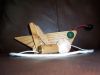
I've posted three pictures of a sidearm writing Windsor chair I made. I constructed the writing surface from Popular wood, but decided a nice figured wood such as Bird's eye Maple would look nice. I was in Minneapolis last week and stopped into Woodcraft looking for a board that would fit the bill. There was nothing that "rang my bell" except on the sale table a packet of veneer BE Maple all book matched. The ten slices were priced at $60 on sale for $20. I couldn't resist it, and the shop manager even thru in a packet of Garlic wood veneer. He said it was stinking-up the store. I had never heard of Garlic wood, but figured I find the use - veneered boxes for close friends. It does smell like garlic, but I don't find it THAT strong. However, I digress here.
I have veneered wood, but ages ago, and I remember I really disliked the smell from the cement in the shop; I'd rather have garlic than those noxious fumes again. Those in the know out there, what do you recommend in a water based veneer that will hold-up well on a writing surface as you see in the pictures? The chair will be painted with milk paint in a salmon color, except for the writing arm surface which I will finish in clear poly.
"... and it was after long searching that I found the carpenter's chest, which was indeed a very useful prize to me, and much more valuable than a ship loading of gold." Daniel Defoe, Robinson Crusoe, 1719
SS 500(09/1980), DC3300, jointer, bandsaw, belt sander, Strip Sander, drum sanders,molder, dado, biscuit joiner, universal lathe tool rest, Oneway talon chuck, router bits & chucks and a De Walt 735 planer,a #5,#6, block planes. ALL in a 100 square foot shop. .
.
Bob
But if you want to use contact cement there is one consideration. With most contact cements there is a strong solvent. It can effect you (bad for your liver and makes you dizzy), it is also very flammable (like in explosion).
Or you can use water solvent cement with none of the problems.
When we were building houses we laminated our own counter tops with formica. We used a spray on water solvent contact cement which worked excellently. Bought ours from the laminate supplier.
Sprayed on like a spider web, but it worked fine.
My wife was using solvant contact cement for parade float and while it had a strong odor it worked fine also.
For your purpose I think regular wood glue with cawl board over the whole surface and clamps would work the best.
[quote="Ed in Tampa"]I think I would use regular wood glue.
But if you want to use contact cement there is one consideration. With most contact cements there is a strong solvent. It can effect you (bad for your liver and makes you dizzy), it is also very flammable (like in explosion).
Or you can use water solvent cement with none of the problems.
Yeah I remember that stuff, Ed. I had to put a fan in the shop window and it still stunk to high heaven. As I remember it now I think it was a counter-top plastic laminate. I have veneered oak sheets, but I don't remember what I used and if it was as bad as the plastic laminate experience; I don't think so. But as you noted, I have no interest in the toxic stuff.
I am leaning to hide glue in the liquid form (thanks for that suggestion). It has a long enough open period, is a nice natural product, is repairable, and I don't think the water in it will create much movement. The trick will be to get good butts on the veneer edges, roll it well, then sandwich it with clamped boards.
Thanks for the kind comments on the chair. I actually did most of the work several years ago before I retired. The chair has been sitting in the shop staring at me. Last winter I made a hutch to serve as a bar in our dining room. I just can't let it stare at me any longer, so this heating season it WILL be finished. That's a long way of saying I didn't take any pictures of the process while making it because I wasn't posting anything then. That said, the process I use is the one I learned from Mike Dunbar at the Windsor Institute. It's all traditional, hand tool work from spoke shaving the red oak spindles, scorping out the pine seat, to using brace and spoon bits to drill holes and lathe turning of legs and cross pieces. Steam is used to bend the parts that need bending. One reason it will be painted is the woods are different based on their characteristics - oak for bending, maple for strength, pine for softness; that's traditional too. IMHO, you cannot learn the process from a book or pictures. You need to take classes, and I took several to get the hands-on feel. It was hard for me at first because there are no right angles in a chair (nor in the human body if you think about it). Yet the right angle is the cornerstone of cabinet work. A lot of what you do is by sight and feel. I will post pictures of this final veneer process and finished work.
"... and it was after long searching that I found the carpenter's chest, which was indeed a very useful prize to me, and much more valuable than a ship loading of gold." Daniel Defoe, Robinson Crusoe, 1719
Beautiful craftsmanship on that chair! Congratulations to you - awesome construction. I really admire your craftsmanship - especially the seat! Man! that takes real talent and patience.
About the glue question - I recommend hide glue.
Octogenarian's have an earned right to be a curmudgeon.
Chuck in Lancaster, CA
I had the reverse experience with water based contact cement. Now I only use the one in the red can. Wear gloves and apply. Bonds forever, especially on veneer. For some commercial applications, where a call back is not an option, the enviro friendly stuff just doesn't cut it, at least for me.

 I had never heard of Garlic wood, but figured I find the use - veneered boxes for close friends.
  It does smell like garlic, but I don't find it THAT strong. However, I digress here.