Hey All,
I've been lurking for awhile here and learning all kinds of neat things about the shopsmith product line.
I recently took the plunge and ended up purchasing two shopsmith Mark V's from a widow of an avid shopsmith woodworker.
I am delighted to be able to refurbish and renew some of the older bits and pieces of the two machines. One of the machines dates back to the mid 50's and is still running fine. Unfortunately, he passed over 6 years ago, and the machines had laid dormant since that time and the wife knew very little about the machines other than that they were still running prior to him passing and that he really loved them.
At this point, most of the equipment still runs fine with a bit of spit, polish and lube.
However, I have noticed that the jointer, which also dates back to the mid 50's (it's a greenie jointer) is out of alignment and I first noticed that I could not joint a straight edge after about 18-20". It kept sliding on the outfeed side without cutting after that point and I followed general jointing technique of applying downward pressure and pressure against the fence throughout the procedure. This eventually produced a significant bow toward the end of the board with multiple joint runs.
I then got out a long straightedge and noticed that the infeed table was not parallel with the outfeed table. Actually, the infeed table tilts downward by a little less than 1/16" from the beginning of the infeed table to the end (when placing straight edge across both the infeed/outfeed table). The hex nut assembly is not too tight and actually, the tilt is a bit better when it is looser, however by keeping it loose, the infeed table tends to wobble front to back a bit (of course not ideal). Even with the looser fit, I still get a slight bow, not as bad as when the hex nut is tightened so as to not allow the infeed table to wobble.
I was reading on the lumberjock forum that I may need to actually have the rails where the two pieces of the jointer meet blanchard ground so that they can become parallel again. It seems that this is the only fix unless I somehow shim the front rails with some type of very thin material that still would allow the infeed and outfeed to slide up and down relative to each other.
Any help or possible solutions would be greatly appreciated. If I do need to have the rails ground down, where would the best place be to have this done. I really do want to salvage this little vintage jointer. Other than the loss of alignment, it still runs great and cuts smooth with blades sharply honed.
Just to note, I completely separated the pieces, cleaned the rails thoroughly (very clean but definitely well worn from years of use) and then re-joined them together. Still the same amount of tilt downward on the infeed side.
Cheers,
John
Old Shopsmith jointer tables not in parallel
Moderator: admin
Old Shopsmith jointer tables not in parallel
- Attachments
-
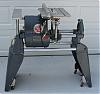
- Infeed/outfeed table out of alignment
- Shopsmith router table mis-alignment..png (11.81 KiB) Viewed 3685 times
Re: Old Shopsmith jointer tables not in parallel
Yes, I had the jointer tables blanchard ground on one joiner so that they can become parallel when I used the infeed table from one joiner and the outfeed table from a separate joiner. Both joiners had a damaged table that I could not weld successfully. This was done at a machine shop that did auto engine heads. I also did a second joiner where the rust on the table surfaces was too deep to sand out. If each of the table surfaces are really flat, you could play with thin shims under the mating surfaces. I have found two joiners that had Impact-Resistant Slippery UHMW Polyethylene strips between the mating surfaces. These were factory made shims that was used at one time. I used steel shims on one joiner to align the two tables because the table surfaces were flat. Each factory joiner has its table surface Blanchard ground so the tables are not interchangeable.
-
rcplaneguy

- Platinum Member
- Posts: 549
- Joined: Mon Sep 23, 2013 6:33 pm
- Location: Chapel Hill, NC
Re: Old Shopsmith jointer tables not in parallel
[youtube]https://youtu.be/sesxx-U_0FU[/youtube]

Re: Old Shopsmith jointer tables not in parallel
Ron Dyck
==================================================================
10ER #23430, 10ER #84609, 10ER #94987,two SS A-34 jigsaws for 10ER.
1959 Mark 5 #356595 Greenie, SS Magna Jointer, SS planer, SS bandsaw, SS scroll saw (gray), DC3300,
==================================================================
10ER #23430, 10ER #84609, 10ER #94987,two SS A-34 jigsaws for 10ER.
1959 Mark 5 #356595 Greenie, SS Magna Jointer, SS planer, SS bandsaw, SS scroll saw (gray), DC3300,
Re: Old Shopsmith jointer tables not in parallel
Thanks for the input! I will probably eventually have to go the route of blanchard grinding. In the meantime, I may try shimming the forward rails with thin strips of different types of material.
I definitely want to be able to re-use this very old and solid piece of equipment. I guess 50 years of use will even wear down solid cast iron.
That blanchard grinding is no joke! I loved how being off about 7/1000 caused one customer to send back the ground unit to the workshop! Very strict tolerances indeed!
I'll let you guys know how the shimming operation goes and what I decide to do in terms of grinding the infeed and outfeed table down. It would be nice to have a nice clean finish on it again.
Cheers,
John
I definitely want to be able to re-use this very old and solid piece of equipment. I guess 50 years of use will even wear down solid cast iron.
That blanchard grinding is no joke! I loved how being off about 7/1000 caused one customer to send back the ground unit to the workshop! Very strict tolerances indeed!
I'll let you guys know how the shimming operation goes and what I decide to do in terms of grinding the infeed and outfeed table down. It would be nice to have a nice clean finish on it again.
Cheers,
John
Re: Old Shopsmith jointer tables not in parallel
Well, it seems as if a little shimming with simple plastic pieces that are roughly 1/64" and 1/128" has helped quite a bit.
I get just the slightest bit of cupping indentation in the middle. A thin sliver of 1/128" right in the middle of the jointed side on 26" long boards. Not perfect, but glue should fill that gap without issue. It no longer stops jointing after about 18-20" and causes extreme outward bowing.
I also was a bit disheartened when I called various machine shops around the durham/raleigh NC area and could find nobody that performed blanchard grinding on anything longer than 24". Plus, one of the machine shops started laughing and "gave me some advice" and told me to get rid of my shopsmith. Clearly, not helpful in this situation.
I also noticed that the infeed table is not entirely flat which may also account for that slight 1/128" center cupping.
I will keep looking for an appropriate shop to see if they can help me grind down the tops. I have heard that cast iron can deform a bit with age so along with the slight downward tilt on the rails, that may be what I am seeing.
Cheers,
John
I get just the slightest bit of cupping indentation in the middle. A thin sliver of 1/128" right in the middle of the jointed side on 26" long boards. Not perfect, but glue should fill that gap without issue. It no longer stops jointing after about 18-20" and causes extreme outward bowing.
I also was a bit disheartened when I called various machine shops around the durham/raleigh NC area and could find nobody that performed blanchard grinding on anything longer than 24". Plus, one of the machine shops started laughing and "gave me some advice" and told me to get rid of my shopsmith. Clearly, not helpful in this situation.
I also noticed that the infeed table is not entirely flat which may also account for that slight 1/128" center cupping.
I will keep looking for an appropriate shop to see if they can help me grind down the tops. I have heard that cast iron can deform a bit with age so along with the slight downward tilt on the rails, that may be what I am seeing.
Cheers,
John
Re: Old Shopsmith jointer tables not in parallel
Wanted to give a quick update. I tossed the shims because they kept sliding out with adjustment and they were simply a stop gap measure to see if I could get the infeed and outfeed coplanar again by adjusting the rails that slide against each other.
I never found a blanchard grinder large enough in the area that could grind down the 28" length of the jointer table, however, one of the old workers at one of the metal mills just got out a 12" flat mill bastard and started milling the top of the surfaces off. He was taking off little by little and could see that it could work if I kept at it for an hour or two. It would also save 150 dollars or so compared to flywheel milling down the surfaces.
Well, I purchased a mill bastard and milled the top slowly and found that there were definite high spots and low spots (mild deformation). I just milled the high spots slowly but surely out and it helped a lot. I also very, very slowly and carefully milled the rails as well.
In the end and after many man hours, the jointer is back in its coplanar state and now works as it should!
I very much appreciated the comments and suggestions. Wish I had a large blanchard grinder in the area that could have shaved (no pun intended) some time off of the process.
I enjoyed restoring it, but given the time and effort, I might just buy a newer shopsmith jointer model off of ebay.
I just wanted to update the thread to help any people out in the future if they run into the same issue.
Cheers,
John
I never found a blanchard grinder large enough in the area that could grind down the 28" length of the jointer table, however, one of the old workers at one of the metal mills just got out a 12" flat mill bastard and started milling the top of the surfaces off. He was taking off little by little and could see that it could work if I kept at it for an hour or two. It would also save 150 dollars or so compared to flywheel milling down the surfaces.
Well, I purchased a mill bastard and milled the top slowly and found that there were definite high spots and low spots (mild deformation). I just milled the high spots slowly but surely out and it helped a lot. I also very, very slowly and carefully milled the rails as well.
In the end and after many man hours, the jointer is back in its coplanar state and now works as it should!
I very much appreciated the comments and suggestions. Wish I had a large blanchard grinder in the area that could have shaved (no pun intended) some time off of the process.
I enjoyed restoring it, but given the time and effort, I might just buy a newer shopsmith jointer model off of ebay.
I just wanted to update the thread to help any people out in the future if they run into the same issue.
Cheers,
John
-
dusty

- Platinum Member
- Posts: 21530
- Joined: Wed Nov 22, 2006 6:52 am
- Location: Tucson (Wildcat Country), Arizona
Re: Old Shopsmith jointer tables not in parallel
BUT FIRST...Ask yourself why the previous owner would sell his jointer on ebay. Will it be any better than what you just worked on.Sazerac81 wrote:Wanted to give a quick update. I tossed the shims because they kept sliding out with adjustment and they were simply a stop gap measure to see if I could get the infeed and outfeed coplanar again by adjusting the rails that slide against each other.
I never found a blanchard grinder large enough in the area that could grind down the 28" length of the jointer table, however, one of the old workers at one of the metal mills just got out a 12" flat mill bastard and started milling the top of the surfaces off. He was taking off little by little and could see that it could work if I kept at it for an hour or two. It would also save 150 dollars or so compared to flywheel milling down the surfaces.
Well, I purchased a mill bastard and milled the top slowly and found that there were definite high spots and low spots (mild deformation). I just milled the high spots slowly but surely out and it helped a lot. I also very, very slowly and carefully milled the rails as well.
In the end and after many man hours, the jointer is back in its coplanar state and now works as it should!
I very much appreciated the comments and suggestions. Wish I had a large blanchard grinder in the area that could have shaved (no pun intended) some time off of the process.
I enjoyed restoring it, but given the time and effort, I might just buy a newer shopsmith jointer model off of ebay.
I just wanted to update the thread to help any people out in the future if they run into the same issue.
Cheers,
John
"Making Sawdust Safely"
Dusty
Sent from my Dell XPS using Firefox.
Dusty
Sent from my Dell XPS using Firefox.
-
BuckeyeDennis

- Platinum Member
- Posts: 3814
- Joined: Tue Jul 24, 2012 10:03 pm
- Location: Central Ohio
Re: Old Shopsmith jointer tables not in parallel
Most likely, because he or she bought a bigger jointer.dusty wrote:BUT FIRST...Ask yourself why the previous owner would sell his jointer on ebay. Will it be any better than what you just worked on.

The SS jointer is outstanding, within its capacity. But face-jointing 6-8" boards is not its strong suit.
Re: Old Shopsmith jointer tables not in parallel
True dusty, I think the reason for selling a perfectly fine piece of equipment is always an important question to ask. Whether they tell the truth is another issue altogether. However, I feel like a lot of the stuff on eBay is from people that have unfortunately passed away or are downsizing their houses or even never used their shopsmith much at all. Some just treat woodworking as a simple whim and find that they didn't realize it would take time, effort and patience to hone the skills necessary to utilize the shopsmith to good effect....
Those are the units that I want to purchase. With that said, I picked up another shopsmith for the planer and it too has another router attached to it.. Hmm, which one to keep. It's too bad I don't know hot to weld, I would consider welding on the infeed table on the second unit to the outfeed table of the first unit to create some more room on the outfeed side.
Those are the units that I want to purchase. With that said, I picked up another shopsmith for the planer and it too has another router attached to it.
. Hmm, which one to keep. It's too bad I don't know hot to weld, I would consider welding on the infeed table on the second unit to the outfeed table of the first unit to create some more room on the outfeed side.