RexLumber
Hello,
I have been reading this forum off and on for the last week, as I think I am in the market for an old Shopsmith. My intended uses for the machine are lathe, drill press, sander, and horizontal borer. My small shop already has a table saw, band saw, jointer, planer, drill press and scroll saw. I am thinking I can sell my drill press to help make room for the shopsmith.
I have noticed several 10ER and Model 500 (greenies and goldies) units for sale in my area. I am having trouble finding information regarding each model's lathe capabilities. I think I read somewhere that the model 500 has approximately a 16" swing. I can't seem to find swing for the 10ER, nor how long of a work piece either machine can handle in lathe mode.
I've also seen some opinions that the 10ER is more stable as a lathe, while the model 500 has the advantage of a larger motor (particularly if one gets a later enough goldie or newer).
I don't see using the table saw functionality, though I have a friend with a 510 and a stand alone cabinet table saw who says he uses the table saw on his 510 more often than the stand alone machine, so I guess I shouldn't rule that possibility out.
Can you point me to where I can find the lathe specs for each? And while I am sure they are both quite usable machines, is there any particular reason why I should choose one over the other given my intended uses?
edflorence
Hi Rex;
Interesting question, as I have been thinking myself of getting a third Shopsmith, which I would dedicate to use only as a lathe. Assuming my plans to build a larger shop space actually come to pass. In that case, I will be looking for a 500, for a couple of reasons. First, the upgrades to the 500 seem to be mostly about improvements to the table saw function, and don't affect the machine when used as a lathe. Others on the forum can correct me if this is not the case. Second, the improved tool rest might not work on the 10, and it is such an improvement to the lathe that it really is a "must have" if you intend to do more than a few turnings. Finally, as you point out, you can get a 500 with the larger horse and an eight motor. By adding the speed reducer into the mix you can get the rotations down around 100 rpm or even less, which is useful for large pieces, and with the 500 it is a simple matter to take a piece up to much higher rpms for sanding. And even though the 500 does not have a reversing motor, it does have an outboard drive hub. It is not hard to rig up a tool rest for the left end, and then you can take bowls, still on the faceplate or in the chuck, and finish turning them on the outboard drive hub, which reverses the grain. I think you would be happy with the 500 as a lathe. Ideally I would like a 500 mounted on a box of sand, at just the right height for me, and never move it.
RexLumber
Hi Ed,
Thanks for the response. Your points are noted, especially about the tool rest improvement. How was the tool rest improved?
I found that
Shopsmith says that the Mark V lathe has a 16-1/2" swing and a 34" distance between centers. If I understand things correctly, that applies to all 500, 510, and 520 machines. Is this correct?
Does anyone know where can I find the 10ER lathe specs? Doesn't the 10ER have a shorter bed than the 500? I assume that has an impact on the distance between centers.
I did see that the
Shopsmith lathe duplicator, which does not seem be available to buy new at this time, does not work with the 10ER.
It's looking like the 500 is the way to go for me.
RFGuy
RexLumber wrote
Hi Ed,
Thanks for the response. Your points are noted, especially about the tool rest improvement. How was the tool rest improved?
Rex,
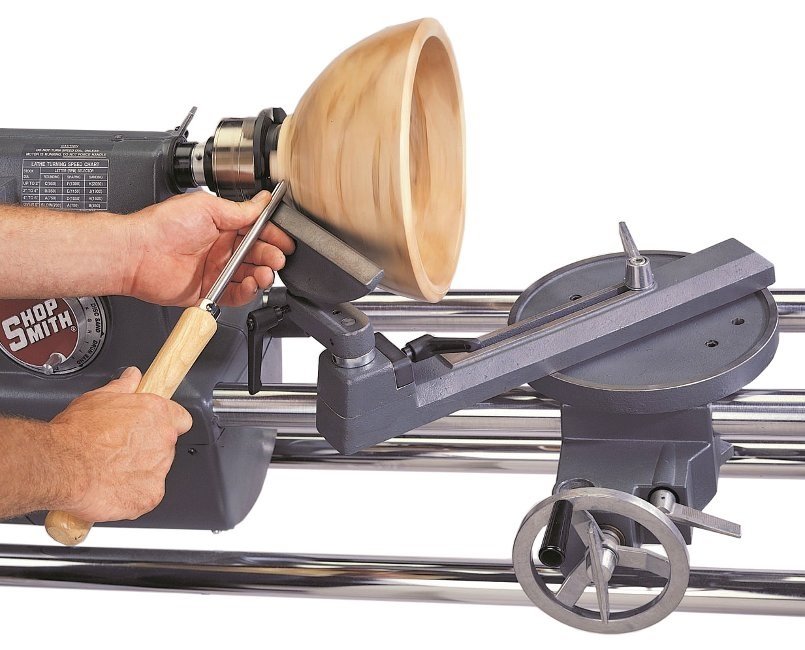
Welcome to the forum! I believe Ed is referring to the Shopsmith Universal Tool Rest (UTR). I am still a woodturning newbie having only gotten into it a few years ago, but have been woodworking for decades. IMHO the UTR is well worth it and is a substantial improvement over the standard tool rest (see link below). It has unfortunately gone up quite a bit in price the last year or so. Mine was around $250 new from Shopsmith, but it is now $319. I agree with Ed's comments above. The one/only disadvantage that I can think of for you in woodturning using a 500 is there is no reverse. So, if you do a lot of woodturning and want to go in reverse for sanding, e.g. to finish a bowl after turning, then you can't easily do this with a 500. There is the PowerPro upgrade from Shopsmith which goes in reverse, but it is EXPENSIVE. Honestly for primarily woodturning...if you want reverse (for sanding) you would be better off going with another brand lathe. Not trying to talk you out of Shopsmith, but just give you some things to think about. Good luck!
https://www.shopsmith.com/ownersite/catalog/l_univlathetoolrest.htm
[deleted]
The Shopsmith Model 10E & 10ER has a lathe capacity of 33" with a 15" swing as listed in its brochure. I can do turnings up to 13" in diameter and spindles up to 33" long or longer if I made an extension. Some creative owners have made extensions for their Shopsmith which include both Model 10's and Mark series tools. The Model 10's are a heavy tool weighing in at around 200 pounds depending on when it was made. Changes to parts during production changed the total weight somewhat.
A Mark V (any model) with the Shopsmith Universal Tool Rest will add additional total weight to the Shopsmith and adds stability. There is a difference between the models of the Mark V when it comes to the Lathe function. It is the Table System that makes the difference between the models and the Carriage is part of that difference. The Mark 5/V with the original Table System, aka 500 has a different Carriage and Lathe Tool Rest Assembly than the other models of the Mark V. The Universal Lathe Tool Rest will work on either Carriage. The Lathe Duplicator will work on either Carriage but it is not designed to work on the Model 10E & 10ER or Mark 2.
It has been suggested if you wanted to turn a bowl in reverse for sanding you could attach it to the left side of the Headstock on the upper Auxiliary shaft. Putting the Tailstock on the left end of the Mark V you could reverse the rotation of a spindle for sanding also if it is not too long. Due to the Carriage the distance between the Headstock and the Tailstock on the left end is shorter than the listed capacity of 34" for Lathe Turning.
If you have been looking at the catalog for the Mark 4 do know that the spindle capacity is shorter than the listed length of 34" which is the length for the other Mark models. The Mark 4 has shorter Bench and Way Tubes than the Mark V models and Mark 7. The online catalog has that length listed incorrectly although the Mark 4 has the same diameter capacity as other Mark series models.
[deleted]
The 10ER way tubes are the same length at the MK series Shopsmith's. The 10ER head stock is (I believe) narrower than the MK head stocks so the turning length should be the same or slightly longer. I would have to measure mine (I have both) to be sure. The 10ER is heavier than the MK V so that is a plus. As for the UTR, it just clamps to the MK V carriage so I see no reason it would not clamp to the 10ER carriage. The carriage just needs to be flat on top which the 10ER is.
As far as SS saying things won't work on the 10ER, I believe that is a lawyer/liability thing. While some things actually physically don't fit others do but SS says they don't because they don't support the 10ER.
JPG
"As far as SS saying things won't work on the 10ER, I believe that is a lawyer/liability thing. While some things actually physically don't fit others do but SS says they don't because they don't support the 10ER."
Ditto Mark VII.
edflorence
RFGuy wrote
RexLumber wrote
Hi Ed,
Thanks for the response. Your points are noted, especially about the tool rest improvement. How was the tool rest improved?
Rex,
Welcome to the forum! I believe Ed is referring to the Shopsmith Universal Tool Rest (UTR).
Exactly right. Thanks for posting the picture...
edflorence
chapmanruss wrote
It has been suggested if you wanted to turn a bowl in reverse for sanding you could attach it to the left side of the Headstock on the upper Auxiliary shaft. Putting the Tailstock on the left end of the Mark V you could reverse the rotation of a spindle for sanding also if it is not too long.
That is a good idea...I will have to remember it! You can also simply swap the spindle end for end on the right side of the headstock, which would not decrease the available length . However, this method is tricky as far as maintaining the spindle's centerline. If I were to try it, I would prepare both ends of the stock for the drive center before I started to turn. That is, saw diagonals both directions on both ends, and then use an awl to dimple the center point on both ends.
JPG
Hmmmm! We jumped from bowls on the rear end to spindles on the rear end.
What next? :D
Never mind - just dawned - reverse spindle on the front end. DUH!!! :eek:
Need to read sl ow er.
RFGuy
Rex,
As the other forum members indicated, it is possible to mount the UTR to the 10ER. It just isn't an "out of the box", bolt on kind of thing from what I understand. I have definitely seen past posts where other forum members have successfully done this on the 10ER. I will link a post below, but I know there are others because the one I remember in my mind I haven't been able to find yet. IF you have access to a good quality 10ER locally and want to go that route it is certainly an option.
https://forum.shopsmith.com/viewtopic.php?p=258905#p258905
RexLumber
My thanks go out to each of you who have taken the time to respond to my query! I'm learning thanks to your input.
I don't think any of the Shopsmiths I have seen for sale on FM or CL have had the Universal Tool Rest. And it is good to know that the UTR can be attached to the 10ER. Most of the machines I see in my price range are either 10ER or Model 500. I did see one Mark 4...
I think it is probably ok if the Shopsmith lacks some functionality of a standalone lathe. The reality is that I have never used a wood lathe. I know there is going to be a learning curve. I just have aspirations to do some turning (I have a project now where having a lathe, and lathe skills, would be useful). My space is limited so I am attracted to the idea that I that I could get turning capability, drill press functionality and sanding to boot. And I have been curious about the Shopsmith since I was briefly introduced to it some 30 years ago.
Some of the machines I see for sale are missing a part or two and/or the owner doesn't know anything about the machine. I guess I need to find a diagram of the old models; I presume they are somewhere on this site.
RFGuy
Rex,
Sorry, I hope I didn't complicate things too much by bringing up sanding for woodturning. As a newbie, I believe you will be very happy woodturning on ANY Shopsmith. I don't have reverse on mine, but I know professional turners use it for sanding. Of course professional turners often need very little, if any sanding on their creations. The type of chisels used and technique (dependent on wood species) can leave a silky smooth woodturning without sanding - similar to using hand planes for woodworking, i.e. no sanding required. It is just a consideration, but if you are just starting out then probably don't worry about it. I am still relatively new to woodturning and I still have to sand at the end. You can still sand on the lathe in the forward direction, but you have to be mindful of grain direction and some wood species are better than others for this. You can sand by hand, but many run their lathes while using a power tool like in the video below. For those of us that still need to sand our turning, powered sanding (cordless drill, etc.) can be a real life saver. Good luck with whatever you decide and keep asking any questions here. There are several very talented woodturners on this forum who can respond.
P.S. You will need to decide what kind of woodturner you want to be. There are two main camps. One uses standard lathe chisels and sharpen them often. The other use carbide cutter insert tools like Easy Wood Tools (link below). Standard lathe chisels require technique and discipline and
always sharpening
while turning, but can result in a smoother finished product that needs less sanding. Carbide insert cutting tools work great on the lathe and you can get very good results with them as well, but the learning curve is much less steep to use them compared to standard chisels. It still requires technique, but just easier so most newbies gravitate towards them. I have both, but have the most experience on the carbide cutters for woodturning, though I hope to get better with standard lathe chisels in the future. I am just not there yet. Think of carbide cutter lathe tools as scraping/shearing the wood, whereas a sharp lathe chisel with the proper grind angle actually cuts into the wood (often along the grain lines). It is wood species dependent, but often woodturnings from standard lathe chisels require little to no sanding typically. Tearout tends to be worse using carbide cutters compared to using sharp standard lathe chisels with proper technique.
P.P.S. There are lots of resources, but I like
Carl Jacobson and
Ashley Harwood so check out their YouTube channels for techniques, ideas, etc. Ashley does hands on classes where she lives in South Carolina. If I lived closer, I would have already taken one from her. She is world renowned for her woodturning skills and even takes classes/demos to other countries on request. I own both of Ashley's video courses on the The Wood Whisperer Guild. It is an excellent video tutorial on woodturning using standard lathe chisels and is fairly inexpensive if you want to consider them. They are very thorough.
https://www.easywoodtools.com/
https://thewoodwhispererguild.com/product/bowl-turning/
https://thewoodwhispererguild.com/product/spindle-turning/
RFGuy
Rex,
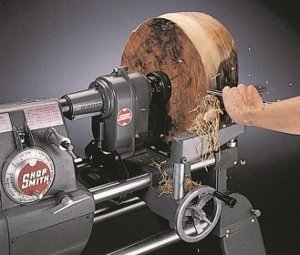
Do you know what types of woodturnings you want to do? The reason that I ask is it may make a difference in what machine you buy or at least what accessories you need with it. Most spindle turnings tend to be small diameter and can be turned at higher speeds. However, if you intend to turn bowls particularly larger ones then you MUST start at lower speeds. Even a perfectly round bowl blank will not necessarily be balanced due to different wood density across the blank. So you have to start at a much lower speed typically with these compared to spindles. For the Mark V (500, 505, 510, 520) or newer Mark 7 you can buy the Shopsmith speed reducer and this helps greatly. I don't know if the speed reducer works on the 10ER or not, but I am sure other forum members here will chime in. Running a wood lathe on too high of a speed and with an out of balance bowl blank will create significant vibration and can even cause the machine to skip across a floor. Also can be more dangerous. I recommend getting an impact resistant face shield and wear it while turning. I know of other turners who have had pieces break off and fly and hit them in the face damaging their teeth, etc. Woodturning can be very safe, but you need the proper safety equipment like anything in woodworking. Always respect when working with any machinery.
https://www.shopsmith.com/ownersite/catalog/speedreducer.htm
roy_okc
RexLumber,
I'll toss out my experiences and thoughts on using a 500 as a lathe. I bought a used 500, in pretty good condition, around 15+ years ago, it was built, if I remember correctly around 83-84, so it is a grey model, but single bearing quill; it came with a bandsaw and jointer. I can't remember what all I thought I might do with it when I bought it, but trying woodturning was definitely on the list.
I took a class via the then available travelling Shopsmith Academy (or whatever it was called) that gave a hands-on overview of the machine, to include turning a pen (still have that pen #1). I bought a lathe chisel sharpening jig to take care of the pretty dully chisels that I got, and a few other small accessories and turned several pens, maybe a few other smalls. A year or two after buying the 500, I took a general woodworking class at a local vo-tech, and one of the topics was woodturning, with an outstanding local professional turner who has taught at Marc Adams' school as the guest instructor for an evening. After that, I started turning a few larger items between centers, up to a table lamp base. Then I discovered a local woodturners group and started attending their meetings and after much inspiration decided to try my hand at bowls and hollow forms which is where my setup showed its weakness. When turning pieces with the right end unsupported, after turned round and balanced between centers, I got what I can best describe as a random harmonic vibration that could shake the whole machine. To stop the vibration, I had to remove the chisel from the piece, let the vibration stop, and then continue. I tried upgrading to a dual-bearing quill with no luck, made sure I didn't have any play between the 4-jaw chuck and adapter, and probably a couple other things that I can't remember; these got the vibration reduced/less likely to occur, but never entirely eliminated it. Maybe the issue was in the chuck adapter (both chuck and adapter were from Penn State Industries) and I never got all the play out. Other issues for me are that the 500 is louder than modern wood lathes, can be too fast even at the lowest setting for rough turning larger blanks, and the worst for me is the height. I'm just a hair over 6' tall and found that the lathe is several inches too low, causing me to bend over a lot and end up with a sore back when I turned for a couple hours or more; I could reduce that problem a bit by putting the feet on top of a 4x4 on each end but really needed a couple inches or so more than that. I eventually bought a used Jet midi lathe which is so much quieter, smoother, wider speed range, and can be set at optimum height; the lesser power nor smaller capacity hasn't generally a problem on it for what I do.
Above is not intended to dissuade you from getting and using a Shopsmith, it was a great platform to see if I was interested in turning, and since the previous owner included the original chisels, it was really no extra cost other than the sharpening jig I bought to get started. If I only wanted to turn between centers, I might have not bought the midi lathe and built taller blocks to get it to a better height for me. Also, if I wanted to turn something longer than the midi can take, I can still use the Shopsmith.
RexLumber
Hi RFGuy,
With regard to the type of wood turning products I want to make, my aspirations mostly involve vintage house parts. I am restoring a Queen Anne Victorian residence. All of my vintage (and not so vintage) power tools in my shop are used for this task. I have had miscellaneous turned parts produced for me by a local woodturner (who has done very good work for me), but he is *very* busy. I have more parts to produce; turned balusters are on the immediate agenda. That's why I mentioned the Shopsmith lathe duplicator.
Good point on the face shield... I've seen folks using them in various turning videos. I do have one.
RexLumber
Roy, thank you for sharing your experience. The NVH point you make is interesting.
Everything I envision doing would be between centers. The largest pieces I imagine turning would be a porch column bases or capitals, or repair sections for column ends, all on the order of 6" in diameter. Or perhaps turning a similar piece for one of my neighbors...
RFGuy
Rex,
Honestly, it sounds like you are doing more production work or semi-production work and doing some rather large mass (6" diameter by how long porch columns?). Just my opinion, but I wouldn't recommend this on any Shopsmith. In earnest the Shopsmith is a hobbyist platform and some do use them for production work for some types of woodworking. However, knowing your intent now and to leverage off of Roy's feedback, I really would NOT recommend a Shopsmith platform for this. You will need low speed to turn those large porch columns. Yes, there have been the occasional person post on this forum about taking on such a massive project using a Shopsmith. One even connected two of them together to turn a large column. In my opinion this is dangerous, especially for a new person to woodturning. Also the speed reducer takes up carriage space so you have even less bed length for a turning. IF you want to take this on, I highly recommend getting a serious quality lathe...one with cast iron bed and legs. You will need the weight and rigidity to tame the vibrations from turning such a large, off-balance mass. Also a good quality lathe will be able to give you the low speed range that you need and will have better concentricity than the Shopsmith platform - also better able to handle the load forces required for such a large turning. I don't have Roy's experience, but I echo many of the points he raised. I am 6'0" tall and the Shopsmith platform is too low to do woodworking on so I have to sit on a stool. I wouldn't recommend this for turning a large mass like a porch column because if it happens to come unseated you want to be able to get out of the way as fast as possible.
RexLumber
To be clear, I am talking about repair sections for columns, not full columns. Maybe 12-16" long by 6" diameter. If a blank for a 14" diameter bowl could be turned on a Shopsmith (as I've read on this forum), why not what I describe?
Regardless, my immediate pursuit is balusters...
RFGuy
RexLumber wrote
To be clear, I am talking about repair sections for columns, not full columns. Maybe 12-16" long by 6" diameter. If a blank for a 14" diameter bowl could be turned on a Shopsmith (as I've read on this forum), why not what I describe?
Regardless, my immediate pursuit is balusters...
Rex,
My advice keeps changing on this thread and for that I apologize. I made false assumptions of what you intended to use it for. Let me start over. Given the information I have now, I would say it is "possible" to do small sections, 6" diameter x 16" long on any Shopsmith. However, this a good amount of mass. We haven't even talked about the wood species, how wet it is, etc. I can't say 100% that this will be smooth sailing on every Shopsmith because some of the older ones have smaller motors and may not be up to the task for this size of turning. IDK. Yes, some Shopsmiths have successfully turned large bowls, using a speed reducer and/or on the newer PowerPro headstock. Just because you see a pretty picture in a Shopsmith catalog/website with a large bowl don't assume it was easy and/or that the turner didn't have a ton of experience to begin with before hopping on that Shopsmith. The largest bowl I have done so far is 8" as that is all I am comfortable with at my current skill level. As Roy stated and I am reiterating that the Shopsmith platform can be used for woodturning, but there are some caveats to it as already mentioned. Doing a lot of work on it for woodturning is going to be very fatiguing unless you are short in height. A stool helps (or putting the machine up on a platform), but the body dynamics are just not right for it as-is unfortunately. It is a compromise because if the machine were taller then it would be too high for tablesaw, etc. modes. Sure you can buy a cheap used Shopsmith, but it sounds like you will likely need a speed reducer and a lathe duplicator for sure and potentially a universal tool rest. Unless you can find all of these on the used market, I really think you need to look at the economics of it and think about how many of these turnings you have to produce. What I am saying is it is "possible" to do all of this on a Shopsmith, but you may be much happier, more productive, less fatigue and body aches going with some kind of dedicated lathe instead. I don't know the pricing of duplicators for other machines, but I know when you add up those 3 accessories at new Shopsmith prices you are well on your way to owning a solid dedicated lathe (assuming you have room in your shop for it), so buying a Shopsmith for this particular semi-production work may not be in your best interest. Anyway, I hope this helps and sorry for any confusion I may have caused.
