hfmann wrote: Tue Jan 20, 2026 11:29 am
Thanks guys for your detailed feedback.
I'm pretty sure I had at least two ports open at the same time these clogs took place. The next time I plane, I'll try shutting it down to the one port. It's such a hassle to take the manifold off to unclog it, I'm hesitant to test it until I need the planer again.
As to the anemometer, you're right, it's probably the cheapest one I could find. It would be interesting to see what it says with the manifold on and various # of open/closed ports.
I have a similar, but different brand anemometer that I got off of Amazon. My point was just that we are at the limit of what these economical anemometers can achieve and measure due to the high airspeed involved. When I started investigating my DC-3300, it was only because the DC-3300 is such an anemic dust collector that I was able to get what I would consider "good" measurements off of it, i.e. I believe my measurements were comfortably inside the rated specs of my anemometer. I don't have a DC-6000, but based on the anemometer measurements Dusty was able to make before his broke, it looks like the DC-6000 is a definite improvement on the DC-3300. Jim McCann at Shopsmith communicated to Dusty that he believed the DC-6000 should be able to maintain 200CFM at all three ports of the manifold
simultaneously, but based on Dusty's findings this appears to be incorrect. As I, and others, have suspected on this forum, the limiting factor seems to be that 3 port manifold as it is very restrictive and I am sure causes A LOT of internal turbulence restricting airflow when more than 1 port is used at a time. Returning to what you measured, your DC-6000 appears to be a bit stronger in suction than Dusty's but it could just be the difference in test setup between the two of you. Dusty was quite thorough in constructing a coupler to optimize testing with the anemometer (see link below). At 200CFM, that is nearly 6000ft/min of airspeed through a single port of the DC-6000. I know the large dust collectors on the market, when they test them, they use a pitot tube style anemometer inserted into the ducting. Once you start getting close to that 6000ft/min airspeed, I believe you are getting at the end of range for most of these off-the-shelf, economical anemometers. The rated specs for your BT-100 show a max airspeed of 67.1mph (5905 ft/min), so anything that meter shows above this is off-scale. It might be reading close to accurate, but then again it could be wildly off. Who knows, your DC-6000 may be even more powerful than what your meter shows. Up to you if you want to take more measurements or not. It is fun. I was just trying to point out some of the limitations we have, both in testing and in interpreting the data. Thanks for giving us another datapoint on the DC-6000's performance.
viewtopic.php?p=304046#p304046
viewtopic.php?p=304121#p304121
P.S. It sucks that Shopsmith stopped selling that manifold replacement for the DC-3300 that would give you a 4" connection instead.
viewtopic.php?p=277212#p277212
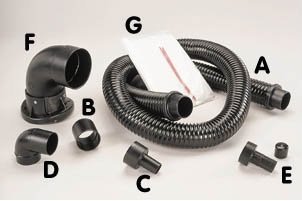
- dust.jpg (12.96 KiB) Viewed 48669 times
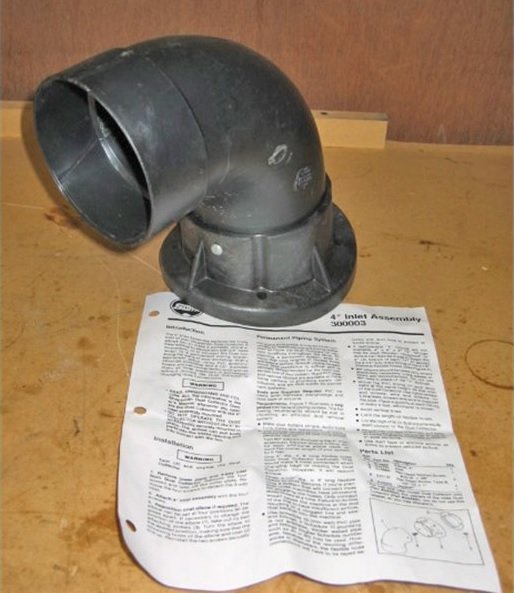
- dust2.jpg (51.04 KiB) Viewed 48669 times
 RF Guy