Just brought back my Dad's Mark V 500 unit that I inherited. Got the Shopsmith along with the jointer, all in very good shape and the only things I didn't find are the saw blade guard and the jointer porkchop (which I'm sure are still at Mom's but just didn't find). Got them moved with no damage or issues I can see. Successfully disassembled the base, pulled all the loose stull and loaded it up.
I'm spacially challenged in my shop so I'm toying with the idea of shortening the tubes and making a dedicated horizontal boring machine out of it.
Three questions I've come up with is typically how much is typically removed from the tubes to shorten the units up? Along with that, it appears the bottom 2 tubes are retained on either end with a pair of bolt held clamps, but how are the upper tubes that the headstock unit slides on retained? So far I haven't found anything that tightens those upper tubes down. It's still strapped on the appliance dolly I used to move it so I'm probably missing something. I haven't gone through all the white paper I got but I didn't see a manual for it in them.
The third question is if you remove the tubes to cut them, anything to watch out for in removing and reinserting shortened ones?
I have a full array of WW equipment - 8" Delta art deco base jointer, 10" cabinet saw, 16"x60" lathe, drill press, 18" band saw, etc, so it will probably be dedicated to horizontal boring only, all the other functions are currently covered by existing tools I already have.
Appreciate any info you have on this. Thanks
Shortening tubes question - Mark V
Moderator: admin

Welcome and congratulations on your new tool. You will receive much fine information here. I would suggest a couple of initial thoughts as I shortened tubes and created an over arm pin router stand. The first thing I learned being that one can create a balance issue if the tubes are too short which can create tipping. As to the method of securing the top tubes, on the one I modified there was an Allen screw mounted underneath coming up through the base. Not easy to see but there none the less. I have read other means on some machines of varying dates of manufacture. Please note that the upper and lower tubes are different length. That difference is important to maintain. I solved thhis part by shortening the tubes the same amount. I would like to suggest first cleaning your Mark V up and lubricating it. Then I would suggest using it for awhile prior to making any modifications. I am often surprised at the number of people who follow such suggestions and decide not modify after all. The Mark V is a highly versatile machine which many users discover they can do a great deal with as well as achieving a high level of accuracy. Good luck. fjimphcbph wrote:Just brought back my Dad's Mark V 500 unit that I inherited. Got the Shopsmith along with the jointer, all in very good shape and the only things I didn't find are the saw blade guard and the jointer porkchop (which I'm sure are still at Mom's but just didn't find). Got them moved with no damage or issues I can see. Successfully disassembled the base, pulled all the loose stull and loaded it up.
I'm spacially challenged in my shop so I'm toying with the idea of shortening the tubes and making a dedicated horizontal boring machine out of it.
Three questions I've come up with is typically how much is typically removed from the tubes to shorten the units up? Along with that, it appears the bottom 2 tubes are retained on either end with a pair of bolt held clamps, but how are the upper tubes that the headstock unit slides on retained? So far I haven't found anything that tightens those upper tubes down. It's still strapped on the appliance dolly I used to move it so I'm probably missing something. I haven't gone through all the white paper I got but I didn't see a manual for it in them.
The third question is if you remove the tubes to cut them, anything to watch out for in removing and reinserting shortened ones?
I have a full array of WW equipment - 8" Delta art deco base jointer, 10" cabinet saw, 16"x60" lathe, drill press, 18" band saw, etc, so it will probably be dedicated to horizontal boring only, all the other functions are currently covered by existing tools I already have.
Appreciate any info you have on this. Thanks
F. Jim Parks
Lakewood, Colorado:)
When the love of power is replaced by the power of love the world will have a chance for survival.
Lakewood, Colorado:)
When the love of power is replaced by the power of love the world will have a chance for survival.
Shortening tubes
Valid points but there are other conditions to consider. First I'm thinking about getting another set of tubes to modify so I'll always be able to return it back to the original configuration if desired, assuming it's a relatively easy process to change out the tubes. The biggest problem I have though is my shop is spacially challenged, I don't have the room to add the Shopsmith to my shop in the full length configuration. The other thing is the only function that the Shopsmith has that isn't already covered by the equipment I already have is the horizontal boring, so I don't expect to elevate the head on it any time in the forseeable future. Right now (best guess) I'm going to have to reduce the length by something like 24"-30" to fit it into the free space I have to work with in the shop. Currently I have a full set of woodworking tools before adding the Shopsmith. As it stands today, virtually everything has to be mobile to wheel out into the aisle to use then wheel back into parking spaces when done.
I'm not going to give up Dad's Shopsmith but I've also got to work it within the physical space I have available. If I had a large out building for a shop, that would be one thing but unfortunately I have to work within the confines of a basement shop in an older house.
I'm not going to give up Dad's Shopsmith but I've also got to work it within the physical space I have available. If I had a large out building for a shop, that would be one thing but unfortunately I have to work within the confines of a basement shop in an older house.
-
judaspre1982
- Platinum Member
- Posts: 1237
- Joined: Tue Jul 08, 2008 10:10 pm
==============================
Last edited by judaspre1982 on Thu May 11, 2017 12:47 pm, edited 1 time in total.
-
dusty

- Platinum Member
- Posts: 21530
- Joined: Wed Nov 22, 2006 6:52 am
- Location: Tucson (Wildcat Country), Arizona
Whatever length you finally decide on, make certain that the way tubes are both the same length and then that the bench tubes are the same length. Precision is not absolutely necessary as you will recognize when you begin to dismantle.
Do make certain that you identify the way tubes as they are different that the bench tubes on most machines. Besides being a different length (shorter) the way tubes are surfaced such that they shine up better and the headstock rides on them smoother. You might have noticed in a lot of the pictures of older machines, the bench tubes are often rusted worse than the way tubes.
As far as the tubes being parallel, they probably won't be. I would suggest that you just reassemble, making certain that the tubes are fully inserted before you secure them. If they are not parallel you will find the headstock and carriage difficult to slide back and forth. I mount the carriage (no headstock) and check that first. If the carriage slides okay the headstock probably will to.
If the carriage binds anywhere along the tubes - loosen the set screws that secure the way tubes and turn them until you find a position where the carriage slides without binding. Tighten everything back down and mount the headstock.
If you can do all of this on a level floor, you will later find that once aligned the Mark V seldom needs realignment.
Retract the casters whenever you are doing Mark V alignments.
Do make certain that you identify the way tubes as they are different that the bench tubes on most machines. Besides being a different length (shorter) the way tubes are surfaced such that they shine up better and the headstock rides on them smoother. You might have noticed in a lot of the pictures of older machines, the bench tubes are often rusted worse than the way tubes.
As far as the tubes being parallel, they probably won't be. I would suggest that you just reassemble, making certain that the tubes are fully inserted before you secure them. If they are not parallel you will find the headstock and carriage difficult to slide back and forth. I mount the carriage (no headstock) and check that first. If the carriage slides okay the headstock probably will to.
If the carriage binds anywhere along the tubes - loosen the set screws that secure the way tubes and turn them until you find a position where the carriage slides without binding. Tighten everything back down and mount the headstock.
If you can do all of this on a level floor, you will later find that once aligned the Mark V seldom needs realignment.
Retract the casters whenever you are doing Mark V alignments.
"Making Sawdust Safely"
Dusty
Sent from my Dell XPS using Firefox.
Dusty
Sent from my Dell XPS using Firefox.
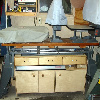
Sounds like your space is dictating the length of the machine. Once you determine how much shorter you want to cut the machine down, just make sure that the bench tubes are 3/4" longer than the way tubes. The starting lengths are 52" and 52-3/4", way tubes and bench tubes respectively. Just maintain that 3/4" difference between them after they have been cut.
Rob in San Diego
Email: SDSSmith51 AT gmail.com
Email: SDSSmith51 AT gmail.com
I used a pipe cutter to shorten my tubes. It worked very well but left a small, raised lip at the cut that I had to grind off to get the way tubes (top tubes) to slip back into the castings. The bench tubes mount differently so I didn't have to grind them. I, too, made mine from an extra set of tubes so I could keep the originals intact.
Jayhawk
1982 Mark V 500 'Shorty' upgraded to 510 S/N 131846 (purchased new)
PowerPro S/N 09-02-10 (Sept 2010)
SS PowerStation, Bandsaw, jointer, belt sander, thickness planer, strip sander, lathe duplicator, ringmaster, jig saw, OPR
1982 Mark V 500 'Shorty' upgraded to 510 S/N 131846 (purchased new)
PowerPro S/N 09-02-10 (Sept 2010)
SS PowerStation, Bandsaw, jointer, belt sander, thickness planer, strip sander, lathe duplicator, ringmaster, jig saw, OPR
-
JPG

- Platinum Member
- Posts: 35600
- Joined: Wed Dec 10, 2008 7:42 pm
- Location: Lexington, Ky (TAMECAT territory)
Not mentioned above is the 'detail' that the older(Greenie and Gilmer Goldies) have different diameter bench tubes(1 7/8").
The reason the older models have 'rustier bench tubes' is because they were initially painted. That and the omission of waxing them.
Make sure you do not shorten them too much(30" shorter) that the stuff that slides on the way tubes will not have room to fit!!!(including the 'normal' separation.
The reason the older models have 'rustier bench tubes' is because they were initially painted. That and the omission of waxing them.
Make sure you do not shorten them too much(30" shorter) that the stuff that slides on the way tubes will not have room to fit!!!(including the 'normal' separation.
╔═══╗
╟JPG ╢
╚═══╝
Goldie(Bought New SN 377425)/4" jointer/6" beltsander/12" planer/stripsander/bandsaw/powerstation /Scroll saw/Jig saw /Craftsman 10" ras/Craftsman 6" thicknessplaner/ Dayton10"tablesaw(restoredfromneighborstrashpile)/ Mark VII restoration in 'progress'/ 10E[/size](SN E3779) restoration in progress, a 510 on the back burner and a growing pile of items to be eventually returned to useful life. - aka Red Grange
╟JPG ╢
╚═══╝
Goldie(Bought New SN 377425)/4" jointer/6" beltsander/12" planer/stripsander/bandsaw/powerstation /Scroll saw/Jig saw /Craftsman 10" ras/Craftsman 6" thicknessplaner/ Dayton10"tablesaw(restoredfromneighborstrashpile)/ Mark VII restoration in 'progress'/ 10E[/size](SN E3779) restoration in progress, a 510 on the back burner and a growing pile of items to be eventually returned to useful life. - aka Red Grange
Thanks
I appreciate all the info. It's going to be a while before I can do anything with it as I have a number of other projects to handle first. I'll also have to get an extra set of tubes before I consider doing anything. For now, it's going to stay in the kitchen strapped to the appliance dolley it's strapped down to.
Thanks again.
Paul
Thanks again.
Paul