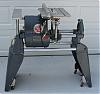
I recently (finally) picked up an older Shopsmith Mark V 500 with a couple of SPT's The bandsaw was a little rough and I have spent the past few weeks getting it cleaned up. While I am waiting on a couple of parts I decided to see what the other thing was and found it to be a Magna 4" Jointer that appeared to be in ok shape. But, when I got it on the bench I could not get the infeed table to move when I turned the adjusting knob. I came on here and found alot of very useful information about clean up, and adjustments, etc. but I could not find anything addressing my issue;When I got it apart I found I had one part too many.The place on the outfeed table where the adjusting knob rests was broken off. During one of my searches I thought I found something about this being a common place for breakage during shipping or if it was handled roughly but I did not see if it was repairable.
A friend of mine said that welding on cast iron (in this case) was probably not an option. Does anyone have a good way to repair this? Any help will be sincerly appreciated.
[quote="2bits"]I recently (finally) picked up an older Shopsmith Mark V 500 with a couple of SPT's The bandsaw was a little rough and I have spent the past few weeks getting it cleaned up. While I am waiting on a couple of parts I decided to see what the other thing was and found it to be a Magna 4" Jointer that appeared to be in ok shape. But, when I got it on the bench I could not get the infeed table to move when I turned the adjusting knob. I came on here and found alot of very useful information about clean up, and adjustments, etc. but I could not find anything addressing my issue]I have nothing to offer in the way of repair but I sure would like to see a couple photos of the problem.
"Making Sawdust Safely" Dusty
Sent from my Dell XPS using Firefox.
2bits wrote:A friend of mine said that welding on cast iron (in this case) was probably not an option. Does anyone have a good way to repair this? Any help will be sincerly appreciated.
Finding a good welder can be difficult. I have a local welding shop where the older owner has welded cast iron parts for me with great success. I have several hand grinders that I use to smooth/reshape the welded area.
Of course, it may be cheaper to buy another joiner and sell (Ebay) the parts (guard, fence, cutter head w knives, tilt quadrant assembly and other misc parts) from this joiner.
Each joiner infeed and outfeed table are a matched set. The tables were surfaced ground after assembling as a unit.
Bill Mayo bill.mayo@verizon.net
Shopsmith owner since 73. Sell, repair and rebuild Shopsmith, Total Shop & Wood Master headstocks, SPTs, attachments, accessories and parts. US Navy 1955-1975 (FTCS/E-8)
I spoke with a gentleman today and he said one option would be to have a steel piece fabricated with "wings" on either side then to grind the area flat and drill bolt holes and bolt it to the outfeed table.
Another friend of mine had a another possible fix of using JB weld to re attach the part then to use some small stainless steel screws and drill and tap through the table into the broken part.
I am thinking of trying plan "B" first. if that does not work, I will try making a part to bolt on using shims if needed to get it set at the proper angle. I'll post my progress (or lack of) as I get to it.
I have been going through the archived posts and found some very helpful info, a copy of the old owners manuel etc. I wish I would have had the forethought to make a list of those I need to thank. In any case, thanks to all who have posted on this forum. Thanks for sharing your knowlege and mishaps. I am sure that there are many of us who have learned alot of tricks and DONOTS. I will try and get the photo thing figured out and post some photos soon.
After speaking to a couple other folks about my problem it would appear that welding cast iron especially in the area of the " saddle" where the depth of cut adjusting knob rests on the bottom of the out feed table is not an option. They both had different methods of welding cast iron but they both said that typically when you weld cast iron, it changes the the properties of the metal, making it more brittle and it will most likely break at the end of the welded area.
I used JB weld and clamps to hold the u shaped saddle in place and then I drilled and taped each side of the horn of the U. Then I threaded a screw into each end and cut the head off the screw and threaded a nut on each one. After putting everything back together it seems to work. Only time will tell as to how well it will actually hold up. I will try and get some pictures posted ASAP. I had some other things come up over the past few days that required my attention. Now I am going to turn off the phones so I can get to the real business of making some sawdust (safely):)
If the JB weld doesn't hold up, you may look into another epoxy. Hilti makes an 10,000 pound epoxy used in new contruction. It holds just about anything and may be worth a shot. You can get it at construction supply centers for contractors, not a lowes or home depot. Good luck with the piece.
Thanks for the tip Spiderclimber. It feels like the threaded screws/studs will work but I will probably get some of the Hilti epoxy to re-enforce. I am a firm believer in over engineering repairs whenever possible:D
2bits wrote:Thanks for the tip Spiderclimber. It feels like the threaded screws/studs will work but I will probably get some of the Hilti epoxy to re-enforce. I am a firm believer in over engineering repairs whenever possible:D
It seems that Hilte offers a very diversified list of products. Which epoxy do you think is appropriate for repairs in the shop. I have a couple that I was going to use JBWeld on but maybe I'll try this.
"Making Sawdust Safely" Dusty
Sent from my Dell XPS using Firefox.