Page 3 of 6
Re: Carriage Stop Ring 516667, the intended function??
Posted: Sun May 22, 2016 5:59 am
by dusty
OKAY! I get the message.
Re: Carriage Stop Ring 516667, the intended function??
Posted: Sun May 22, 2016 3:01 pm
by reible
Dug through the manual and it does say to put the ring on the rear tube.
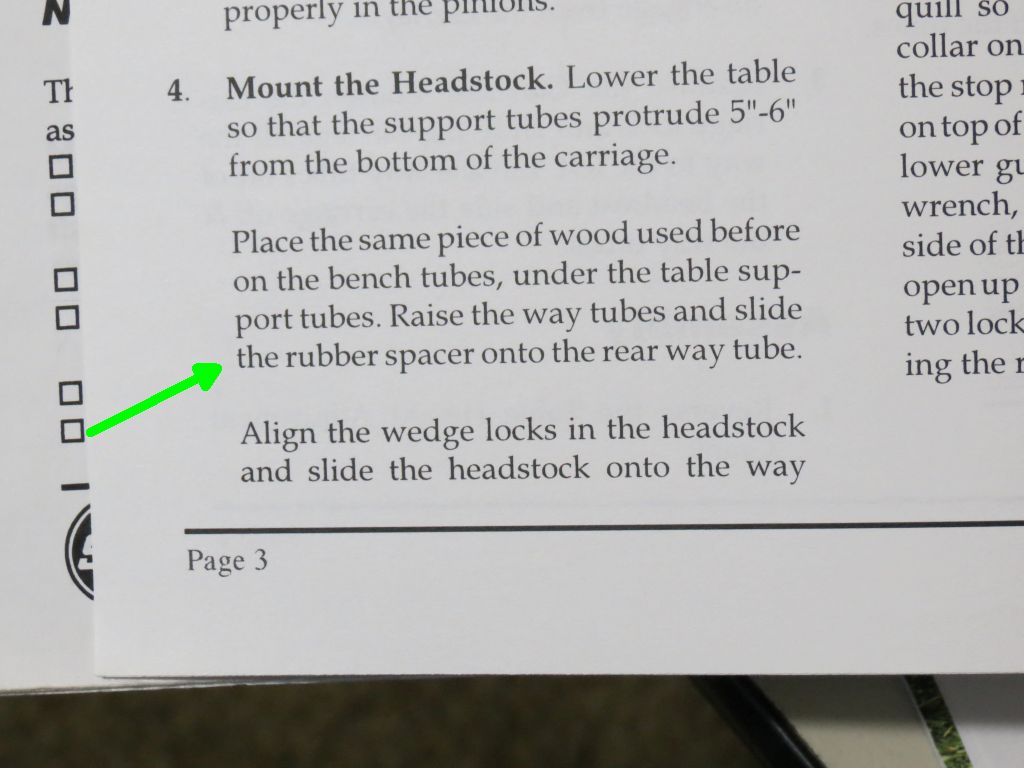
- IMG_2096scm.jpg (93.88 KiB) Viewed 7109 times
Ed
Re: Carriage Stop Ring 516667, the intended function??
Posted: Sun May 22, 2016 4:24 pm
by algale
Be that as it may, my circa 2001 520 has one such ring on the front tube.
Re: Carriage Stop Ring 516667, the intended function??
Posted: Sun May 22, 2016 6:11 pm
by reible
BTW this information was taken from the "Mark V Table System Retrofit Kit" 845464 Rev A 5/01.
I don't see any particular reason for being on the rear or front but as I mentioned I have several machines and they all have it on the rear. Those machines date from the mid 70's to early 80's but the manual shown is newer.
Perhaps it is just chance that happened or perhaps it depended on who put the machine together that day.
Ed
Re: Carriage Stop Ring 516667, the intended function??
Posted: Tue May 24, 2016 12:57 pm
by everettdavis
My question is, what is the core material Shopsmith buys to make them (or have them made), and where can I get some?
I think we all can cut it to the length that is appropriate to the machine series we have using whatever dimensions we are replicating if we can obtain it.
To me, anything I can source or make locally is preferable in many areas as the cost to ship smaller items and does little more than increase my cost.
That applies less for folks who only have one machine or so, but for those of us who restore, service or otherwise maintain many, it is something to consider. Cost savings are cost savings, and freight costs doesn't add value to me.
I am not looking for a similar material, I am looking for exactly the same material and I doubt Magna or Shopsmith had it custom made for such a function. It was something they could readily source and use for their purpose.
Anyone know exactly what it is or where to get it?
Everett
Re: Carriage Stop Ring 516667, the intended function??
Posted: Tue May 24, 2016 1:12 pm
by dusty
everettdavis wrote:My question is, what is the core material Shopsmith buys to make them (or have them made), and where can I get some?
I think we all can cut it to the length that is appropriate to the machine series we have using whatever dimensions we are replicating if we can obtain it.
To me, anything I can source or make locally is preferable in many areas as the cost to ship smaller items and does little more than increase my cost.
That applies less for folks who only have one machine or so, but for those of us who restore, service or otherwise maintain many, it is something to consider. Cost savings are cost savings, and freight costs doesn't add value to me.
I am not looking for a similar material, I am looking for exactly the same material and I doubt Magna or Shopsmith had it custom made for such a function. It was something they could readily source and use for their purpose.
Anyone know exactly what it is or where to get it?
Everett
I think that you are probably right but resizing those rings is more of a chore than you might think. It is some tough stuff.
JPG suggested freezing and sanding. I have not tried that yet but I may. Using a knife is not working so pretty good. I am just thankful that I have not ruined a spacer YET.
Re: Carriage Stop Ring 516667, the intended function??
Posted: Tue May 24, 2016 1:22 pm
by reible
It reminds me of radiator hose like in a car.........
Putting this stuff in a typical freeze is not likely to give the results you want. We use to dip in liquid nitrogen then cut, need less to say that is unlikely to be a house hold item. This was for some applications we were experimenting with that required more then a utility knife precision.
You could turn a block of wood so the hose just fits snugly over it and then cut it that way, well maybe, anyway it might be worth a test or two before getting down to the a final product. Another likely lathe project??
Ed
Re: Carriage Stop Ring 516667, the intended function??
Posted: Tue May 24, 2016 1:29 pm
by dusty
reible wrote:It reminds me of radiator hose like in a car.........
Putting this stuff in a typical freeze is not likely to give the results you want. We use to dip in liquid nitrogen then cut, need less to say that is unlikely to be a house hold item. This was for some applications we were experimenting with that required more then a utility knife precision.
You could turn a block of wood so the hose just fits snugly over it and then cut it that way, well maybe, anyway it might be worth a test or two before getting down to the a final product. Another likely lathe project??
Ed
Creating a wood core is not a show stopper. With the sand-able core inserted it might be worth a try to take it to the sander. Plan on loosing a sanding belt though. Will have to do that on a belt that has about served its useful life.
Re: Carriage Stop Ring 516667, the intended function??
Posted: Tue May 24, 2016 2:50 pm
by everettdavis
If it is rubber truly similar to a radiator hose, one might do what my late uncle did when he was cutting radiator hoses to fit properly on show cars.
He took a hose clamp and tightened it where he wanted the cut to be, then he walked over to the tire changer and got a bit of the bead lubricant (water and soap) and wet the edge of the rubber, and the edge of his razor knife.
The lubricant on his knife blade made it cut like butter, and he loosened the clamp and readjusted it to finish the cut where the tightening screw was initially, wiping the soap off.
Those were very clean cuts just like the factory and looked great on the cars that I saw him do it on.
Everett
Re: Carriage Stop Ring 516667, the intended function??
Posted: Tue May 24, 2016 3:24 pm
by jsburger
JPG wrote:ERLover wrote:just venting, so dont take it personally, this subject has been beaten to death and then beaten to life again.
I tend to agree, but at least we succeeded it getting Dusty to 'see the light'(realize it is not a baby bumper, but a spacer)(finally!!!).
I think we also revealed Hans' wisdom in not making it out of a rubber tube.

And Hans' was adjustable. Go figure!
Here is one more variable I just thought of that nobody has mentioned. The vertical plane of the head stock casting that the quill stops against when fully retracted and the vertical plane of the head stock casting down at the way tube that the spacer hits against. Are those vertical planes the same distance apart on every machine. If no the same length spacer will give different results.