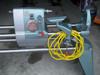
pennview wrote:Before I'd spend the money on lead, I'd buy a few bags of sand and put them on the bench tubes or distribute the sand in some other way. I'd also make some sort of clamping devices to tie the bench tubes and way tubes together, making the Shopsmith more rigid and likely to handle larger or out of round turning blanks.
Jcraigie, lead weighs .4092 pounds per cubic inch. Rotometals says it's shot weights .24 pounds per cubic inch, so I'd have to assume it's not solid material they were talking about.
I think I'm with you. I'll spend my time and money making sawdust instead.
Hey, you could drill some holes in the shop floor for anchors and chain it down real tight.
"Making Sawdust Safely" Dusty
Sent from my Dell XPS using Firefox.
pennview wrote:Before I'd spend the money on lead, I'd buy a few bags of sand and put them on the bench tubes or distribute the sand in some other way. I'd also make some sort of clamping devices to tie the bench tubes and way tubes together, making the Shopsmith more rigid and likely to handle larger or out of round turning blanks.
Jcraigie, lead weighs .4092 pounds per cubic inch. Rotometals says it's shot weights .24 pounds per cubic inch, so I'd have to assume it's not solid material they were talking about.
I agree with the clamping suggestion. Just off both ends of the headstock.
Add brace(s) between the legs at the accessory shelf mounting holes, and tie that also to the bench tubes. Run diagonals from the bench/waytube clamps to the legs end of the added braces. Use steel(it's heavier).
Now if it will just keep all four feet on the floor!:D
╔═══╗
╟JPG ╢
╚═══╝
Goldie(Bought New SN 377425)/4" jointer/6" beltsander/12" planer/stripsander/bandsaw/powerstation /Scroll saw/Jig saw /Craftsman 10" ras/Craftsman 6" thicknessplaner/ Dayton10"tablesaw(restoredfromneighborstrashpile)/ Mark VII restoration in 'progress'/ 10E[/size](SN E3779) restoration in progress, a 510 on the back burner and a growing pile of items to be eventually returned to useful life. - aka Red Grange
I went this direction myself after going through all of the thoughts about filling the tubes. Concrete was the best option I came up with but also firmly clamping the unit down and the tubes together. All the above is true and will help.
You guys don't know how to have fun. If you don't have your Shopsmith jumping a foot and half off the floor while turning an off balanced wood block at too high of speed you aren't living.
Without a little excitement life can get boring. So go ahead bounce those SS!:D
Ed in Tampa wrote:You guys don't know how to have fun. If you don't have your Shopsmith jumping a foot and half off the floor while turning an off balanced wood block at too high of speed you aren't living.
Without a little excitement life can get boring. So go ahead bounce those SS!:D
We need Herr Gass to 'invent' a lathe foot off ground detection system to immediately(5 ms?) drop a cubic yard or two of concrete onto the bouncing lathe so as to protect the operator from having the lathe foot from stepping on the operators foot thus preventing much pain and injury(mashed toes, amputated toes, fallen arch(:rolleyes:), lost wages, medical claims yada yada yada!
Just hope the operator can jump out of the way quickly enough!:D
Problem is, in order to get that quick a response time, the concrete must be about 1 inch above the workpiece.
╔═══╗
╟JPG ╢
╚═══╝
Goldie(Bought New SN 377425)/4" jointer/6" beltsander/12" planer/stripsander/bandsaw/powerstation /Scroll saw/Jig saw /Craftsman 10" ras/Craftsman 6" thicknessplaner/ Dayton10"tablesaw(restoredfromneighborstrashpile)/ Mark VII restoration in 'progress'/ 10E[/size](SN E3779) restoration in progress, a 510 on the back burner and a growing pile of items to be eventually returned to useful life. - aka Red Grange
The added weight seems like a good idea at first blush, but I would worry about the added weight's effect on the casters and asssociated cams. I find it necessary to rotate my Mark V 90 degrees quite often. This allows me to continue working from a rubber mat when sawing, band sawing, lathe work, drill press. Also in order to allow enough infeed/outfeed space.
When comes the time for stabilization, I will try the sandbox/lathe raising system shown by Nick.
Octogenarian's have an earned right to be a curmudgeon.
Chuck in Lancaster, CA
charlese wrote:The added weight seems like a good idea at first blush, but I would worry about the added weight's effect on the casters and asssociated cams. I find it necessary to rotate my Mark V 90 degrees quite often. This allows me to continue working from a rubber mat when sawing, band sawing, lathe work, drill press. Also in order to allow enough infeed/outfeed space.That's why I was wanting to fill the tubes instead of a tie-down system the 100#'s or so from filling the tubes would be a nice weight addition and Im don't think it would hurt the casters (mine are the old metal ones) and still allow me to move it around.
When comes the time for stabilization, I will try the sandbox/lathe raising system shown by Nick.
I haven't seen the sandbox/lathe raising system.
1984 Mark V 500 and an early 1954 greenie. jointer, belt sander, bandsaw, jigsaw, planner.
Has anyone thought about just adding the jointer when turning, with the jointer, accessory shelf and universal tool rest the Shopsmith weight in at about 300 lbs.
If you don't need the tail-stock you could also add another accessory and get even more weight.
When I had my 500 I had hung the tool cabinet on the lower rails and I stored the jointer in it plus 100's of pounds of other stuff. When I upgraded to the 510 it no longer fit.
Paul Cohen
Beaverton, OR
A 1982 500 Shopsmith brand upgraded to a Mark 7 PowerPro, Jointer, Bandsaw (with Kreg fence), Strip Sander, Ring Master and lots of accessories all purchased new
12" Sliding Compound Mitre Saw, 1200 CFM DC
jcraigie wrote:I haven't seen the sandbox/lathe raising system.
I searched through the archives without any luck finding it. My memory tells me that his post is here somewhere.
Here's what I remember: The thread was from someone having back aches from using the lathe. Nick's reply (it wasn't the only one) showed two boxes built from 2X6s and filled with sand. The expected results from putting a leg in each sand box is to raise the lathe and allow the legs to settle down into the sand, so as to stabilize the lathe.
Maybe another(s) of the old timers can find the post and/or correct my memory.
Octogenarian's have an earned right to be a curmudgeon.
Chuck in Lancaster, CA