
Project question/dilema

Forum for people who are new to woodworking. Feel free to ask questions or contribute.

Moderator: admin

User avatar
mrhart
Platinum Member
Posts: 938
Joined: Thu Nov 25, 2010 4:38 pm
Location: Meridian Idaho

Project question/dilema

Post by mrhart »

I started a project over the weekend. I'm working with a piece of walnut 3/4 x 3/4 and about a foot long. I need to turn the ends into 1/2" round about 2 full inches or so. When I'm done it would be a square rod thats round on the ends.
I don't have anything for turning but the SS standards, no fancy chucks ect.

Can someone tell me what other methods I might use to accomplish the task.
:confused:
R Hart
charlese
Platinum Member
Posts: 7501
Joined: Fri Dec 08, 2006 10:46 pm
Location: Lancaster, CA

Post by charlese »

The standard spur drive center an fixed tail center should do you just fine. Remember to drill 1/8" holes in the ends and saw corner to corner 1/8" slots in the drive side. Also, apply bees wax to the dead center to prevent burning.

You should also try doing this work with another 3/4 x3/4 piece of pine or poplar in order to get the feel of the need technique. You will probably be happier if you make your wood about an inch longer than needed in order to remove the end holes and slots.
Octogenarian's have an earned right to be a curmudgeon.
Chuck in Lancaster, CA
User avatar
mrhart
Platinum Member
Posts: 938
Joined: Thu Nov 25, 2010 4:38 pm
Location: Meridian Idaho

Post by mrhart »

charlese wrote:The standard spur drive center an fixed tail center should do you just fine. Remember to drill 1/8" holes in the ends and saw corner to corner 1/8" slots in the drive side. Also, apply bees wax to the dead center to prevent burning.

You should also try doing this work with another 3/4 x3/4 piece of pine or poplar in order to get the feel of the need technique. You will probably be happier if you make your wood about an inch longer than needed in order to remove the end holes and slots.

I guess thats what I forgot to account for, just a short supply of walnut and the parts are already cut close to finished length. I knew better. Thats why I posted the question. I'm not sure if once mounted up, I'd be able to sound down to 1/2" all the way to the end.
R Hart
User avatar
JPG
Platinum Member
Posts: 35598
Joined: Wed Dec 10, 2008 7:42 pm
Location: Lexington, Ky (TAMECAT territory)

Post by JPG »

The spur center will interfere with turning 1/2" round on that end, but, can be roughed out and flipped end for end to allow turning down at the tailstock end.

If you are very careful, you can get close at the tailstock end. You may need to hand carve a shallow shoulder off the very end(s).

A 'dead' drive center would be preferable.


P.S. If that walnut is very dry, be extra careful!
╔═══╗
╟JPG ╢
╚═══╝

Goldie(Bought New SN 377425)/4" jointer/6" beltsander/12" planer/stripsander/bandsaw/powerstation /Scroll saw/Jig saw /Craftsman 10" ras/Craftsman 6" thicknessplaner/ Dayton10"tablesaw(restoredfromneighborstrashpile)/ Mark VII restoration in 'progress'/ 10
E[/size](SN E3779) restoration in progress, a 510 on the back burner and a growing pile of items to be eventually returned to useful life. - aka Red Grange
charlese
Platinum Member
Posts: 7501
Joined: Fri Dec 08, 2006 10:46 pm
Location: Lancaster, CA

Post by charlese »

mrhart wrote:I guess thats what I forgot to account for, just a short supply of walnut and the parts are already cut close to finished length. I knew better. Thats why I posted the question. I'm not sure if once mounted up, I'd be able to sound down to 1/2" all the way to the end.

If the ends of your piece won't show there will be no problem starting with the length that you have. Or you can fill the holes.

Don't forget to first use a practice piece!
Octogenarian's have an earned right to be a curmudgeon.
Chuck in Lancaster, CA
User avatar
beeg
Platinum Member
Posts: 4790
Joined: Sun Oct 14, 2007 2:33 pm
Location: St. Louis,Mo.

Post by beeg »

First off what ya making? If I were doing this, I'd throw it between centers and start with the skew, to get sharp corners on the square part. Then turn the 2 inch part down to the final 1/2 inch.
SS 500(09/1980), DC3300, jointer, bandsaw, belt sander, Strip Sander, drum sanders,molder, dado, biscuit joiner, universal lathe tool rest, Oneway talon chuck, router bits & chucks and a De Walt 735 planer,a #5,#6, block planes. ALL in a 100 square foot shop.
.
.

Bob
User avatar
mrhart
Platinum Member
Posts: 938
Joined: Thu Nov 25, 2010 4:38 pm
Location: Meridian Idaho

Post by mrhart »

I will take pics tonight, I'll mount it up and give it a try.
R Hart
User avatar
terrydowning
Platinum Member
Posts: 1678
Joined: Mon Jul 19, 2010 3:26 pm
Location: Windsor, CO

Post by terrydowning »

Another option for reducing splintering where square meets round is to make a saw kerf where the transition is.

First setup your blank
scribe a line where the transition is to take place.
Put saw kerfs in an X fashion corner to corner on at least one end (both ends if you plan on flipping the stock) Not too deep, 1/16" or so should be fine, just enough for the spurs to get a purchase on the end grain and keep the stock spinning. Drill a 1/8" hole in the center, not too deep, maybe an 1/8 inch, just enough to get the points started in the center and keep them from wandering. The squeeze from mounting will do the rest of the work.

Mount the stock between centers (line up the x with the spur drive). Make sure to use plenty of beeswax for the dead center. I use a toilet bowl wax ring for this (clean and new of course:D ). Advance the quill and compress the wood into the spur drive and dead center and give it a few test turns by hand.

Position your tool rest as close as you can get it with out hitting your work. The closer the tool rest, the better your tools will perform especially skews.

With the lathe still unplugged, take a small saw and cut a kerf on the transition line you scribed earlier. I use one of those hobby sized fine tooth back saws. Cut just deep enough to cut the grain on the surface (1/8 " or so should do maybe a bit deeper on the corners) this will prevent tear out and provide a relief to work against.

Hone your skew.

Now you can plug in your lathe and start cutting use a sharp freshly honed skew and take light cuts to get to your final dimension.

Start a bit away from the transition relief cut and slice through the grain sneaking up on the transition, just take the corners off and get it round.

Next round the corners at the end and take it to final dimension, now you just have to work the final dimension to the relief cut and you're done. Remember light cuts and let the chisel do the work. If you have to apply pressure to make the cut, stop and hone your skew.

Since you're going to 1/2" on the final dimension, use a clean 1/2" wrench as a gauge to check your work.

Flip the blank and repeat the procedure. I would opt for flipping the stock as contacting the spur center with a skew is NOT fun and will most likely ruin your work. I'm also better on the tail stock side than I am on the head stock side.

Of course practice this once or twice on a cutoff you can spare or use in another project.
--
Terry
Copy and paste the URLs into your browser if you want to see the photos.

1955 Shopsmith Mark 5 S/N 296860 Workshop and Tools
https://1drv.ms/i/s!AmpX5k8IhN7ahFCo9VvTDsCpoV_g

Public Photos of Projects
http://sdrv.ms/MaXNLX
User avatar
mrhart
Platinum Member
Posts: 938
Joined: Thu Nov 25, 2010 4:38 pm
Location: Meridian Idaho

Post by mrhart »

terrydowning wrote:Another option for reducing splintering where square meets round is to make a saw kerf where the transition is.

First setup your blank
scribe a line where the transition is to take place.
Put saw kerfs in an X fashion corner to corner on at least one end (both ends if you plan on flipping the stock) Not too deep, 1/16" or so should be fine, just enough for the spurs to get a purchase on the end grain and keep the stock spinning. Drill a 1/8" hole in the center, not too deep, maybe an 1/8 inch, just enough to get the points started in the center and keep them from wandering. The squeeze from mounting will do the rest of the work.

Mount the stock between centers (line up the x with the spur drive). Make sure to use plenty of beeswax for the dead center. I use a toilet bowl wax ring for this (clean and new of course:D ). Advance the quill and compress the wood into the spur drive and dead center and give it a few test turns by hand.

Position your tool rest as close as you can get it with out hitting your work. The closer the tool rest, the better your tools will perform especially skews.

With the lathe still unplugged, take a small saw and cut a kerf on the transition line you scribed earlier. I use one of those hobby sized fine tooth back saws. Cut just deep enough to cut the grain on the surface (1/8 " or so should do maybe a bit deeper on the corners) this will prevent tear out and provide a relief to work against.

Hone your skew.

Now you can plug in your lathe and start cutting use a sharp freshly honed skew and take light cuts to get to your final dimension.

Start a bit away from the transition relief cut and slice through the grain sneaking up on the transition, just take the corners off and get it round.

Next round the corners at the end and take it to final dimension, now you just have to work the final dimension to the relief cut and you're done. Remember light cuts and let the chisel do the work. If you have to apply pressure to make the cut, stop and hone your skew.

Since you're going to 1/2" on the final dimension, use a clean 1/2" wrench as a gauge to check your work.

Flip the blank and repeat the procedure. I would opt for flipping the stock as contacting the spur center with a skew is NOT fun and will most likely ruin your work. I'm also better on the tail stock side than I am on the head stock side.

Of course practice this once or twice on a cutoff you can spare or use in another project.

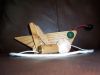
All good advice sir. I can get one end but the other end won't take a spur center without starting to crack.
Like I said before, I didn't leave enough length in my work piece to have extra. My explanation earlier was a bit foggy but basically I'm taking a 3/4 stick and making the last 2 inches on each end round.
If I had a chuck that I could put the round ends I have turned tonight in it, then I could do the other. I need a local lathe buddy...
R Hart
User avatar
JPG
Platinum Member
Posts: 35598
Joined: Wed Dec 10, 2008 7:42 pm
Location: Lexington, Ky (TAMECAT territory)

Post by JPG »

mrhart wrote:All good advice sir. I can get one end but the other end won't take a spur center without starting to crack.
Like I said before, I didn't leave enough length in my work piece to have extra. My explanation earlier was a bit foggy but basically I'm taking a 3/4 stick and making the last 2 inches on each end round.
If I had a chuck that I could put the round ends I have turned tonight in it, then I could do the other. I need a local lathe buddy...
If you can get one end turned down to 1/2" od, you could chuck that end into the drill chuck and turn the other end(again using the tail stock etc.)!
╔═══╗
╟JPG ╢
╚═══╝

Goldie(Bought New SN 377425)/4" jointer/6" beltsander/12" planer/stripsander/bandsaw/powerstation /Scroll saw/Jig saw /Craftsman 10" ras/Craftsman 6" thicknessplaner/ Dayton10"tablesaw(restoredfromneighborstrashpile)/ Mark VII restoration in 'progress'/ 10
E[/size](SN E3779) restoration in progress, a 510 on the back burner and a growing pile of items to be eventually returned to useful life. - aka Red Grange
Post Reply