Page 1 of 3
Harvesting giant redwoods in the 1940's
Posted: Thu Dec 10, 2015 7:44 am
by BuckeyeDennis
Can you imagine felling a giant redwood tree with an axe? Unbelievable!
Times have certainly changed.
[youtube]
https://www.youtube.com/watch?v=qb_YNZn_kaQ[/youtube]
Re: Harvesting giant redwoods in the 1940's
Posted: Thu Dec 10, 2015 7:55 am
by algale
Thanks for posting this. In the 1920s my Grandfather went from Maine to Quebec and logged. No giant redwoods, but I imagine the techniques and equipment were very similar to what is shown in the video.
Re: Harvesting giant redwoods in the 1940's
Posted: Thu Dec 10, 2015 12:21 pm
by tomsalwasser
Oh my, thanks for sharing this Dennis! Did you see them sharpening the axe? I picked up a similar sharpening wheel at a garage sale. Why I don't know, I just wanted it. I hope to use it some day.
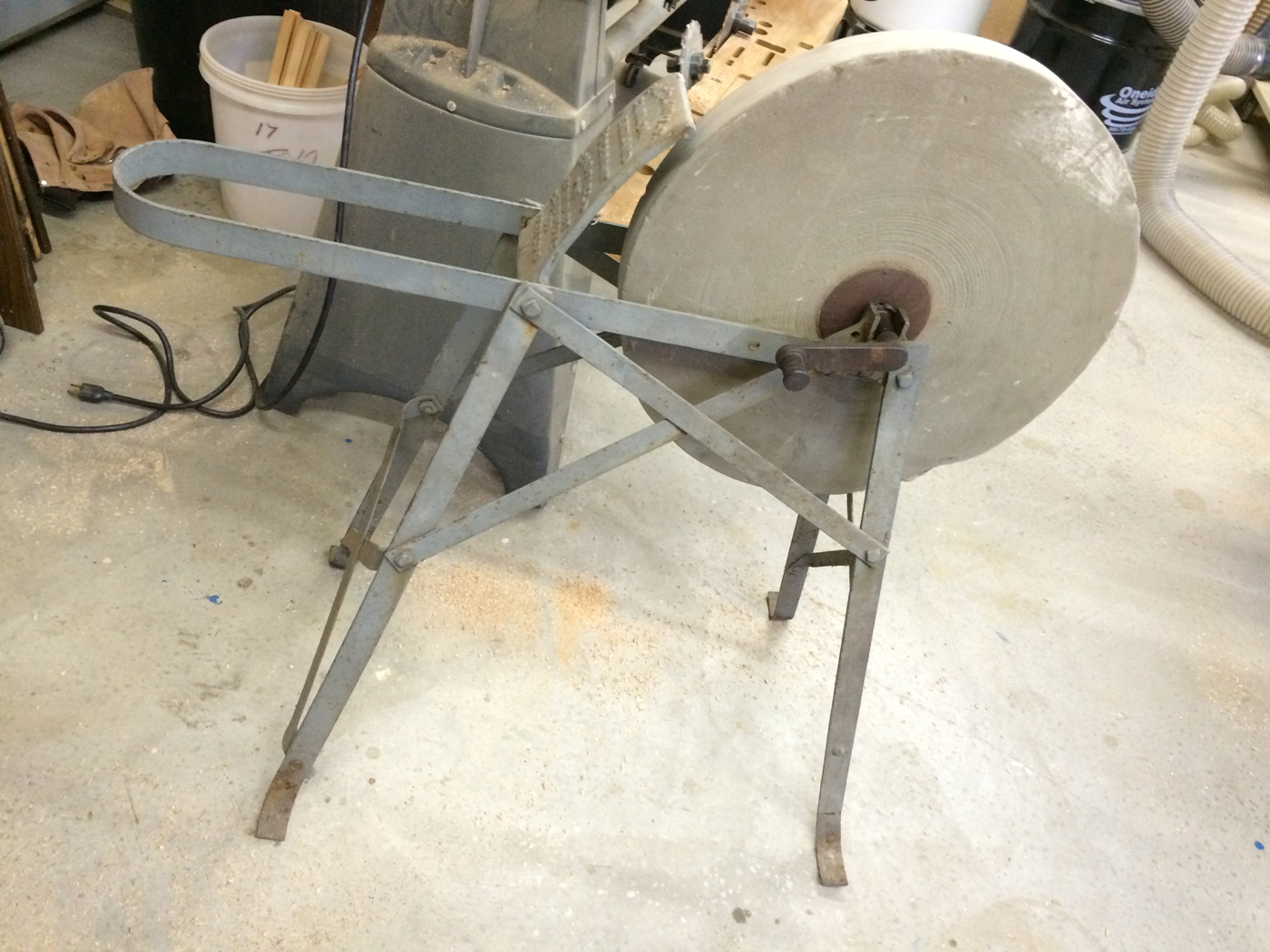
- sharpening wheel.jpg (787.36 KiB) Viewed 2866 times
Re: Harvesting giant redwoods in the 1940's
Posted: Thu Dec 10, 2015 12:39 pm
by JPG
Just a bigger Tormek!

Re: Harvesting giant redwoods in the 1940's
Posted: Thu Dec 10, 2015 12:39 pm
by tomsalwasser
It's not easy to see in Dennis' video but the locomotive is a Lima Shay geared locomotive. In Minnesota, the first logging era in the mid to late 1800s involved cutting trees and floating logs down rivers to the sawmill. The second era in the early 1900s was a mop up operation using these special geared locomotives on logging railroads in the woods. These locomotives could handle the steeper grades encountered in the forest. Notice the geared wheels in the video below. Those gears mean power. The logging trains hauled the logs on short, temporary spur tracks up to the main line. A few of these locomotives are still in use today as museum trains.
[youtube]
https://www.youtube.com/watch?v=TbsbcZKCWDY[/youtube]
Re: Harvesting giant redwoods in the 1940's
Posted: Thu Dec 10, 2015 4:12 pm
by davebodner
Cool. So, I guess the idea for these locomotives was that they were geared so much lower than a normal locomotive. Huge amount of torque at the expense of top speed.
Re: Harvesting giant redwoods in the 1940's
Posted: Thu Dec 10, 2015 4:26 pm
by JPG
Torque applied at a rate(speed) that prevents slipping. Notice even the tender wheels were driven. Recall the steam tractor(15hp?) vs the 'green monster' John Deere (850hp?) post a while back?
I was thinking cogged railway at first. Kept looking for the cog gear(s).
Then it dawned! The driven wheels are geared and torque applied by the horizontal shafts.
Any reason for the off set boiler? Never mind - figgered it out.
They burned coal I assume!
Very interesting! Thanks.
Re: Harvesting giant redwoods in the 1940's
Posted: Thu Dec 10, 2015 4:40 pm
by tomsalwasser
You're welcome...it is interesting! This is from wikipedia:
The steam locomotive, as commonly employed, has its pistons directly attached to cranks on the driving wheels; thus, there is no gearing, one revolution of the driving wheels is equivalent to one revolution of the crank and thus two power strokes per piston (steam locomotives are almost universally double-acting, unlike the more familiar internal combustion engine).
The maximum rotational speed is fairly fixed for a given engine technology. Given the lack of any variable-ratio transmission between the piston engine and the wheels, the designer is forced to compromise between desired torque and desired maximum speed; the radius of the driving wheels determines this. The radius of the crank affixed to the wheel is of course less than this; its radius determines the length of the piston stroke. This cannot be too large, for the locomotive will be unable to generate enough steam to supply those large cylinders at speed; it cannot be too small, or the starting torque and thus tractive effort will be too small, and the locomotive will not be able to start a train.
Many applications required a low speed locomotive with ample starting tractive effort – industrial use, mines and quarries and logging operations, steeply graded lines and the like – especially when the track is cheaply built and not suited to high speeds anyway. Unfortunately, although the trade-off of speed versus torque can be adjusted in favour of torque and tractive effort by reducing the size of the driving wheels, there is a practical limit below which this cannot be done without making the piston stroke too short on a directly driven locomotive.
The solution is to separate the crank from the wheels, firstly allowing for a reasonable piston stroke and crank radius without requiring larger than desired driving wheels, and secondly allowing for reduction in rotational speed via gearing. Such a locomotive is a geared locomotive. Most were and are still single speed, but some did employ a variable-ratio gearbox and multiple ratios.
Re: Harvesting giant redwoods in the 1940's
Posted: Thu Dec 10, 2015 5:18 pm
by jsburger
davebodner wrote:Cool. So, I guess the idea for these locomotives was that they were geared so much lower than a normal locomotive. Huge amount of torque at the expense of top speed.
That is pretty much it. With a direct drive piston steam engine you can get more torque with smaller wheels. There is a limit however. Since the crank is directly connected to the driving wheel on a direct drive steam engine its radius is smaller than the wheel and that radius determines the stroke of the piston. If you go too small with the driving wheel the crank radius is so short that torque is lost and the piston stroke is too short to work properly (efficiently).
There were three types of geared engines used commonly in North America although there were a few others(clones). The Shay had an off set boiler with vertical cylinders on the right side. The Heisler had V Twin cylinders under the boiler. The Climax had two cylinders, one on either side of the boiler. The Shay was the most common type used. They were also narrow gauge engines.
Re: Harvesting giant redwoods in the 1940's
Posted: Thu Dec 10, 2015 5:39 pm
by ERLover
Ya JPG the first thing I was thinking too was a cog, like the one on Mnt Washington in NH, noisy thing!!!
Cool, would that be coincided a core less engine? With its exposed crank shafts?