Page 1 of 2
Lift Assist Benefits and Disadvantages
Posted: Sun Apr 30, 2017 1:47 pm
by sehast
I have a Mark V with 520 table, PowerPro headstock and Double tilt upgrades, so it is basically a Mark 7. I am contemplating buying a Lift Assist but have a few concerns. One is the length of the way tubes lost on the right side. This looks to be about 2 inches but would anyone like to confirm this who has one and comment on how it constrains other operations?
The second concern is the space below the bench tubes required for the lift assist to work. I currently have an accessory table mounted that might be impacted. It is hard to judge from the pictures just how much space is needed. Could someone provide a measurement from the top of the bench tubes to the bottom of the lift assist assembly?
The last concern is the difficulty of disconnecting and re-connecting the Gas-Charged Cylinder when under the table operations require tilting to the left. A quick disconnect is referred to on the web page but it doesn't explain how it works. What are the comments of owners out there on this issue?
Thanks in advance for the help.
Re: Lift Assist Benefits and Disadvantages
Posted: Sun Apr 30, 2017 2:43 pm
by dusty
I cannot speak to the quick disconnect feature because I do not have that but I do have emotions regarding the other two concerns.
The lift assist does interfere with anything you might have that resides beneath the Bench Tubes. It comes out toward the center of the tubes about 1/3 of the way and it drops below the Bench Tubes about 3". I have to say "about" because I have taken mine off (when I installed the Double Tilt Upgrade) and have not put it back on.
As for helping the lift, it does a real good job.
Re: Lift Assist Benefits and Disadvantages
Posted: Sun Apr 30, 2017 2:53 pm
by jsburger
sehast wrote:I have a Mark V with 520 table, PowerPro headstock and Double tilt upgrades, so it is basically a Mark 7. I am contemplating buying a Lift Assist but have a few concerns. One is the length of the way tubes lost on the right side. This looks to be about 2 inches but would anyone like to confirm this who has one and comment on how it constrains other operations?
The second concern is the space below the bench tubes required for the lift assist to work. I currently have an accessory table mounted that might be impacted. It is hard to judge from the pictures just how much space is needed. Could someone provide a measurement from the top of the bench tubes to the bottom of the lift assist assembly?
The last concern is the difficulty of disconnecting and re-connecting the Gas-Charged Cylinder when under the table operations require tilting to the left. A quick disconnect is referred to on the web page but it doesn't explain how it works. What are the comments of owners out there on this issue?
Thanks in advance for the help.
You loose about 2 1/2" on the upper way tubes. I have never found that to be a problem. I have heard people say you loose turning length. I don't see how since the maximum turning length is the distance between the head stock all the way to the left and the tail stock. The position of the tail stock is fixed and totally unaffected by the lift assist.
The depth from the top of the way tubes to the bottom of the lift assist end that is towards the center of the machine is 4 3/8". The depth of the bracket that is right next to the right leg is 8".
As for the quick release, I have not bought the upgraded MK 7 gas cylinder for my Power Pro yet. I have the original cylinder which is ball and cup connection. The ball is held in the cup with a metal spring clip. I would not call that quick release. However, looking at the pictures in the catalog of the MK 7 gas cylinder, the ends are clearly different than the MK V cylinder. The MK 7 cylinder ends look like the table raiser ends. I have the table raiser and it is truly quick release. The ball is held in the cup by a spring loaded sliding sleeve. You just pull the sleeve back and pop the end of the cylinder off the ball.
Re: Lift Assist Benefits and Disadvantages
Posted: Sun Apr 30, 2017 3:14 pm
by thunderbirdbat
The lift assist extends down to just above the level of the SS accessory shelf. If your shelf is at that height then you do not have to worry. The lift is at an angle so it may interfere with things that you have stored on the shelf. It is just like the quick disconnect on the table raiser. The amount of space it takes up on the right tubes is dependent on the adjustment due to the inherent differences in the gas cylinders but normally less than 3 inches.
Re: Lift Assist Benefits and Disadvantages
Posted: Sun Apr 30, 2017 3:30 pm
by reible
When I first got mine I thought I'd leave it on 100% of the time. Well that didn't last long. I made up some spacers so that I could take off the lift and put it back on in the same location and would not have to fiddle with readjusting.
On my machine I loose 2-1/2" of tube length. Yours may vary from this.
Below the issue is more complex. Here is a picture:
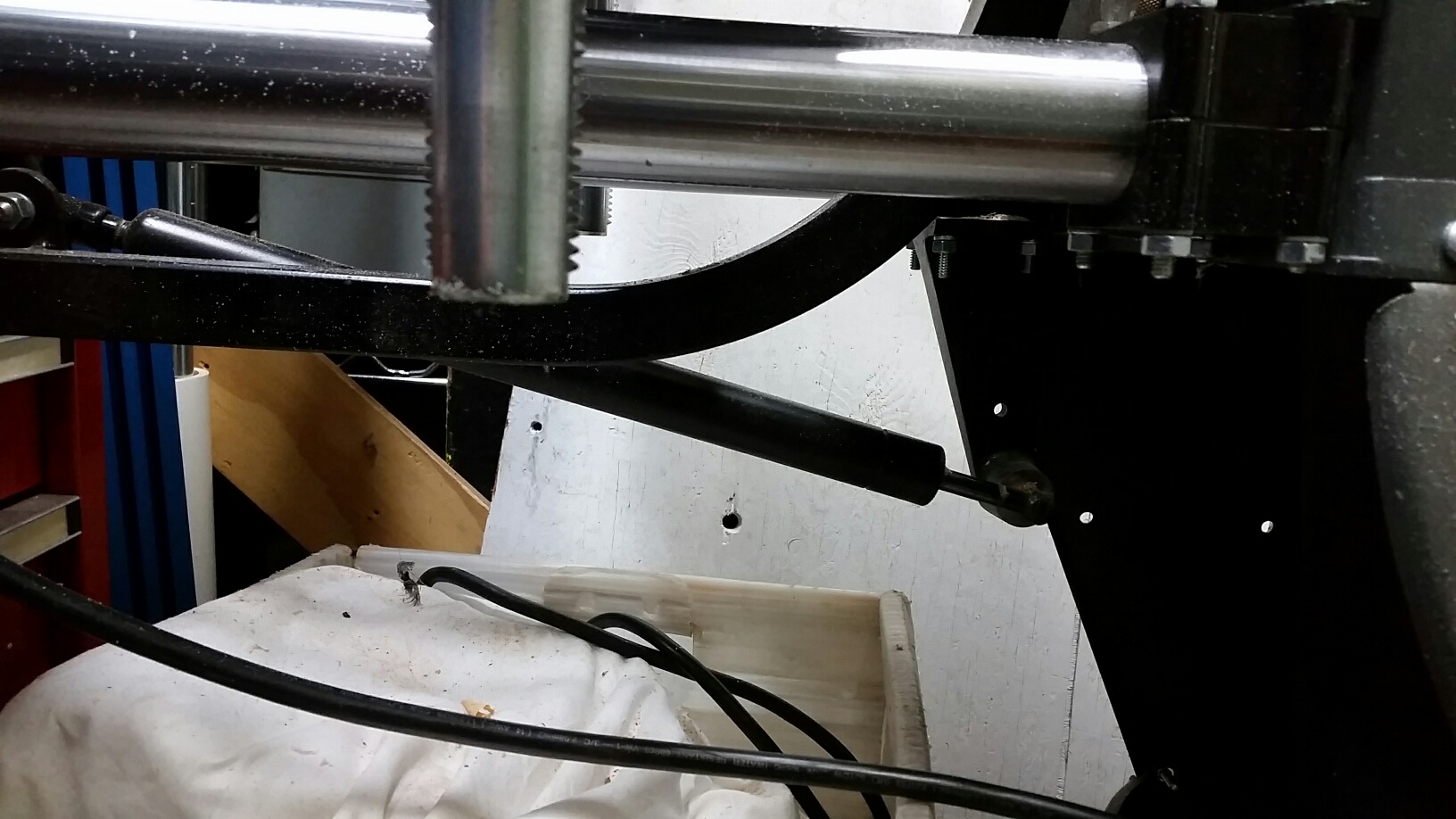
- 20170430_140123_1493579734471_resized.jpg (344.79 KiB) Viewed 9889 times
As you can see the amount of space need varies. I would say from some where near 2-1/2"-3" to near 6" on the end near the legs.
Lathe work is effected, cutting at certain depths at a full 45 deg is effected and the solutions are removal for some of those cases. It still takes time but without the left assist the powerpro headstock is quite heavy. And even if you have the lift and detach it you will still be required to lift again to attach.
The attachment and or detachment is simple. a ball stud on one end and a spring loaded slide on the other. When you first set up you have to adjust to get it to fit nicely or it will be a pain to do. This the reason I did the spacer thing.
Ed
Re: Lift Assist Benefits and Disadvantages
Posted: Sun Apr 30, 2017 4:01 pm
by reible
jsburger wrote:
You loose about 2 1/2" on the upper way tubes. I have never found that to be a problem. I have heard people say you loose turning length. I don't see how since the maximum turning length is the distance between the head stock all the way to the left and the tail stock. The position of the tail stock is fixed and totally unaffected by the lift assist.
The lathe issues are that the carriage and headstock are now kept farther away from the tail stock. If you mount a lathe drive center and a dead center in the tail stock the two points will not meet(you do that during setup of the lathe). There are solutions but lets just say it is not the length maximum that is an issue but the lathe minimum.
Ed
Re: Lift Assist Benefits and Disadvantages
Posted: Sun Apr 30, 2017 4:11 pm
by jsburger
reible wrote:jsburger wrote:
You loose about 2 1/2" on the upper way tubes. I have never found that to be a problem. I have heard people say you loose turning length. I don't see how since the maximum turning length is the distance between the head stock all the way to the left and the tail stock. The position of the tail stock is fixed and totally unaffected by the lift assist.
The lathe issues are that the carriage and headstock are now kept farther away from the tail stock. If you mount a lathe drive center and a dead center in the tail stock the two points will not meet(you do that during setup of the lathe). There are solutions but lets just say it is not the length maximum that is an issue but the lathe minimum.
Ed
That is what I was thinking but can't it be compensated for by extending the quill farther? I have not tried so maybe there is not enough quill travel to overcome the additional 2 1/2".
Re: Lift Assist Benefits and Disadvantages
Posted: Sun Apr 30, 2017 4:22 pm
by reible
No. The distance will require other ways of doing things such as the MT2 to MT2 extenders(also a potential problem if the tang of the inserted is not long enough to reach the drift to remove it.) Or if you have the live tail stock you can get the extenders that come with the lathe duplicator to add some reach. There are other ways too, just not as nice as without the lift.
Ed
jsburger wrote:reible wrote:jsburger wrote:
You loose about 2 1/2" on the upper way tubes. I have never found that to be a problem. I have heard people say you loose turning length. I don't see how since the maximum turning length is the distance between the head stock all the way to the left and the tail stock. The position of the tail stock is fixed and totally unaffected by the lift assist.
The lathe issues are that the carriage and headstock are now kept farther away from the tail stock. If you mount a lathe drive center and a dead center in the tail stock the two points will not meet(you do that during setup of the lathe). There are solutions but lets just say it is not the length maximum that is an issue but the lathe minimum.
Ed
That is what I was thinking but can't it be compensated for by extending the quill farther? I have not tried so maybe there is not enough quill travel to overcome the additional 2 1/2".
Re: Lift Assist Benefits and Disadvantages
Posted: Sun Apr 30, 2017 7:46 pm
by sehast
Thanks for everyone's inputs. My biggest take away is if you use under the table operations very often the benefits are greatly decreased because every time you have to re-attach the cylinder you have to raise it unassisted into the drill press mode. The other issues are rather minor as far as I am concerned. I think I will probably live without it at least for a while.
Re: Lift Assist Benefits and Disadvantages
Posted: Sun Apr 30, 2017 8:05 pm
by jsburger
sehast wrote:Thanks for everyone's inputs. My biggest take away is if you use under the table operations very often the benefits are greatly decreased because every time you have to re-attach the cylinder you have to raise it unassisted into the drill press mode. The other issues are rather minor as far as I am concerned. I think I will probably live without it at least for a while.
But if you don't have it you always have to lift it unassisted to drill press mode. Which is "worse"?