Page 1 of 2
powerpro some rpm numbers
Posted: Tue Jan 01, 2019 6:32 pm
by reible
First I expect that my cheap meter is the issue but none the less lets get started with what I found.
Set for 10K rpm, average reading said 9523, so for the rest of the testing expect and get lower results then what the machine says.
With the setting at 1000 rpm it was reading 961 on the output shaft. Now the motor said 600 rpm. Very close to 1.6 from motor speed to main output.
So there you have it, at least within the range I have the ability to test.
Ed
Re: powerpro some rpm numbers
Posted: Tue Jan 01, 2019 8:07 pm
by JPG
reible wrote:First I expect that my cheap meter is the issue but none the less lets get started with what I found.
Set for 10K rpm, average reading said 9523, so for the rest of the testing expect and get lower results then what the machine says.
With the setting at 1000 rpm it was reading 961 on the output shaft. Now the motor said 600 rpm. Very close to 1.6 from motor speed to main output.
So there you have it, at least within the range I have the ability to test.
Ed
Idler shaft speed 1536 rpm?
Re: powerpro some rpm numbers
Posted: Tue Jan 01, 2019 11:31 pm
by wa2crk
Set for 10,000RPM and measured 9523
Set for 1000 RPM and measured 961 RPM
Seems very linear to me.
I don,t think that actual speed is all that important for the majority of stuff we do as woodworkers, but the linearity of the measurements is impressive.
Bill V
In one of my earlier posts I measured the motor pulley at 3,125 inches and the drive sleeve pulley at 2 inches which yielded a ratio .64 to one. So 10,000 RPM spindle speed would mean a motor speed of 6400 RPM. Which is very consistent with your results.
Re: powerpro some rpm numbers
Posted: Wed Jan 02, 2019 12:25 am
by JPG
961 / 600 = 1.60 rpm main/motor
3.125 / 2 = 1.56 size motor/main
Both are reasonably coincident.
NOTE: these results are NOT to be confused with the main/idler shaft ratio of 1.6.
The motor - idler shaft ratio is about 2.56.
3.125 / 2.56 = 1.22 idler pulley size
1.22 x 1.6 = 1.95 close to 2"
Re: powerpro some rpm numbers
Posted: Wed Jan 02, 2019 3:51 am
by dusty
wa2crk wrote:Set for 10,000RPM and measured 9523
Set for 1000 RPM and measured 961 RPM
Seems very linear to me.
I don,t think that actual speed is all that important for the majority of stuff we do as woodworkers, but the linearity of the measurements is impressive.
Bill V
In one of my earlier posts I measured the motor pulley at 3,125 inches and the drive sleeve pulley at 2 inches which yielded a ratio .64 to one. So 10,000 RPM spindle speed would mean a motor speed of 6400 RPM. Which is very consistent with your results.
With what facts we are assuming, the numbers do not add up.
Motor pulley diameter =3.125"
Drive Sheave pulley diameter = 1.8125"
Ratio 3.125/1.8125 = 1.724
Motor top "advertised" speed = 5500rpm
Max. spindle speed = 5500rpm x 1.724 = 9482 rpm
It is possible (maybe probable) that these differences can all be attributed to the fact that the critical neasurements are not all be taken the same way.
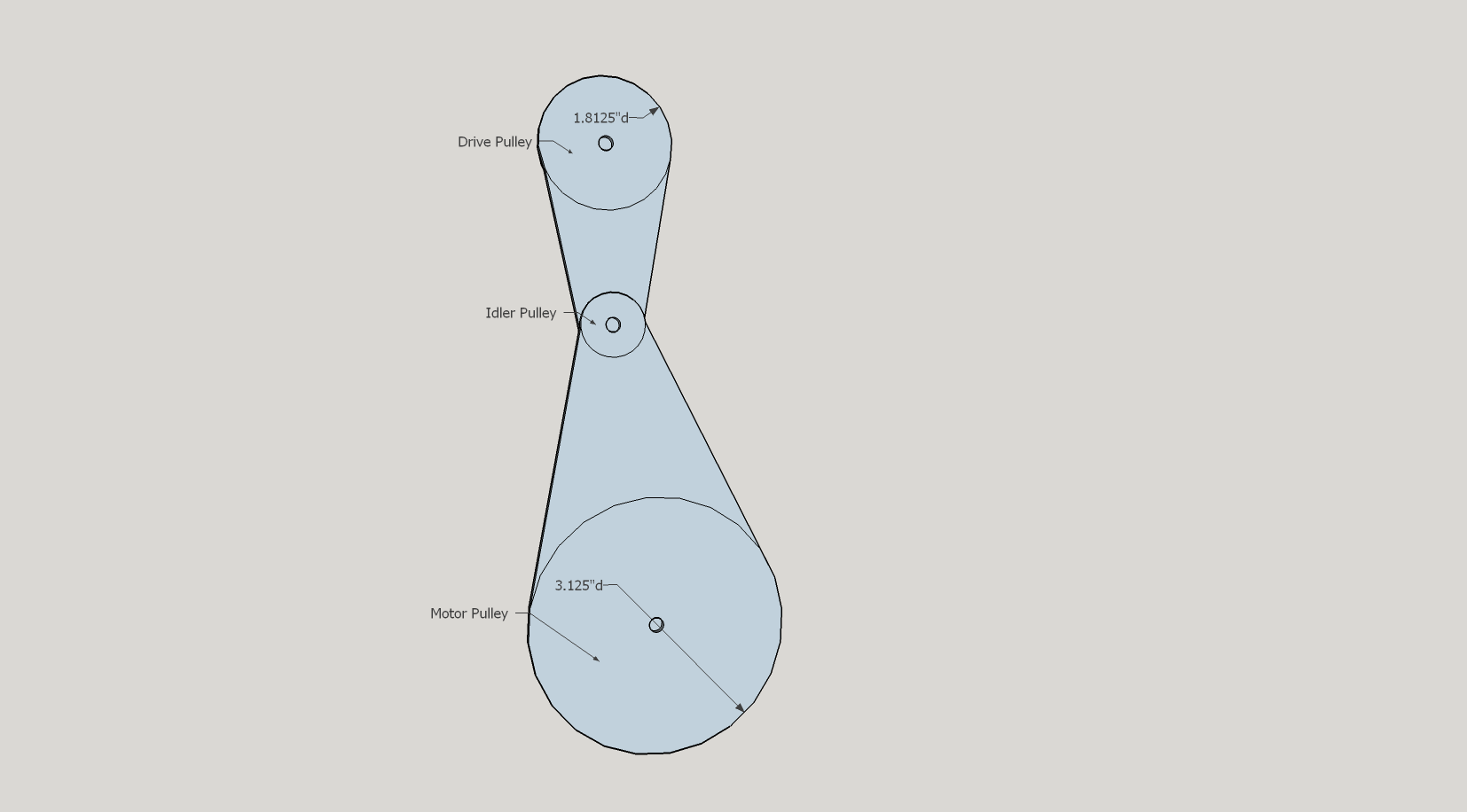
- PowerPro Spindle Speeds.png (28.52 KiB) Viewed 10573 times
A tool that I found @ blocklayer.com/pulley
Re: powerpro some rpm numbers
Posted: Wed Jan 02, 2019 8:21 pm
by JPG
We are dealing with poly-v pulleys. Each pulley has a root diameter, an outer diameter and an effective diameter.
The effective diameter is somewhere between the other two.* It is the offset from the other two that will be the same on all sizes, but will NOT change with the diameters that we measure.
So the effective ratio of a 1" and a 3" poly-v pulley will not be 1:3.
As an example, assume the offset is 0.1". The effective diameters become 0.9 and 2.9 and the effective ratio becomes 0.9 : 2.95 = 3.11.
We can chase around with the measurements of the pulleys until the cows come home. I for one pay more attention to the measured speeds that Ed did. I also think the 1.6:1 ration of the idler shaft:quill shaft is set in granite.
Using that I derived the 2.56 ratio of motor to idler speed.
Research has revealed that the effective diameter is slightly greater than the OD.
Re: powerpro some rpm numbers
Posted: Thu Jan 03, 2019 10:31 am
by dusty
JPG wrote:We are dealing with poly-v pulleys. Each pulley has a root diameter, an outer diameter and an effective diameter.
The effective diameter is somewhere between the other two. It is the offset from the other two that will be the same on all sizes, but will NOT change with the diameters that we measure.
So the effective ratio of a 1" and a 3" poly-v pulley will not be 1:3.
As an example, assume the offset is 0.1". The effective diameters become 0.9 and 2.9 and the effective ratio becomes 0.9 : 2.95 = 3.11.
We can chase around with the measurements of the pulleys until the cows come home. I for one pay more attention to the measured speeds that Ed did. I also think the 1.6:1 ration of the idler shaft:quill shaft is set in granite.
Using that I derived the 2.56 ratio of motor to idler speed.
Unless your primary objective is idler shaft speed (relative to either motor speed
or drive shaft speed) the 1.6 ratio is really immaterial. My measurements, however, result in that number being 1.635 while at the same time (using the same base numbers) I believe the idler shaft to motor ratio is 2.942.
Enough of this. It is whatever it is! The PowerPro goes faster and delivers more torque. The numbers that we are dealing with are approximations at best.
Re: powerpro some rpm numbers
Posted: Thu Jan 03, 2019 11:06 am
by everettdavis
I will paraphrase my late uncle;
"A man with a tachometer can tell you how fast a shaft is rotating. A man with two is often unsure."
Everett
Re: powerpro some rpm numbers
Posted: Thu Jan 03, 2019 11:57 pm
by JPG
The point of the idler/main shaft ratio is that it IS 1.6 period regardless of any measurements(pulley diameter or speed). It has been for over 50 years and continues to be so. It is a basic design parameter.
Re: powerpro some rpm numbers
Posted: Fri Jan 04, 2019 2:53 am
by dusty
No one has challenged that "fact".
The question is whether or not that has changed. It seems as though new performance characteristics can not be achieved without either a change to that number. This is why I asked the question in the other thread. I hoped that someone would supply an answer. I do not believe that has yet occurred.