Page 1 of 1
Strongest Wood Joints
Posted: Sun Apr 12, 2020 3:20 pm
by sehast
We had a short discussion a few weeks ago about different joints and their strength. I came across this older FWW article in the archives and thought I would share it. One of the biggest surprises for me was how close the domino joint was to a common biscuit joint. It certainly does not justify the outrageous price of a domino jointer.
Re: Strongest Wood Joints
Posted: Sun Apr 12, 2020 6:59 pm
by roy_okc
Color me shocked at the simple glued miter joint doing so well!
I wonder if a 3/8" tenon bridle joint would have won the shootout since the 1/4" broke right at the tenon edge.
Thanks for posting the article, very informative.
Re: Strongest Wood Joints
Posted: Sun Apr 12, 2020 8:58 pm
by BuckeyeDennis
That doesn’t seem like a fair test for the Dominos. The dowels and pocket screws each got two or three fasteners, with the outer ones near the edges of the boards. But for some reason, they used a single Domino in the center of the board, where it is at a mechanical disadvantage. It certainly looks like there is enough room to use two Dominos, and that would have would have given very different results. And while there was also only one biscuit used, it was long enough to span most of the joint.
The miter joint has a big advantage, if I understand the applied test load correctly. Because it is cut on a diagonal, the joined surfaces are 41% longer than for the other tests. So they have a commensurately greater mechanical advantage, causing less stress on the glue joint. Any mechanical or structural engineers out there should double-check this EE’s thinking, but it seems to me that the combination of a 41% longer “lever arm”, plus 41% more glue area, should make it twice as resistant to the applied racking forces, everything else being equal. But if you change the applied force to sideways bending, all of a sudden it’s the weak joint that it’s reputed to be.
However, that “better way to spline a miter” joint (that they didn’t think of in time to test) should be a winner in every respect. It has the same mechanical advantage as the straight miter joint, but would effectively form a piece of “plywood” with good strength in all directions.
Re: Strongest Wood Joints
Posted: Mon Apr 13, 2020 3:48 am
by Hobbyman2
I have used the splined miter and the 1/2 lap miter and a splined 45 on cabinet door frames ,, the splined miters / 45's were much stronger and actually easier to work with , the test shown are neat , I wonder how differently the test would have been if they had been wrapped with say walnut , oak , mahogany or something .
Re: Strongest Wood Joints
Posted: Mon Apr 13, 2020 2:08 pm
by sehast
Here is one of the more interesting reader comments concerning the article.
"I replicated these test in my shop using 2 1/2" stock and a simple vise and my arm. I can't obviously give a psi specification for breaking strengths, but I can tell you that my results paralleled those published. However, there are a number of caveats that need to be pointed out. One: the miter joint did show surprising strength when applying downward pressure as seen the Fine Woodworking video, but pushing upwards it let go under very light pressure. The biscuit joints were the weakest I tested. The Dominos were next. However two domino one over the other seemed to provide more than double the strength of the joint and made it acceptable for more stressful applications. The shortcomings of the domino surprised and saddened me. To get two dominos in a 2/12" rail you have to use the 5/30 mm and they tear the side out of the stile in failing because they are too short. Festool would be helping themselves and their customers if they provided the narrower dominos in longer lengths. These set one over the other would provide a really nice joint that could be applied to narrow rail stock."
Re: Strongest Wood Joints
Posted: Mon Apr 13, 2020 6:41 pm
by RFGuy
Well, I have seen plenty of these joint strength tests online now and it seems like all of them have wildly different results...so much so that my head is spinning from all of them. Full disclaimer, I do own a Domino, but I will try not to let that bias my thinking.
Has anyone watched the video that accompanies this article (see link below)? Unfortunately you need to be a FWW subscriber and have online access to their site. I was really quite disappointed when I watched this video. So, the basis of the test is they are trying to assess racking forces for a face frame joint like what might be in a face frame, door cabinet, etc. So, they milled up some cherry that they are joining to create an "L". Imagine this "L" shape being rotated 45 degrees and put under a vertical hydraulic press. They cut small 45 degree corners on the two ends so that this "L" shape sits at a 45 degree inside this press...just resting on the bottom plate. Then they lower the press until the joint fails. There is no kind of test fixture or other method to hold the joint under test into position (so it could easily slide around under the top plate of the press). I am not a mechanical engineer, but from what I remember of my statics and dynamics classes this doesn't seem like a good test methodology to me (for consistency of test results). I could easily see the translation of the normal forces being transferred into the joint under test varying quite a bit between each one being tested. I can see why the biscuit performed well with this type of test because of the direction of the forces and the biscuit is basically acting like a spline for this test. However, comparing the Domino (loose tenon joint) to the basic M&T makes no sense at first glance, but then you have to consider the way the joint is being tested. As Dennis pointed out you could easily put 2 tenons in there and I expect if you did the Domino would perform closer to the basic M&T performance which is what one would expect. Half lap and M&T have a hug advantage in glue surface area in the planes affected by the forces from the press. Also, I am sure they used Beech tenons for the Domino testing and they sheared off completely in the video showing the tenon was the weak link. Personally, I don't exactly consider Beech a hardwood, so I would be curious to see how the Domino joint might fare with different wood species tenons.
Bottomline, the joint strength doesn't matter in most applications (with chair making being an obvious exeception) IMHO - most properly executed woodworking joints with good quality glue are more than sufficient. It really comes down to which joint is
strong enough, that you have the tools to make it with and which you enjoy building.
https://www.finewoodworking.com/2009/02 ... ength-test
P.S. Thanks for posting this article though. I usually enjoy FWW articles, but I do wish that they would include more details sometimes. Often I have read tool reviews in FWW and depending on the author some of them have very little details on why one tool was chosen over another one. Unfortunately this joint strength test article just skims the surface of what was tested and doesn't give any description of the how or why of the testing. It would be good to get at some of the data and test methods behind this article to analyze more closely.
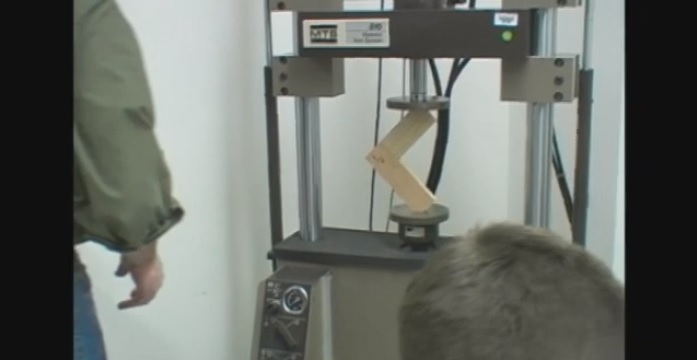
- joint_test.jpg (36.21 KiB) Viewed 9064 times
Re: Strongest Wood Joints
Posted: Tue Apr 14, 2020 12:48 am
by JPG
The thing I took from this is that when using anything dowels, dominos, tenon, the distance they penetrate into the 'stile' determines the stress location(that is where the stile will split. I assume the longer it is, the stronger the joint. So a thick through tenon seems to be the strongest. I do not think they tested that.
Re: Strongest Wood Joints
Posted: Tue Apr 14, 2020 9:08 am
by RFGuy
JPG wrote:The thing I took from this is that when using anything dowels, dominos, tenon, the distance they penetrate into the 'stile' determines the stress location(that is where the stile will split. I assume the longer it is, the stronger the joint. So a thick through tenon seems to be the strongest. I do not think they tested that.
Thanks JPG. I guess you are right. When I first looked at the photos of the Domino failed joint, I thought it was closer to the edge of the board (where the two boards meet), but looking at it again now it does look like the split occurred essentially where the Domino tenon ends. This is similar to the beadlock and dowelmax failures. Thanks for pointing this out.
 JointTest.pdf