Page 1 of 3
Suggestions needed ..
Posted: Mon Sep 21, 2020 10:50 am
by bainin
Well- I've walked myself into a bit of a corner I think.
I want to build walnut/cherry end grain cutting board..so after cursory views of the process on various youtube videos I dove in.
I ended up at this point where I have strips (1inch wide by 12 in long) made from roughly 1 inch cubes of walnut/cherry glued together which i have rotated to misalign the end grains.
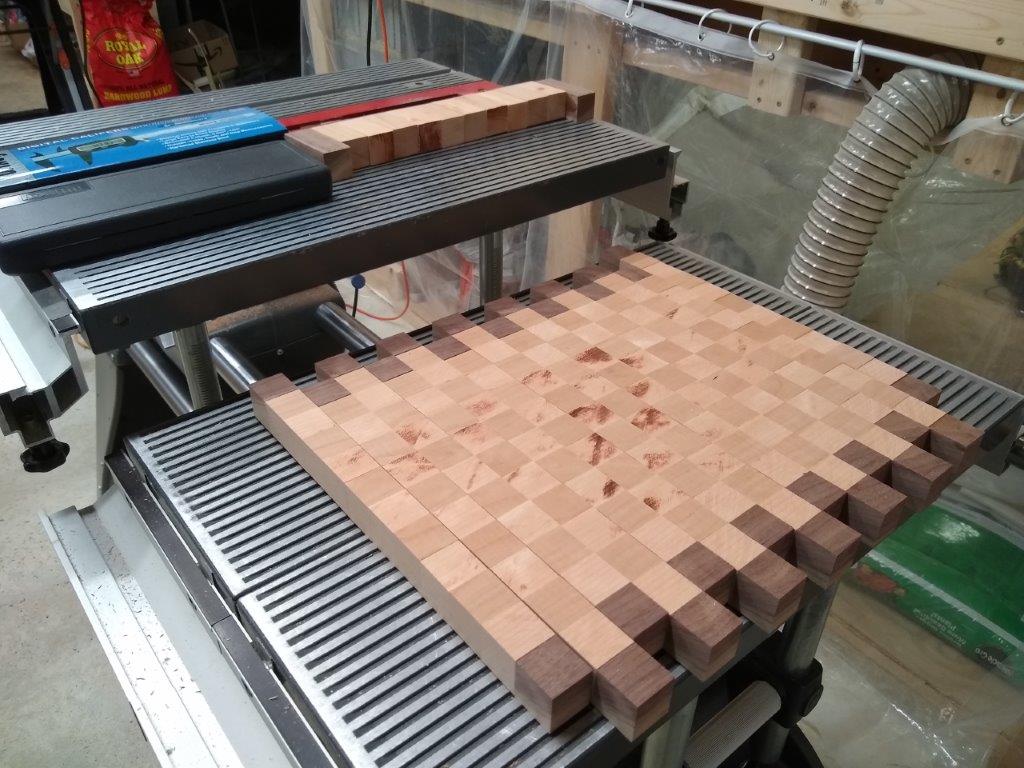
- conundrum.jpg (135.15 KiB) Viewed 3041 times
The end grain surfaces are smooth and well aligned to each other, however the edge grain sides (which ultimately get glued together along the 12in length) have some small steps along the 12 inch length where the 1 inch cubes didnt completely align on gluing.
So I'm looking at my saw, jointer, planer, and disc sander and wondering which approach would be the least stressful on these wimpy little 1nch glued surfaces to flatten those 12 inch sides to allow for a good glue up ?
Your thoughts are appreciated.
b
Re: Suggestions needed ..
Posted: Mon Sep 21, 2020 11:33 am
by br549
I would either use sanding disk with fence slightly offset and feed from back to front
or
drum sander (set up horizontally) and feed from back to front (against rotation). Make one pass on each edge of each glued up strip before raising table for next pass(es).
Re: Suggestions needed ..
Posted: Mon Sep 21, 2020 11:39 am
by JPG
I think the conical disk sander is the best choice. Gets yer pinkies kinda close!

Re: Suggestions needed ..
Posted: Mon Sep 21, 2020 12:01 pm
by BuckeyeDennis
Whichever sander you use, you'll want to be very careful about the following things.
1) Sander alignment: if the strips wind up wedge-shaped, the board isn't going to want to glue up flat. (Although you could probably fix this by simply alternating the direction of the "wedges" during glue-up.)
2) Feed rate: if the feed slows or stops, the sandpaper will continue to "pressure cut", leaving an indentation on the strip.
3) Table rigidity: Any table flex will affect accuracy, and tend to cause some "snipe" at the ends.
If using the drum sander or disc sander, I'd tie the main table to the aux table, for higher rigidity.
If using a conical disc sander, you can't tie to the aux table with the tubes. But I'd still butt them together to increase the rigidity, and then adjust sanding depth/pressure using the quill.
Good luck!
Re: Suggestions needed ..
Posted: Mon Sep 21, 2020 12:19 pm
by bainin
Thanks all -
I have setup the conical sander earlier, but havent had a chance to try it yet.
I dont know-somehow I feel like the saw just kissing the edge would be the least stressful...but I think this is going to take a bit of experimentation either way.
BR549 -
I'm curious why you suggest feeding from back to front ... I think this means the piece would feel a lifting from the table on the entry side...is that to reduce stress on the glue joints?
If so-would i then need featherboard support on the fence to press down on the piece?
b
Re: Suggestions needed ..
Posted: Mon Sep 21, 2020 12:25 pm
by DLB
Quick history - The earlier rip fence styles had a setscrew for creating the small offset described by br549 for edge truing used with a flat sanding disc. (See PTWFE) Recommended offset is from 1/16" to 1/8" off true, measured from front to rear of fence, and with the rear farther from the disc. This 'off-setscrew' went away on 520 and M7, preferred solution was the conical disc per JPG's suggestion.
IIWM and I wanted to do this with a flat disc, I'd make an auxiliary fence face with the offset and attach with T-nuts. Heed br549's front-to-back suggestion, or reverse rotation direction. You do not want to catch your project on the part of the disc moving up relative to the table. I know this from the negative reinforcement learning process. And you want your table fairly low, maybe just above the centerline of the disc. If you do it near the top you have an effective launcher, more negative reinforcement.
I'd stay away from Jointer and Planer, because I'm thinking some of those blocks are going to be organized such that I'd have to cut across the grain.
I'd consider using a clamp during the operation I chose to reinforce those glue joints during the process. And if you have the scrap I'd make a couple of extra strips to evaluate.
- David
Re: Suggestions needed ..
Posted: Mon Sep 21, 2020 12:43 pm
by edflorence
Really good suggestions all.
I agree sanding is the best way to go for this job. I haven't used the conical sander enough to really talk about it, but I do know from experience that the drum sander will work well as a thickness sander. You didn't say how big the misalignment is, but with the drum sander taking off 1/64th is too much, and it is best to keep each pass to no more than 0.01", and actually 0.008" works even better. After the stock has been reduced nearly to the desired thickness, a finishing pass or two at about 0.004" will leave a nice surface. What's nice about using the drum sander is that you can easily dial in these small changes in depth of pass with the adjustable stop collar.
Re: Suggestions needed ..
Posted: Mon Sep 21, 2020 1:12 pm
by edma194
Agree with all the above about sanding. I don't have a conical, I still use the angled fence method with the 12" disk sander.
Not sure if your gluing was off or the size of the cubes. Using the disk sander and the quill with a depth stop set you could have made all those pieces into perfect cubes.
Re: Suggestions needed ..
Posted: Mon Sep 21, 2020 1:47 pm
by br549
bainin wrote:I'm curious why you suggest feeding from back to front ... I think this means the piece would feel a lifting from the table on the entry side...is that to reduce stress on the glue joints?
If so-would i then need featherboard support on the fence to press down on the piece?
DLB explained the procedure very well about the offset fence and why the feed direction should be from back to front. I can only add that the fence needs to be offset enough so that workpiece does not contact the flat disc until it is over halfway past the disk, and the disc is traveling down, not up. A featherboard to help hold the workpiece down is a good idea, or at least a good long push stick. Since I don't have a conical disc, I didn't think of using that, and also didn't know that post-500 fences don't have the setscrews for offsetting. When I use this method, I slide the headstock and table as far to the right as possible, so I can more easily walk around the end of the machine to pull the workpiece thru after the leading end gets past the front edge of the table.
Re: Suggestions needed ..
Posted: Mon Sep 21, 2020 2:27 pm
by DLB
br549 wrote:...Since I don't have a conical disc, I didn't think of using that, and also didn't know that post-500 fences don't have the setscrews for offsetting...
Clarification - 510s also have the off-setscrew, but 520s (and M7s) do not.
- David